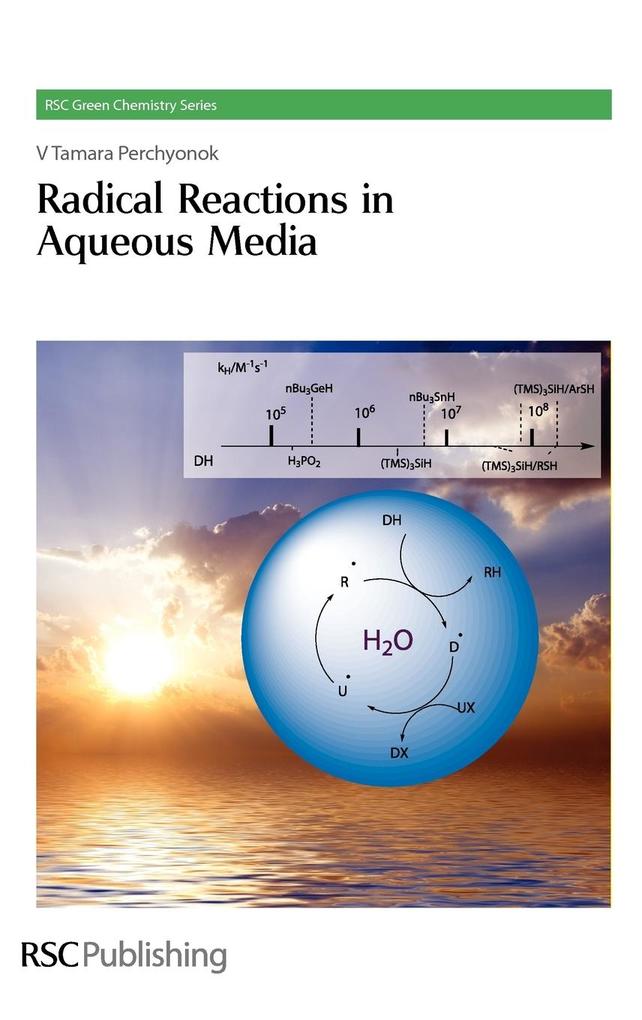
Chemists are now moving away from volatile, environmentally harmful, and biologically incompatible organic solvents. With its low cost, ready availability, and capacity to remove environmentally unfriendly by-products, water is an obvious replacement. This book describes carbon-hydrogen bond formations in aqueous media via radical reactions with a specific focus on HAT (Hydrogen Atom Transfer). Suitable for students of chemistry, industrial chemists and academic researchers, it combines extensive knowledge of free radical chemistry with the latest innovations and creative applications. Divided into five main areas, it covers the: generation of carbon centred free radicals; radical initiators; solubility of substrate; suitability of free radical hydrogen donors, and HAT reactions in aqueous media.
Inhaltsverzeichnis
Contents: Free Radical Chemistry and Green Chemistry: The historical perspective, Basic Radical Chemistry: General aspects of synthesis with radicals, Why Water as a Solvent? Reasons and Advantages, Reducing agents based Group 4 and Aqueous Media, Hypophosporous acid (H3PO2) as a free radical hydrogen donors in aqueous media, Organoboron Compounds as Radical Reducing Agents, : Carbon-Carbon Bond formation and stereoaspects, Redox Processes and Electron Transfer via Free Radicals, Chain vs Non-Chain Free Radical Processes in Aqueous Media, Future Directions and Practical considerations including methods of radical formation.