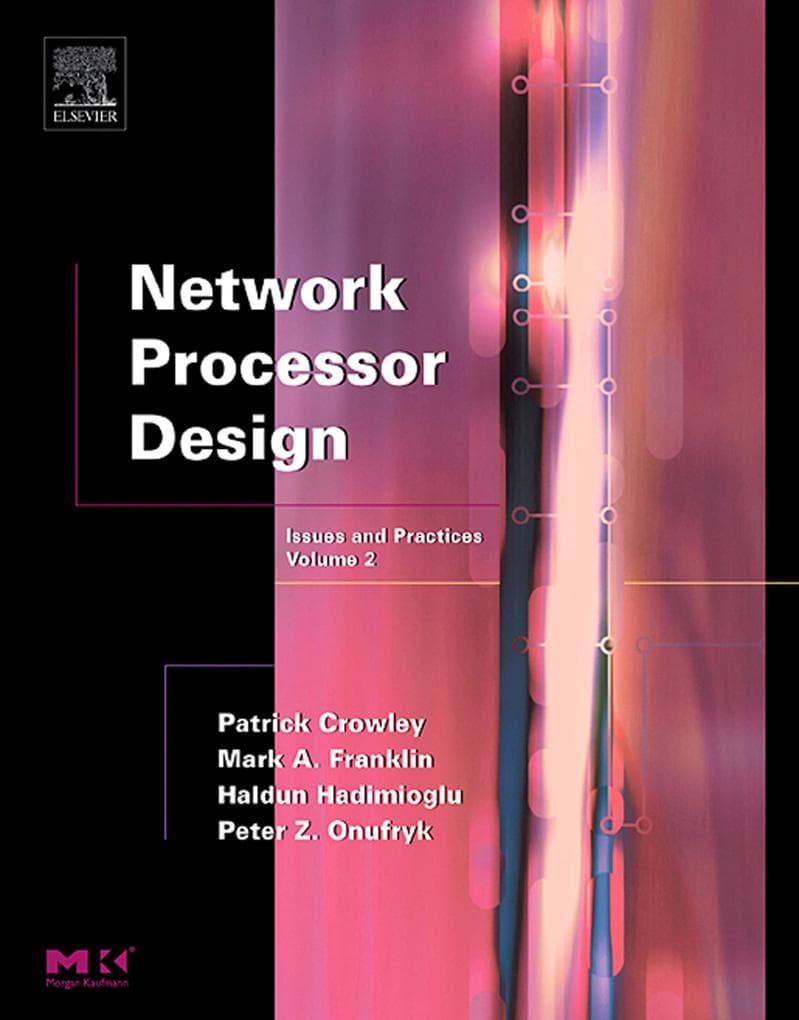
The past few years have seen significant change in the landscape of high-end network processing. In response to the formidable challenges facing this emerging field, the editors of this series set out to survey the latest research and practices in the design, programming, and use of network processors.
Through chapters on hardware, software, performance and modeling, Network Processor Design illustrates the potential for new NP applications, helping to lay a theoretical foundation for the architecture, evaluation, and programming of networking processors.
Like Volume 2 of the series, Volume 3 further shifts the focus from achieving higher levels of packet processing performance to addressing other critical factors such as ease of programming, application developments, power, and performance prediction. In addition, Volume 3 emphasizes forward-looking, leading-edge research in the areas of architecture, tools and techniques, and applications such as high-speed intrusion detection and prevention system design, and the implementation of new interconnect standards.
- Investigates current applications of network processor technology at Intel; Infineon Technologies; and NetModule
- Presents current research in network processor design in three distinct areas:
- Architecture at Washington University, St. Louis; Oregon Health and Science University; University of Georgia; and North Carolina State University.
- Tools and Techniques at University of Texas, Austin; Academy of Sciences, China; University of Paderborn, Germany; and University of Massachusetts, Amherst.
- Applications at University of California, Berkeley; Universidad Complutense de Madrid, Spain; ETH Zurich, Switzerland; Georgia Institute of Technology; Vrije Universiteit, the Netherlands; and Universiteit Leiden, the Netherlands.
Inhaltsverzeichnis
1;Cover;1 2;Contents;8 3;About the Editors;6 4;Preface;16 5;Chapter 1. Network Processors: New Horizons;18 5.1;1.1 Architecture;20 5.2;1.2 Tools and Techniques;21 5.3;1.3 Applications;22 5.4;1.4 Conclusions;24 5.5;References;24 6;Chapter 2. Supporting Mixed Real-Time Workloads in Multithreaded Processors with Segmented Instruction Caches;26 6.1;2.1 Instruction Delivery in NP Data Processors;28 6.2;2.2 Segmented Instruction Cache;30 6.3;2.3 Experimental Evaluation;34 6.4;2.4 Related Work;46 6.5;2.5 Conclusions and Future Work;47 6.6;References;47 7;Chapter 3. Efficient Packet Classification with Digest Caches;50 7.1;3.1 Related Work;51 7.2;3.2 Our Approach;52 7.3;3.3 Evaluation;59 7.4;3.4 Hardware Overhead;66 7.5;3.5 Conclusions;68 7.6;Acknowledgments;69 7.7;References;69 8;Chapter 4. Towards a Flexible Network Processor Interface for RapidIO, Hypertransport, and PCI-Express;72 8.1;4.1 Interface Fundamentals and Comparison;74 8.2;4.2 Modeling the Interfaces;76 8.3;4.3 Architecture Evaluation;85 8.4;4.4 Conclusions;94 8.5;Acknowledgments;95 8.6;References;95 9;Chapter 5. A High-Speed, Multithreaded TCP Offload Engine for 10 Gb/s Ethernet;98 9.1;5.1 Requirements on TCP Offload Solution;100 9.2;5.2 Architecture of TOE Solution;104 9.3;5.3 Performance Analysis;112 9.4;5.4 Conclusions;114 9.5;Acknowledgments;115 9.6;References;115 10;Chapter 6. A Hardware Platform for Network Intrusion Detection and Prevention;116 10.1;6.1 Design Rationales and Principles;117 10.2;6.2 Prototype NNIDS on a Network Interface;121 10.3;6.3 Evaluation and Results;127 10.4;6.4 Conclusions;132 10.5;References;133 11;Chapter 7. Packet Processing on a SIMD Stream Processor;136 11.1;7.1 Background: Stream Programs and Architectures;137 11.2;7.2 AES Encryption;139 11.3;7.3 IPv4 Forwarding;148 11.4;7.4 Related Work;156 11.5;7.5 Conclusions and Future Work;157 11.6;Acknowledgments;159 11.7;References;159 12;Chapter 8. A Programming Environment for Packet-Processing Systems: Design Considerations;162 1
2.1;8.1 Problem Domain;164 12.2;8.2 Shangri-La. A Programming Environment for Packet-Processing Systems 150 ;167 12.3;8.3 Design Details and Challenges;169 12.4;8.4 Conclusions;185 12.5;References;186 13;Chapter 9. RNOSA Middleware Platform for Low-Cost Packet-Processing Devices;190 13.1;9.1 Scenario;191 13.2;9.2 Analysis Model of RNOS;192 13.3;9.3 Implementation Model of RNOS;204 13.4;9.4 Measurements and Comparison;209 13.5;9.5 Conclusions and Outlook;210 13.6;Acknowledgments;211 13.7;References;211 14;Chapter 10. On the Feasibility of Using Network Processors for DNA Queries;214 14.1;10.1 Architecture;215 14.2;10.2 Implementation Details;227 14.3;10.3 Results;228 14.4;10.4 Related Work;232 14.5;10.5 Conclusions;233 14.6;Acknowledgments;234 14.7;References;234 15;Chapter 11. Pipeline Task Scheduling on Network Processors;236 15.1;11.1 The Pipeline Task Assignment Problem;238 15.2;11.2 The Greedypipe Algorithm;242 15.3;11.3 Pipeline Design with Greedypipe;245 15.4;11.4 A Network Processor Problem;249 15.5;11.5 Conclusions;259 15.6;Acknowledgments;260 15.7;References;260 16;Chapter 12. A Framework for Design Space Exploration of Resource Efficient Network Processing on Multiprocessor SoCs;262 16.1;12.1 Related Work;264 16.2;12.2 Modeling Packet-Processing Systems;266 16.3;12.3 Scheduling;272 16.4;12.4 Mapping the Application to the System;278 16.5;12.5 Estimating the Resource Consumption;281 16.6;12.6 A Design Space Exploration Example;285 16.7;12.7 Conclusions;292 16.8;Acknowledgments;292 16.9;References;293 17;Chapter 13. Application Analysis and Resource Mapping for Heterogeneous Network Processor Architectures;296 17.1;13.1 Related Work;299 17.2;13.2 Application Analysis;300 17.3;13.3 ADAG Clustering Using Maximum Local Ratio Cut;304 17.4;13.4 ADAG Results;308 17.5;13.5 Mapping Application DAGs to NP Architectures;319 17.6;13.6 Conclusions;323 17.7;References;323 18;Index;326