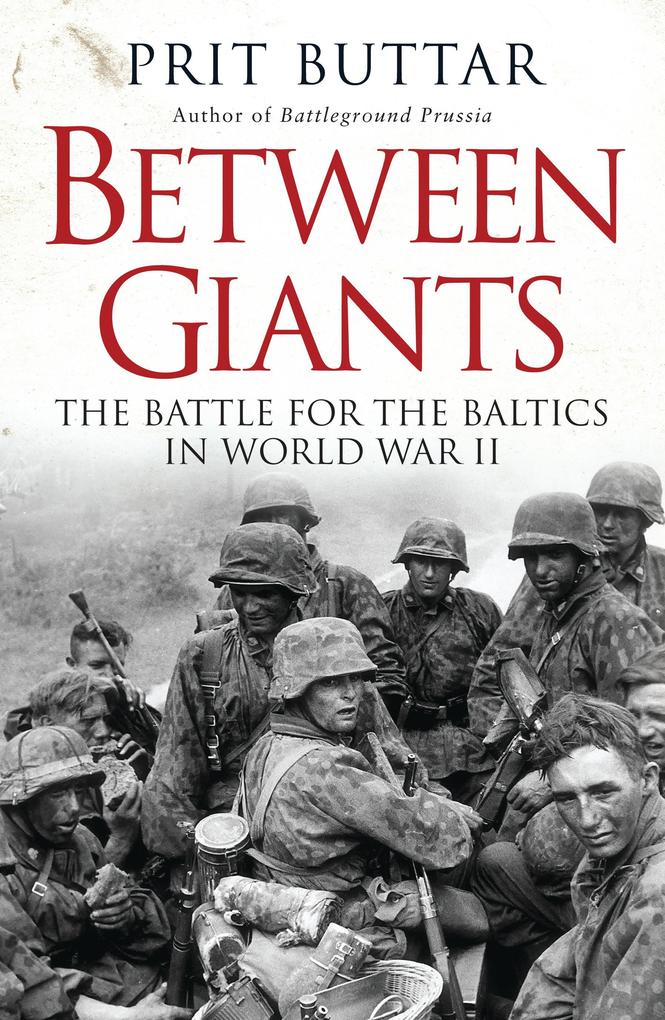
From an expert on the Eastern Front of World War II, this book chronicles the cataclysmic experience of the region that includes modern-day Lithuania, Estonia and Latvia.
The Baltic States suffered more than almost any other territory during World War II, caught on the front-line of some of the war's most vicious battles and squeezed between the vast military might of the German Wehrmacht and the Soviet Red Army.
Combining new archival research and numerous first-hand accounts, this is a magisterial description of conquest and exploitation, of death and deportation and the fight for survival both by countries and individuals.
Inhaltsverzeichnis
Introduction * Brief outline of the independence wars, and the relationships between the Baltic States, Germany and the Soviet Union. * The political situation in the three states during the 1930s. * Discussion of the ethnic tensions within Lithuania and Latvia and its consequences for what followed. Chapter 1. The first Soviet occupation * Soviet intentions towards the Baltic States: Stalin's xenophobia; the classification of the Baltic States as 'enemy nations;' the purging of Baltic communists within the Soviet Union; exploitation of racial disharmony in Latvia and Lithuania. * The Molotov-Ribbentrop Pact, and the 'mutual assistance treaties' and the arrival of Soviet troops. * The Soviet occupation of the Baltic States in 1940; Soviet policy after occupation; mass deportations in 1941; the polarisation of ethnic tensions in Latvia and Lithuania. Chapter 2. German intentions towards the Baltic States * Rosenberg and plans for the creation of Ostland. * The deployment of Army Group North. * The Einsatzgruppen and their orders. Chapter 3. The German conquest * The swift conquest of Lithuania and Latvia. * The destruction of the Soviet 8th and 11th Armies. * The Battle of Raseiniai between Hoepner's 4th Panzer Group (Reinhardt's XLI Panzer Corps, Manstein's LVI Panzer Corps) and the Soviet III and XII Mechanised Corps; the resumption of the German advance. * The seizure of Tallinn. 4. The Baltic Holocaust * Lithuanian and Latvian actions against Jews. * The creation of ghettoes. * The arrival of Jews from Western Europe. * Mass extermination. * The role of Latvians and Lithuanians in Soviet territory. 5. Reluctant allies * Baltic police units and anti-partisan operations. * The creation of SS formations. * The deployment of Estonian and Latvian SS Divisions and their war record. 6. The Soviet conquest of Estonia * The Red Army's advance from Leningrad and the Panther Line. * The fall of Tallinn. * The capture of the Baltic islands. 7. The battles for Riga. * The initial isolation of Army Group North, and the counter-attack by von Saucken (4th, 5th, 7th Panzer Divisions and Grossdeutschland) and von Strachwitz (Operations Doppelkopf and Casar). * The Soviet advances towards Riga and German attempts to disrupt it. 8. Bagramian's drive to Memel * The drive to the Baltic coast. * The battles between Soviet units and Grossdeutschland, 5th Panzer Division and 7th Panzer Division. * The siege of Memel. 9. The first three battles for Courland * Early Soviet attempts to break into Courland; the vital role of 4th, 12th and 14th Panzer Divisions. * Rising opposition to the German presence in Courland. 10. The last three battles for Courland * The final battles in Courland. * The growing partisan movement. * The fate of Baltic units elsewhere in the Reich. 11. The surrender * German attempts to evacuate the Courland bridgehead. * The final surrender. * The fate of Germans and Baltic citizens in Sweden.