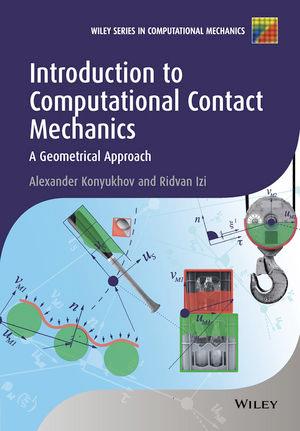
Introduction to Computational Contact Mechanics: A Geometrical
Approach covers the fundamentals of computational contact
mechanics and focuses on its practical implementation. Part one of
this textbook focuses on the underlying theory and covers essential
information about differential geometry and mathematical methods
which are necessary to build the computational algorithm
independently from other courses in mechanics. The geometrically
exact theory for the computational contact mechanics is described
in step-by-step manner, using examples of strict derivation from a
mathematical point of view. The final goal of the theory is to
construct in the independent approximation form /so-called
covariant form, including application to high-order and
isogeometric finite elements.
The second part of a book is a practical guide for programming of
contact elements and is written in such a way that makes it easy
for a programmer to implement using any programming language. All
programming examples are accompanied by a set of verification
examples allowing the user to learn the research verification
technique, essential for the computational contact analysis.
Key features:
* Covers the fundamentals of computational contact mechanics
* Covers practical programming, verification and analysis of
contact problems
* Presents the geometrically exact theory for computational
contact mechanics
* Describes algorithms used in well-known finite element software
packages
* Describes modeling of forces as an inverse contact
algorithm
* Includes practical exercises
* Contains unique verification examples such as the generalized
Euler formula for a rope on a surface, and the impact problem and
verification of thå percussion center
* Accompanied by a website hosting software
Introduction to Computational Contact Mechanics: A Geometrical
Approach is an ideal textbook for graduates and senior
undergraduates, and is also a useful reference for researchers and
practitioners working in computational mechanics.