“Adam Kahane worked with us on the future of our country. The four scenarios we built have come to life one after another, and today we are living the best one....Kahane explains how scenario planning can transform the future. In Colombia we can attest that such transformation is really possible.” —Juan Manuel Santos, President of Colombia and Nobel Peace Prize recipient
Collaboration is increasingly difficult and increasingly necessary.
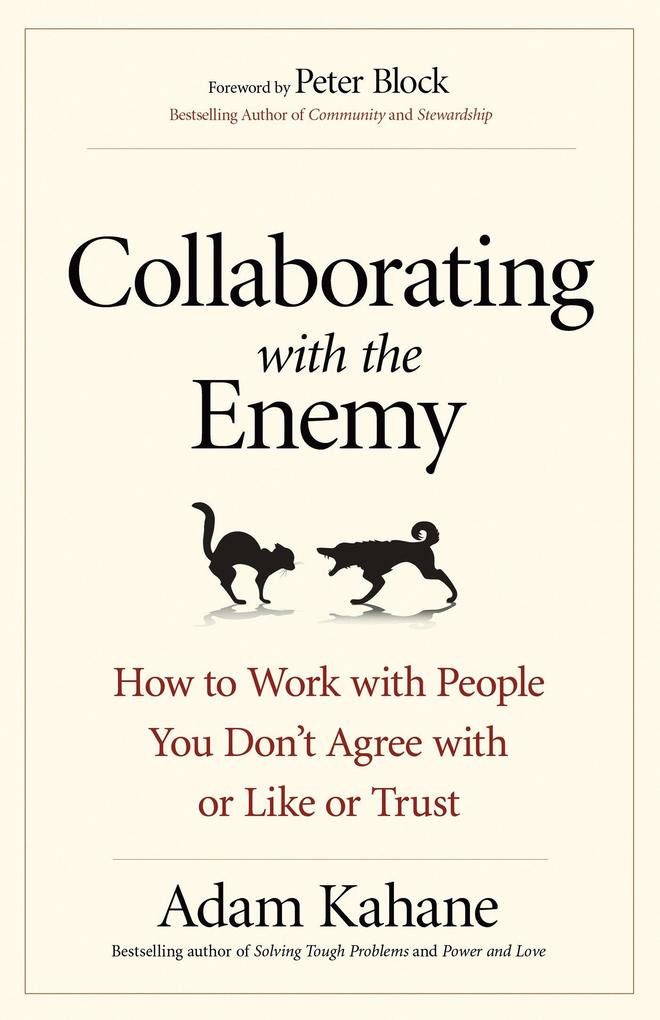
Often, to get something done that really matters to us, we need to work with people we don’t agree with or like or trust. Adam Kahane has faced this challenge many times, working on big issues like democracy and jobs and climate change and on everyday issues in organizations and families. He has learned that our conventional understanding of collaboration—that it requires a harmonious team that agrees on where it’s going, how it’s going to get there, and who needs to do what—is wrong. Instead, we need a new approach to collaboration that embraces discord, experimentation, and genuine cocreation—which is exactly what Kahane provides in this groundbreaking and timely book.
“Kahane shows that people who don’t see eye-to-eye really can come together to solve big challenges. Whether in our businesses, our governments, our communities, or our personal lives, we can all benefit from this smart and timely book.” —Mark Tercek, former President, The Nature Conservancy and coauthor of Nature’s Fortune
“Shows us how thinking and seeing differently can help us navigate this challenging landscape. Kahane abandons orthodoxy in taking on the most intransigent problems, showing us the path to effective action in a complex world.” —James Gimian, coauthor of The Rules of Victory
“Collaborating with the Enemy belongs on the same shelf as Sun Tzu’s The Art of War and Machiavelli’s The Prince.” —Stephen Huddart, President, The J.W. McConnell Family Foundation
Inhaltsverzeichnis
Contents
Foreword by Peter Block ix
Preface xvii
Introduction: How to Work with People You Don’t Agree with or Like or Trust 1
1: Collaboration Is Becoming More
Necessary and More Difficult 5
“I could never work with those people!” 5
The enemyfying syndrome 7
The central challenge of collaboration 9
2: Collaboration Is Not the Only Option 11
The way forward is unclear 12
“The miraculous option is that we work things
through together” 12
There are three alternatives to collaboration 15
Collaboration must be a choice 18
3: Conventional, Constricted Collaboration
Is Becoming Obsolete 25 Constriction prevents movement 25
Change management assumes control 26
“There is only one right answer” 29
The limitations of conventional collaboration 31
4: Unconventional, Stretch Collaboration
Is Becoming Essential 39 Stretching creates flexibility and discomfort 39
How to end a civil war 41
Stretch collaboration abandons the illusion of control 46
5: The First Stretch Is to Embrace
Conflict and Connection 49
Dialogue is not enough 49
There is more than one whole 55
Every holon has two drives 59
Alternate power and love 61
6: The Second Stretch Is to Experiment
Way A Way Forward 69
We cannot control the future, but we can influence it 69
We are crossing the river by feeling for stones 75
Creativity requires negative capability 80
Listen for possibility rather than for certainty 82
7: The Third Stretch Is to Step into the Game 89
“They need to change!” 90
If you’re not part of the problem, you can’t be
part of the solution 93
Be a pig rather than a chicken 96
Conclusion: How to Learn to Stretch 99
Notes 109
Acknowledgments 115
Index 118
About the Author 126
About Reos Partners 128
A Note from the Artist, Jeff Barnum 130