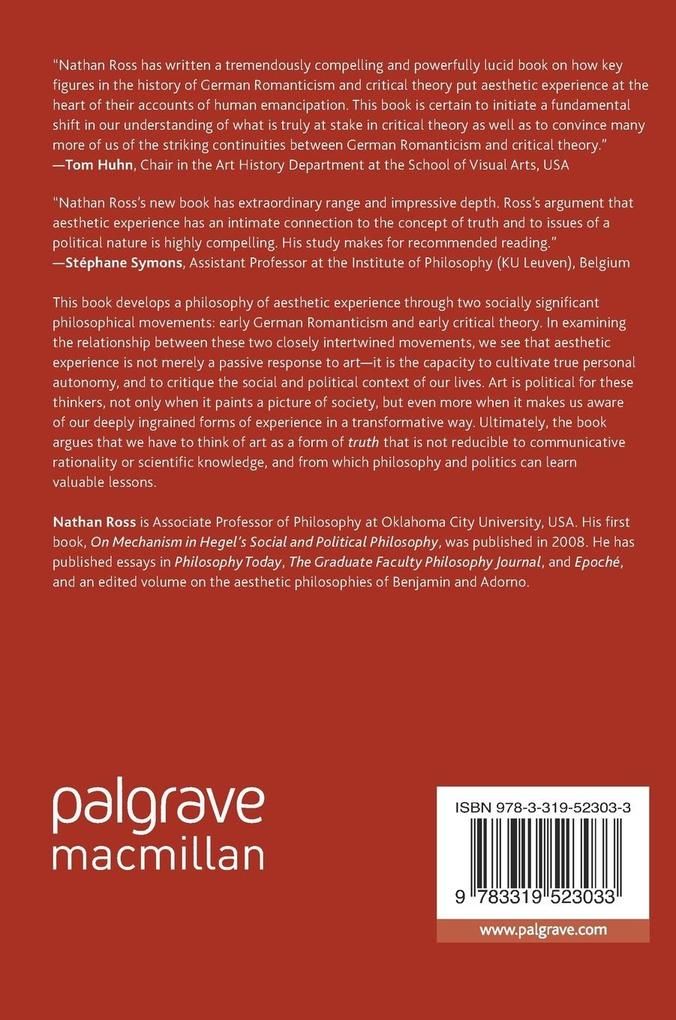
This book develops a philosophy of aesthetic experience through two socially significant philosophical movements: early German Romanticism and early critical theory. In examining the relationship between these two closely intertwined movements, we see that aesthetic experience is not merely a passive response to art-it is the capacity to cultivate true personal autonomy, and to critique the social and political context of our lives. Art is political for these thinkers, not only when it paints a picture of society, but even more when it makes us aware of our deeply ingrained forms of experience in a transformative way. Ultimately, the book argues that we have to think of art as a form of truth that is not reducible to communicative rationality or scientific knowledge, and from which philosophy and politics can learn valuable lessons.
Inhaltsverzeichnis
1. Introduction. - 2. Aesthetic Semblance and Play as Responses to the Disfigurement of Human Social Existence in Schiller s Aesthetic Education. - 3. Aesthetic Experience at the Limits of Thought in Hölderlin s New Letters on Aesthetic Education. - 4. The Endless Pursuit of Universal Sense in Friedrich Schlegel s Political and Aesthetic Thought. - 5. Walter Benjamin s Philosophy of Critical Experience From the Romantic Artwork to the Disillusioning of Mimesis. - 6. Aesthetic Truth as the Mimesis of False Consciousness in Adorno s Aesthetic Theory. - 7. Conclusion: The Benjamin Adorno Debate on the Nature of Aesthetic Experience.