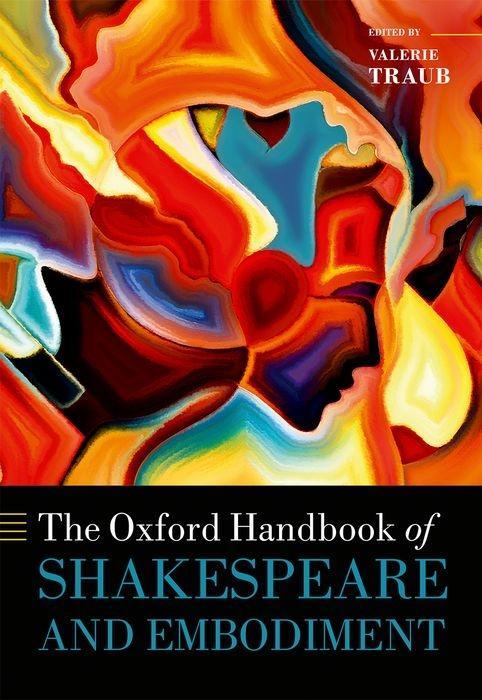
The Oxford Handbook of Shakespeare and Embodiment brings together 40 of the most important scholars writing on the subject today. They explore representations of gender in the context of race, ethnicity, sexuality, disability, and religion, and consider Shakespeare's life, contemporary editing practices, and the performance of his plays.
Inhaltsverzeichnis
- 1: Valerie Traub: Introduction: Feminist Shakespeare Studies: Cross Currents, Border Crossings, Conflicts, and Contradictions
- Part I: The Lives of William Shakespeare
- 2: Lena Cowen Orlin: Shakespeare's Marriage
- 3: Alan Stewart: The Undocumented Lives of William Shakespeare
- Part II: Early Modern Women's Lives
- 4: Bernadette Andrea: Amazons, Turks, and Tartars in the Gesta Grayorum and The Comedy of Errors
- 5: Stephen Spiess: Puzzling Embodiment: Proclamation, La Pucelle, and The first Part of Henry VI'
- 6: Susan Frye: Specters of Female Sovereignty in Shakespeare's Plays
- 7: Wendy Wall: All's Well That Ends Well and Recipe Cultures of Knowledge
- Part III: Race and Ethnicity in Local and Transnational Contexts
- 8: M. Lindsay Kaplan: Constructing the Inferior Body: Medieval Theology in The Merchant of Venice
- 9: Ian Smith: The Textile Black Body: Race and 'shadowed livery' in The Merchant of Venice
- 10: Patricia Akhimie: Bruis'd with Adversity: Reading Race in The Comedy of Errors
- 11: Emily Bartels: Identifying 'the Dane': Gender and Race in Hamlet
- 12: The Imperial Graft: Horticulture, Hybridity, and the Art of Mingling Races in Henry V and Cymbeline: Jean Feerick
- 13: Ania Loomba: Identities and Bodies in Early Modern Studies
- Part IV: Sexualities
- 14: Julie Crawford: Shakespeare. Same Sex. Marriage
- 15: Kathryn Schwarz: Comedies End in Marriage
- 16: Will Stockton: The Fierce Urgency of Now: Queer Theory, Presentism, and Romeo and Juliet
- 17: Melissa Sanchez: Impure Resistance: Heteroeroticism, Feminism, and Shakespearean Tragedy
- 18: Carol Thomas Neely: 'Strange Things in Hand': Perverse Pleasures and Erotic Triangles in The Merry Wives of Windsor
- 19: William Fisher: 'Stray[ing] lower where the pleasant fountains lie': Cunnilingus in Venus and Adonis and in English Culture, c.1600-1700
- 20: Karen Raber: Equeer: Human-Equine Erotics in 1 Henry IV
- Part V: Embodied Worlds, Reconfigured Agencies
- 21: Elizabeth Harvey: Passionate Spirits: Animism and Embodiment in Cymbeline and The Tempest
- 22: Mario DiGangi: Entangled Agency: The Assassin's Conscience in Richard III and King John
- 23: Amanda Bailey: Personification and the Political Imagination of A Midsummer Night's Dream
- 24: Gina Bloom: Time to Cheat: Chess and The Tempest's Performative History of Dynastic Marriage
- 25: Tobin Siebers: Shakespeare Differently Disabled
- 26: Vin Nardizzi: Disability Figures in Shakespeare
- 27: Marjorie Rubright: Incorporating Kate: The Myth of Monolingualism in Shakespeare's Henry the Fifth
- 28: Ari Friedlander: Roguery and Reproduction in The Winter's Tale
- 29: Maureen Quilligan: Exit Pursued by a Bear: Staging Animal Bodies in A Winter's Tale
- Part VI: Textual Production and Reproduction
- 30: Laurie Maguire: Typographical Embodiment: the case of etcetera
- 31: Valerie Wayne: The Gendered Text and its Labour
- 32: Jeffrey Masten: Glossing and T*pping: Editing Sexuality, Race, and Gender in Othello
- Part VII: Cultural Performances Past and Present
- 33: Kathleen McLuskie: A Time for The Merry Wives of Windsor
- 34: Jennifer Waldron: Dead Likenesses and Sex Machines: Shakespearean Media Theory
- 35: Evelyn Tribble: Pretty and Apt: Boy Actors, Skill, and Embodiment
- 36: Holly Dugan: Double Falsehood: Cardenio and the Lost History of Rape
- 37: Jean Howard: Interrupting the Lucrece Effect? The Performance of Rape on the Early Modern Stage
- 38: Diana E. Henderson: Magic in the Chains: Othello, Omkara, and the Materiality of Gender Across Time and Media
- 39: Susan Bennett: Precarious Bodies: Romeo and Juliet in Baghdad at the World Shakespeare Festival
- 40: Lauren Eriks Cline: Becoming Caliban: Monster Methods and Performance Theories
- 41: Ayanna Thompson and Laura Turchi: Embodiment and the Classroom Performance
- 42: Denise Albanese: Feeling Shakespeare