Following the end of the Cold War, the economic reforms in the early 1990s, and ensuing impressive growth rates, India has emerged as a leading voice in global affairs, particularly on international economic issues. Its domestic market is fast-growing and India is becoming increasingly important to global geo-strategic calculations, at a time when it has been outperforming many other growing economies, and is the only Asian country with the heft to counterbalance China. Indeed, so much is India defined internationally by its economic performance (and challenges) that other dimensions of its internal situation, notably relevant to security, and of its foreign policy have been relatively neglected in the existing literature.
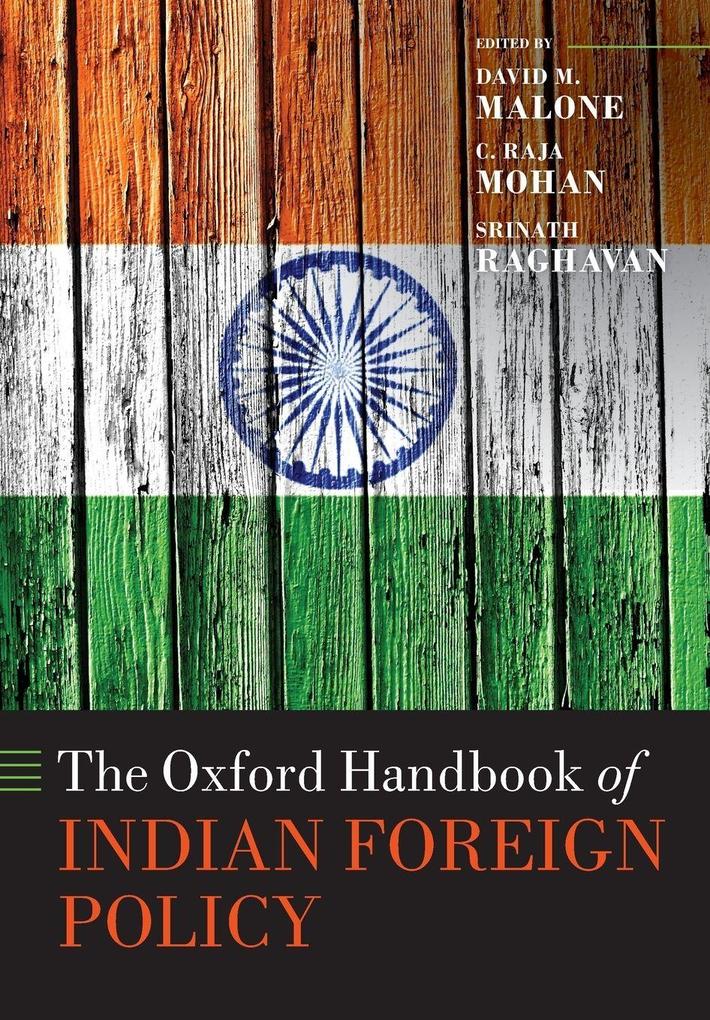
This handbook presents an innovative, high profile volume, providing an authoritative and accessible examination and critique of Indian foreign policy. The handbook brings together essays from a global team of leading experts in the field to provide a comprehensive study of the various dimensions of Indian foreign policy.
Inhaltsverzeichnis
- Section I: Introduction
- 1: David M. Malone, C. Raja Mohan and Srinath Raghavan: India and the World
- 2: Kanti Bajpai: Five Approaches to the Study of Indian Foreign Policy
- 3: Siddhartha Mallavarapu: Theorising India's Foreign Relations
- Section II: Evolution of Indian Foreign Policy
- 4: Sneh Mahajan: Foreign Policy of the Raj and its Legacy
- 5: Rahul Sagar: Ideas about Foreign Policy Before Independence
- 6: Pallavi Raghavan: Establishing the Ministry of External Affairs
- 7: Andrew Kennedy: Nehru's Foreign Policy: Idealism and Realism Conjoined?
- 8: Surjit Mansingh: Indira Gandhi's Foreign Policy: Hard Realism?
- 9: Srinath Raghavan: At the Cusp of Transformation: The Rajiv Gandhi Years, 1984-89
- 10: C. Raja Mohan: Foreign Policy After 1990: Transformation Through Incremental Adaptation
- 11: Sumit Ganguly: India's National Security
- 12: Ligia Norohna: Resources
- 13: Rohan Mukherjee: India's International Development Program
- 14: Rani Mullen: India's Soft Power
- Section III: Institutions and Actors
- 15: Paul Staniland and Vipin Narang: State and Politics
- 16: Rudra Chaudhuri: The Parliament
- 17: Tanvi Madan: Officialdom
- 18: Rajiv Kumar: The Private Sector
- 19: Manoj Joshi: The Media in the Making of Foreign Policy
- 20: Amitabh Mattoo and Rory Medcalf: Think-Tanks, Universities
- 21: Latha Varadarajan: Mother India and Her Children Abroad: The Role of the Diaspora in India's Foreign Policy
- 22: Devesh Kapur: Public Opinion
- 23: Jaideep A. Prabhu: Indian Scientists in Defence and Foreign Policy
- 24: The Economic Imperatives Shaping India's Foreign Policy
- Section IV: Geography
- 25: Stephen Cohen: India and the Region
- 26: Alka Acharya: China
- 27: Rajesh Basrur: India's Policy Towards Pakistan
- 28: Krishnan Srinivasan and Sreeradha Dutta: Bangladesh
- 29: S.D. Muni: India's Nepal Policy
- 30: V. Suryanarayan: India-Sri Lanka Equation: Geography as Opportunity
- 31: Emilian Kavalski: India's Bifurcated Look in Central Eurasia: The Central Asian Republics
- 32: Talmiz Ahmad: The Persian Gulf
- 33: Amitava Acharya: India's 'Look East' Policy
- 34: David Scott: The Indian Ocean as India's Ocean: Geopolitics and Geoeconomic Drivers for the 21st Century
- Section V: Key Partnerships
- 35: Ashley Tellis: US-India Relations: The Struggle for an Enduring Partnership
- 36: Christian Wagner: Western Europe
- 37: Rajan Menon: The Russian Federation: The Anatomy and Evolution of a Relationship
- 38: Varun Sahni: Brazil: Fellow Traveller on the Long and Winding Road to Grandeza
- 39: P.R. Kumaraswamy: Israel: A Maturing Relationship
- 40: Kudrat Virk: India and South Africa
- 41: Constantino Xavier: Unbreakable Bond: Africa in India's Foreign Policy
- Section VI: Multilateral Diplomacy
- 42: Poorvi Chitalkar and David M. Malone: India and Global Governance
- 43: Manu Bhagavan: India and the United Nations- or Things Fall Apart
- 44: Jason Kirk: India and the International Financial Institutions
- 45: Samir Saran: India's Contemporary Pluritalerism
- 46: Pradeep S. Mehta and Bipul Chatterjee: India in the International Trading System
- 47: Rajesh Rajagopalan: Multilateralism in India's Nuclear Policy: A Questionable Default Option
- 48: Navroz Dubash and Lavanya Rajamani: Multilateral Diplomacy on Climate Change
- Section VII: Looking Ahead
- 49: Sunil Khilnani: India's Rise: The Search for Wealth and Power in the 21st Century
- 50: Eswaran Sridharan: Rising or Constrained Power? Why India Will Find It Difficult To Convert Economic Growth and Nuclear Capability into Power