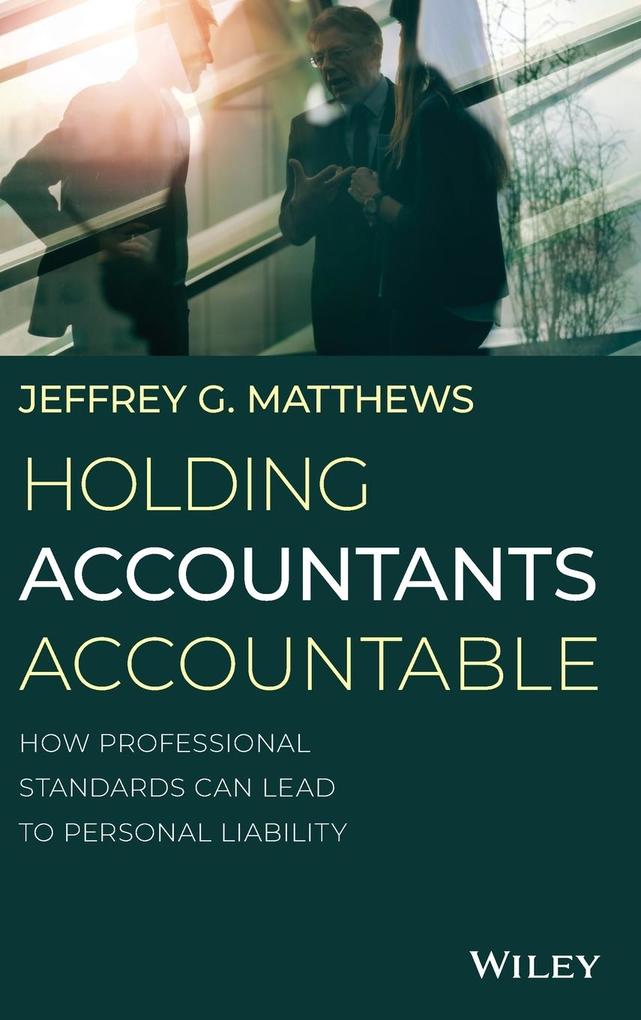
Holding Accountants Accountable offers a detailed review of Jeffrey Matthews' remarkable (and often hair-raising) journey as a forensic accountant and contains hard-won, practical advice to help accountants avoid being caught in unethical practices. During the course of his career, Matthews faced death threats, retaliation, and family hardships while working on various fraud investigations. While challenged on many occasions, he never deviated from upholding professional standards.
Holding Accountant Accountable is filled with real-life stories that clearly illustrate the common tendencies that so often hinder an accountant's ability to detect, deter, and prevent fraud and misconduct that could violate the standards and ethics of the accounting profession. Drawing on his years of experience, Matthews explains how accountants can avoid being subject to unethical and fraudulent practices, such as: Forgetting the Present: Many practitioners feel it could never happen to them or to their clients. Professionals must stay on top of emerging trends to identify new areas of weakness. Relying on Others: A work environment that is not conducive to collaboration, relies on inexperienced staff, and/or combined with an over-extended supervisor with limited time (or budget) can lead to a disaster. Accepting Not Testing: Practitioners must maintain a healthy dose of skepticism in discharging their duties. Underestimating the Effort and Qualifications: Often practitioners are presented with assignments but have little time, budget, or direction. Some firms push examiners to accept engagements they are not fully qualified to perform. Determining the Outcome Prior to Performing the Assignment: Examiners can become close to their clients and establish biases. Sometimes, the examiner may not realize there is a bias at all. In addition to the author's many colorful examples, Matthews clarifies his points by including the standards from the American Institute of Certified Public Accountants, the Association of Certified Fraud Examiners, and the Institute of Internal Auditors. Written for accountants that want to maintain the highest ethical standards of their profession, Holding Accountants Accountable is a readable resource written by an acclaimed accountant, lecturer, and college professor.
Inhaltsverzeichnis
Preface vii
Introduction xi
Statement on Standards for Consulting Services xx
Discussion Points xxvii
Chapter 1: F - Forgetting the Present and the Past 1
Fraud in the Present and Past 1
Management 6
External Auditors 11
Internal Auditors 17
Ethical Standards around the World 18
Audit versus Fraud Investigation 32
Summary 40
Recommendations 40
Chapter 2: R - Relying on Others 45
Introduction 45
Management 46
External Auditors 55
Internal Auditors 69
Expert Witnesses 71
Additional Considerations 74
Summary 75
Recommendations 75
Discussion Questions 76
Chapter 3: A - Accepting, Not Verifying 81
Introduction 81
Sufficient Evidential Matter 84
Management 89
External Auditors 96
Others: Expert Witnesses 100
Summary 106
Recommendations 106
Chapter 4: U - Underestimating the Effort 109
Introduction 109
External Auditors 111
Expert Witnesses, Fraud Examiners, and Consulting Experts 118
Management and Internal Audit 136
Summary 137
Recommendations 138
Chapter 5: D - Determining the Outcome Before the Work 141
Introduction 141
Objectivity 145
Objectivity in Other Areas 152
Due Professional Care and Skepticism 154
Summary 164
Recommendations 164
Chapter 6: Overcoming Barriers to Reporting Fraud and Misconduct 167
Introduction 167
Barriers 168
Summary 189
Recommendations 190
About the Author 195
Acknowledgments 197
Index 203