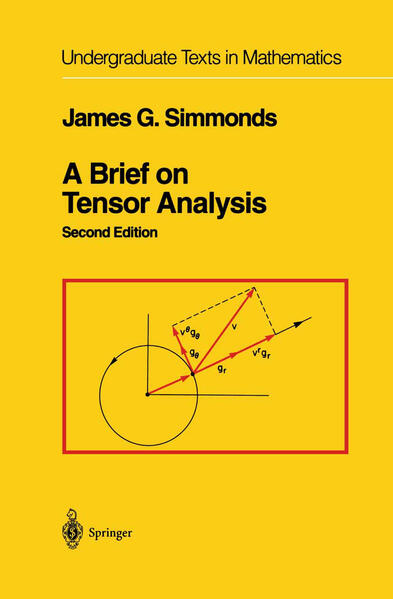
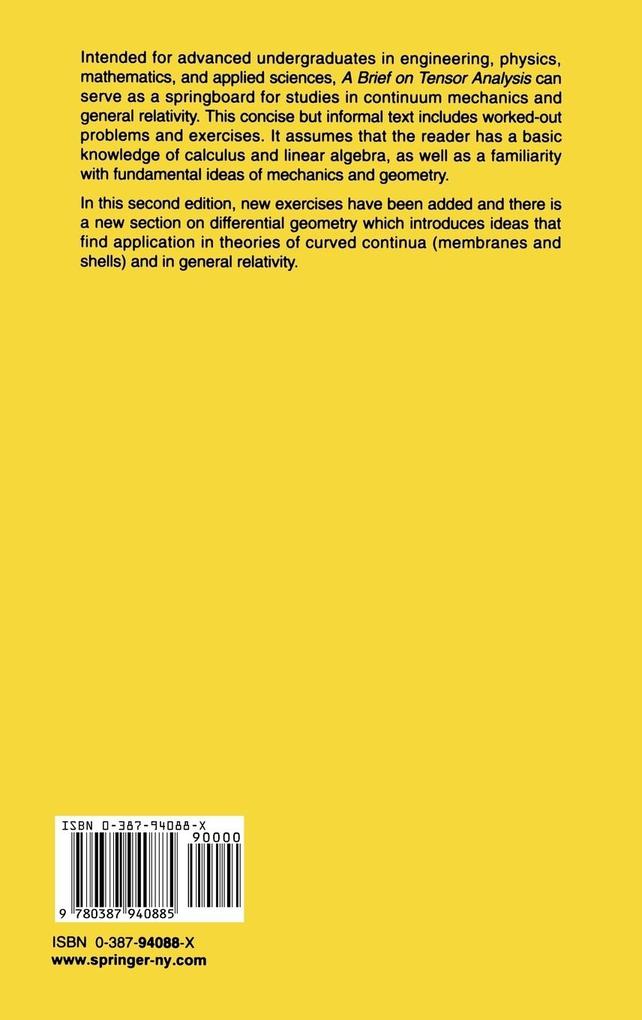
There are three changes in the second edition. First, with the help of readers and colleagues-thanks to all-I have corrected typographical errors and made minor changes in substance and style. Second, I have added a fewmore Exercises, especially at the end ofChapter4. Third, I have appended a section on Differential Geometry, the essential mathematical tool in the study of two-dimensional structural shells and four-dimensional general relativity. JAMES G. SIMMONDS vii Preface to the First Edition When I was an undergraduate, working as a co-op student at North Ameri can Aviation, I tried to learn something about tensors. In the Aeronautical Engineering Department at MIT, I had just finished an introductory course in classical mechanics that so impressed me that to this day I cannot watch a plane in flight-especially in a turn-without imaging it bristling with vec tors. Near the end of the course the professor showed that, if an airplane is treated as a rigid body, there arises a mysterious collection of rather simple looking integrals called the components of the moment of inertia tensor.
Inhaltsverzeichnis
I Introduction: Vectors and Tensors. - Three-Dimensional Euclidean Space. - Directed Line Segments. - Addition of Two Vectors. - Multiplication of a Vector v by a Scalar ? . - Things That Vectors May Represent. - Cartesian Coordinates. - The Dot Product. - Cartesian Base Vectors. - The Interpretation of Vector Addition. - The Cross Product. - Alternative Interpretation of the Dot and Cross Product. Tensors. - Definitions. - The Cartesian Components of a Second Order Tensor. - The Cartesian Basis for Second Order Tensors. - Exercises. - II General Bases and Tensor Notation. - General Bases. - The Jacobian of a Basis Is Nonzero. - The Summation Convention. - Computing the Dot Product in a General Basis. - Reciprocal Base Vectors. - The Roof (Contravariant) and Cellar (Covariant) Components of a Vector. - Simplification of the Component Form of the Dot Product in a General Basis. - Computing the Cross Product in a General Basis. - A Second Order Tensor Has Four Sets of Components in General. - Change of Basis. - Exercises. - III Newton s Law and Tensor Calculus. - Rigid Bodies. - New Conservation Laws. - Nomenclature. - Newton s Law in Cartesian Components. - Newton s Law in Plane Polar Coordinates. - The Physical Components of a Vector. - The Christoffel Symbols. - General Three-Dimensional Coordinates. - Newton s Law in General Coordinates. - Computation of the Christoffel Symbols. - An Alternative Formula for Computing the Christoffel Symbols. - A Change of Coordinates. - Transformation of the Christoffel Symbols. - Exercises. - IV The Gradient, the Del Operator, Covariant Differentiation, and the Divergence Theorem. - The Gradient. - Linear and Nonlinear Eigenvalue Problems. - The Del Operator. - The Divergence, Curl, and Gradient of a Vector Field. - The Invariance of ? · v, ? × v, and ? v. - The Covariant Derivative. - The Component Forms of ? · v, ? × v, and ? v. - The Kinematics of Continuum Mechanics. - The Divergence Theorem. - Differential Geometry. - Exercises.