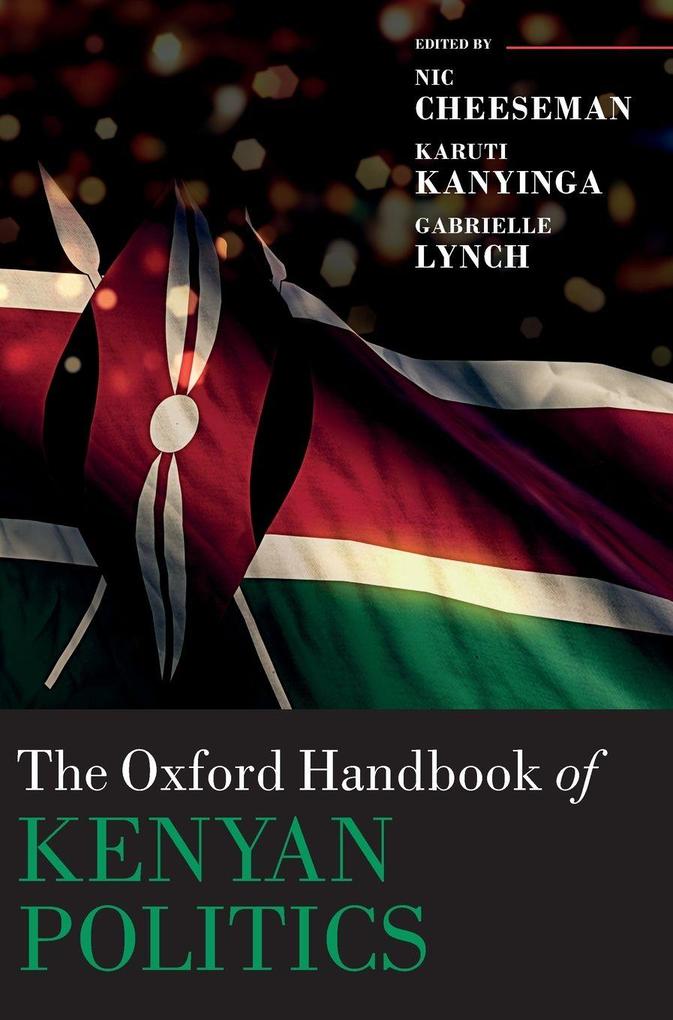
Kenya is one of the most politically dynamic and influential countries in sub-Saharan Africa. Today, it is known in equal measure as a country that has experienced great highs and tragic lows. In the 1960s and 1970s, Kenya was seen as a ''success story of development in the periphery, and also led the way in terms of democratic breakthroughs in 2010 when a new constitution devolved power and placed new constraints on the president. However, the country has also made international headlines for the kind of political instability that occurs when electoral violence is expressed along ethnic lines, such as during the Kenya crisis of 2007/08 when over 1,000 people lost their lives and almost 700,000 were displaced. The Oxford Handbook of Kenyan Politics explains these developments and many more, drawing together 50 specially commissioned chapters by leading researchers. The chapters they have contributed address a range of essential topics including the legacy of colonial rule, ethnicity, land politics, devolution, the constitution, elections, democracy, foreign aid, the informal economy, civil society, human rights, the International Criminal Court, the growing influence of China, economic policy, electoral violence, and the impact of mobile phone technology. In addition to covering some of the most important debates about Kenyan politics, the volume provides an insightful overview of Kenyan history from 1930 to the present day and features a set of chapters that review the impact of devolution on regional politics in every part of the country.
Inhaltsverzeichnis
- Introduction
- 1: Nic Cheeseman, Karuti Kanyinga, and Gabrielle Lynch: The political economy of Kenya: Community, clientelism, and class
- Part I - The struggle for democracy
- 2: Derek R. Peterson: Colonial rule and the rise of African politics (1930-1964)
- 3: David W. Throup: Jomo Kenyatta and the creation of the Kenyan state (1963-1978
- 4: David W. Throup: Daniel arap Moi and one-party rule (1978-1991)
- 5: Raymond Muhula: The limits of multipartyism (1992-2005)
- 6: James D. Long: Civil conflict, power sharing, truth and reconciliation (2005-2013)
- 7: Collins Odote: The 2013 elections and the peace narrative (2013-2015)
- 8: Marie-Emmanuelle Pommerolle: The 2017 elections and electoral (in)justice (2015-2017)
- Part II - Identity politics
- 9: John Lonsdale: Race and ethnicity in colonial Kenya
- 10: Gregory Deacon: The political role of Christian churches
- 11: Ngala Chome: The political role of Islam
- 12: Winnie Mitullah: Gender mainstreaming and the campaign for equality
- 13: Naomi van Stapele: Youth and masculinity
- 14: Sini Hassinen: Sexual minority rights and activism
- Part III - Political institutions
- 15: Yash Ghai: Constitutions and constitutionalism
- 16: Walter O. Oyugi and Jimmy O. Ochieng: The politics of the Provincial Administration
- 17: Ken Opalo: The rise and fall of the legislature
- 18: Michelle D'Arcy: Devolution and county government
- Part IV - Civil society, the media and political culture
- 19: Angelique Haugerud, Meghan Ference, and Dillon J. Mahoney: Satire, social media, and cultures of resistance
- 20: Denis Galava: The role of traditional media
- 21: Michelle Osborn: Chiefs, elders, and traditional authority
- 22: Geoffrey Lugano: Civil society and the state
- 23: Thomas P. Wolf: The science, suspicion and sustainability of opinion polls
- Part V - Political parties and strategies of mobilisation
- 24: Susanne D. Mueller: High stakes ethnic politics
- 25: Adams Oloo: The weaknesses of political parties
- 26: Sarah Jenkins: Violence as an election strategy
- Part VI - Law and (dis)order
- 27: Irina Ichim: The protection and promotion of human rights
- 28: Ambreena Manji: Land rights and the rule of law
- 29: Musambayi Katumanga: Post-colonial state-military relations
- 30: Abduallahi Boru Halakhe: Police, reform, and counter-terrorism
- 31: Jacob Rasmussen: Gangs and vigilantism
- Part VII - The political economy of development
- 32: John W. Harbeson and Frank Holmquist: The lessons and legacies of the "Kenya debate''
- 33: Radha Upadhyaya and Edoardo Totolo: The financial sector
- 34: Mai Hassan: The local politics of resource distribution
- 35: Bitange Ndemo and Dennis Aiko: Mobile technology and development
- 36: Jennifer N. Brass: NGOs and public service provision
- 37: Jane N.O. Khayesi: The informal economy and its relationship with the state
- Part VIII - Kenya and the world
- 38: Michael Chege: The political economy of foreign aid to Kenya
- 39: Njoki Wamai: International relations and the International Criminal Court
- 40: David M. Anderson: Kenya's war in Somalia
- 41: L. Muthoni Wanyeki: Foreign policy and regional relations
- 42: Samuel M. Makinda: The rise of China in Kenya's foreign relations
- Part IX - Regional politics in the time of devolution
- 43: Patrick O. Asingo: Nyanza: The Odinga dynasty and beyond
- 44: Peris S. Jones: Nairobi: The politics of the capital
- 45: Alex Dyzenhaus: Rift Valley: The struggle for supremacy
- 46: Hassan H. Kochore: North Eastern: From the periphery to the center
- 47: Dominic Burbidge and Thomas Raji: Central: Self-sufficiency in a local arena
- 48: Frederick O. Wanyama: Western: Negotiating political heterogeneity
- 49: Mumo Nzau: Eastern: The dynamics of "bridesmaid politics"
- 50: Hannah Waddilove: The Coast: An elusive political bloc