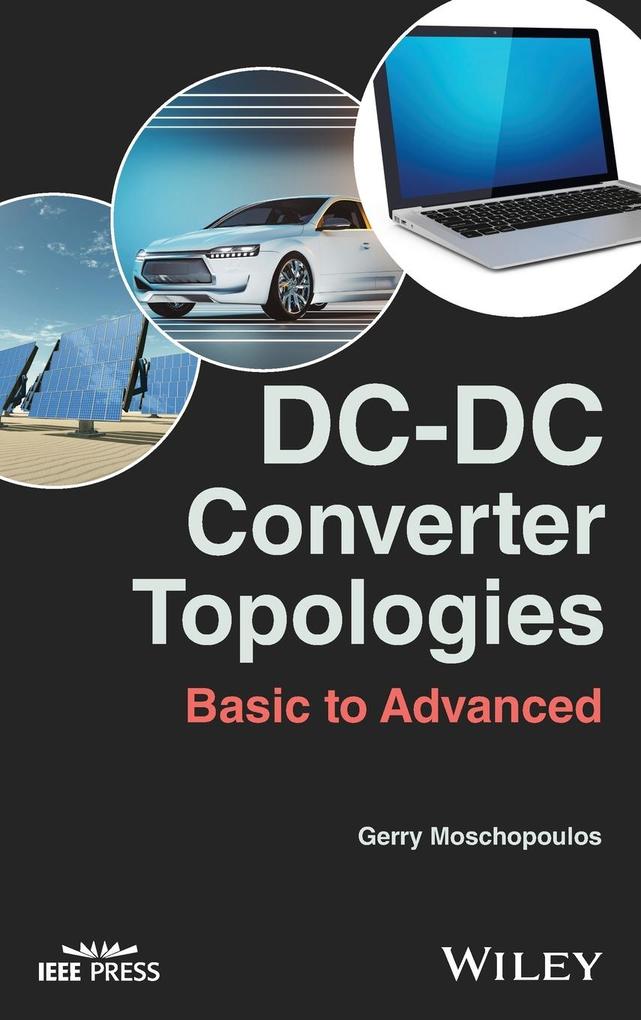
A comprehensive look at DC-DC converters and advanced power converter topologies for all skills levels As it can be rare for source voltage to meet the requirements of a Direct Current (DC) load, DC-DC converters are essential to access service. DC-DC power converters employ power semiconductor devices (like MOSFETs and IGBTs) as switches and passive elements such as capacitors, inductors, and transformers to alter the voltage provided by a DC source into the necessary DC voltage as is required by a DC load. This source can be a battery, solar panels, fuel cells, or a DC bus voltage fed by rectified AC utility voltage. As the many components of DC-DC converters can be differently arranged into circuit structures called topologies, there are as many possible circuit topologies as there are possible combinations of circuit elements. Focusing on DC-DC switch-mode power converters ranging from 50 W to 10kW, DC-DC Converter Topologies provides a survey of all converter topology types within this power range. General principles are described for each topology type using a representative converter as an example. Variations that can be found that differ from the example are then examined, with a helpful discussion of comparisons when relevant. A broad range of topics is covered within the book, from simple, low-power converters to complex, high-power converters and everywhere in between. DC-DC Converter Topologies readers will also find:
- A detailed discussion of four key DC-DC converter topologies
- Description of isolated two-switch pulse-width modulated (PWM) topologies including push-pull, half-bridge, and interleaved converters
- An exploration of high-gain converters such as coupled inductors, voltage multipliers, and switched capacitor converters
This book provides the tools so that a non-expert will be equipped to deal with the vast array of DC-DC converters that presently exist. As such, DC-DC Converter Topologies is a useful reference for electrical engineers, professors, and graduate students studying in the field.
Inhaltsverzeichnis
About the Author xv
Preface xvi
1 Basic Concepts 1
1. 1 Linear Voltage Regulators 1
1. 2 Switch-Mode Power Supply Fundamentals 3
1. 2. 1 Buck Converter 3
1. 2. 2 Boost Converter 5
1. 2. 3 Buck-Boost Converter 6
1. 3 PWM Converters with Voltage Step-Up and Step-Down Capabilities 8
1. 3. 1 Cuk Converter 8
1. 3. 2 Single-Ended Primary Inductance Converter (SEPIC) 9
1. 3. 3 Zeta Converter 10
1. 3. 4 Comparison Between Converters with Voltage Step-Up and Step-Down Capabilities 10
1. 4 Interleaved Converters 12
1. 5 Semiconductor Devices 14
1. 5. 1 Silicon Diodes 14
1. 5. 2 Silicon MOSFETs 15
1. 5. 3 Silicon IGBTs 17
1. 5. 4 Gate Drive Circuits 18
1. 5. 5 Wide Bandgap Devices 19
1. 6 Snubbers 21
1. 7 Conclusion 23
References 23
2 Non-isolated Zero-voltage Switching PWM Converters 25
2. 1 Basic ZVS Principles for MOSFETS 26
2. 2 ZVS-PWM Quasi-Square-Wave DC-DC Converters 28
2. 3 ZVS-PWM DC-DC Converters with Auxiliary Circuits 30
2. 3. 1 Nonresonant Auxiliary Circuits 31
2. 3. 2 Resonant Auxiliary Circuits 37
2. 3. 3 Dual Auxiliary Circuits 40
2. 4 Miscellaneous Considerations 42
2. 4. 1 Application-Specific ZVS-PWM Converters 42
2. 4. 2 ZVS-PWM Techniques in Converters with Wide Bandgap Devices 43
2. 5 Conclusion 44
References 45
3 Non-isolated Zero-current Switching PWM Converters 46
3. 1 ZCS-PWM Converters with Series-Resonant Auxiliary Circuits 47
3. 1. 1 ZCS-PWM Converter with Fully Resonant Auxiliary Circuit 48
3. 1. 2 ZCS-PWM Converter with Modified Resonant Auxiliary Circuit 51
3. 1. 3 Converter with Hard-Switching Auxiliary Circuit 51
3. 2 ZCS-PWM Boost Converters with Conventional PWM Converter Main Switch Current Stress 52
3. 2. 1 ZCS-PWM Converter with Series Boost Diode 52
3. 2. 2 ZCS-PWM Converter with Output Resonance 54
3. 2. 3 ZCT-PWM Converters with Parallel Auxiliary Circuit 55
3. 3 ZVSZCS-PWM Boost Converters 57
3. 4 Conclusion 60
References 61
4 Basic Isolated Converters 63
4. 1 Transformer Models 64
4. 2 Flyback Converter 64
4. 3 Forward Converter 67
4. 4 Variations on the Forward Converter 69
4. 4. 1 Forward Converter with RCD Snubber 69
4. 4. 2 Forward Converter with LCDD Snubber 70
4. 4. 3 Forward Converter with Regenerative Energy Snubber 71
4. 5 Basic Two-Switch Isolated Converters 72
4. 5. 1 Two-Switch Forward Converter 72
4. 5. 2 Push-Pull Converter 74
4. 5. 3 Half-Bridge Converter 76
4. 6 Full-Bridge Converter 77
4. 7 Conclusion 80
Reference 81
5 Secondary-side Implementations in Isolated DC-DC Converters 82
5. 1 Synchronous Rectifiers 82
5. 2 Current Doublers 90
5. 3 Multi-Output Converters 94
5. 4 Conclusion 98
References 99
6 Soft-switching Forward and Flyback Converters 102
6. 1 Forward Converters with Resonant Reset 103
6. 2 Active Clamp Converter 104
6. 2. 1 Modes of Operation 106
6. 2. 2 Design Considerations 110
6. 2. 3 Active Clamp Flyback Converter 114
6. 3 Alternatives to the Active Clamp Converter 115
6. 3. 1 Forward Converters 115
6. 3. 2 Flyback Converters 117
6. 3. 3 Converters with Regenerative Energy Snubber 119
6. 4 Conclusion 120
References 121
7 The ZVS-PWM Full-bridge Converter 123
7. 1 DC-DC PWM Full-Bridge Converter with Basic PWM Control 124
7. 2 ZVS-PWM Full-Bridge Converter with Phase-Shift PWM 125
7. 3 Issues Related to the Operation of ZVS-PWM PWM Full-Bridge Converter 131
7. 3. 1 ZVS Operation 131
7. 3. 2 Duty-Cycle Loss 134
7. 3. 3 Voltage Ringing 136
7. 4 ZVS-PWM PWM Full-Bridge Converter Design Considerations 137
7. 5 Light Load Operation and Hybrid PWM 140
7. 6 ZVS PWM Full-Bridge Converters with Wide Bandgap Devices 140
7. 7 Conclusion 141
References 142
8 Variations on the Conventional Zero-voltage-Switching DC-DC PWM Full-bridge Converter 144
8. 1 Modified ZVS-PWM DC-DC Full-Bridge Converter with Saturable Reactors 145
8. 1. 1 Modified ZVS-PWM-FB Converter with Primary-Side Saturable Reactor 145
8. 1. 2 Modified ZVS-PWM-FB Converters with Secondary-Side Saturable Reactors 146
8. 2 Modified ZVS-PWM-FB Converters with Passive Series Auxiliary Circuits 149
8. 3 ZVS-PWM-FB Converters with Passive Parallel Auxiliary Circuits 151
8. 4 ZVS-PWM-FB Converters with Passive Parallel Auxiliary Circuits with a Transformer 153
8. 4. 1 ZVS-PWM-FB Converter with a Passive Auxiliary Series Auxiliary Circuit with a Transformer 153
8. 4. 2 ZVS-PWM-FB Converters with Passive Parallel Auxiliary Circuits and Reduced Output Current Ripple 156
8. 5 ZVS-PWM-FB Converters with Active Auxiliary Circuits 157
8. 6 ZVS-PWM-FB Converter with a Single Active Auxiliary Circuit 161
8. 7 ZVS-PWM-FB Converters Based on Dual Half-Bridge Converters 164
8. 8 ZVS-PWM-FB Converters with Modified Secondary-Side Circuits for ZVS Operation 167
8. 9 Conclusion 170
References 172
9 Zero-voltage-zero-current-switching DC-DC Full-bridge PWM Converters 174
9. 1 Fundamental ZVZCS-PWM DC-DC Full-Bridge Converter 175
9. 2 ZVZCS-PWM DC-DC Full-Bridge Converters with Secondary Auxiliary Circuit 183
9. 3 Variations of ZVZCS Converters for Full ZVS or Full ZCS Operation 193
9. 3. 1 ZVS Converters 193
9. 3. 2 ZCS Converters 194
9. 3. 3 ZVS-PWM Converters Based on ZVZCS-PWM Converters with Triangular Primary Current Waveform 195
9. 4 Conclusion 198
References 199
10 Isolated Current-fed DC-DC PWM Converters 201
10. 1 Basic Current-Fed Push-Pull Converter 203
10. 2 Basic Two-Inductor Current-Fed Converter 204
10. 3 Modified Two-Inductor Current-Fed Converter with Auxiliary Transformer 207
10. 4 Basic Current-Fed Full-Bridge Topology 210
10. 5 Current-Fed DC-DC Full-Bridge Converters with Blocking Diodes 212
10. 6 Current-Fed DC-DC Full-Bridge Converters without Blocking Diodes 215
10. 6. 1 ZVS-PWM Active-Clamp Full-Bridge Converter 215
10. 6. 2 ZCS-PWM Full-Bridge Converter with Parallel Auxiliary Circuit 217
10. 7 Conclusion 219
References 220
11 Resonant Converters Part I - Fundamentals 222
11. 1 Resonant Power Conversion Fundamentals 223
11. 2 Fundamental Resonant DC-DC Converters 228
11. 2. 1 Resonant Converter Analysis Using First Harmonic Approximation Method 231
11. 2. 2 Series-Resonant Converter vs Parallel-Resonant Converter 234
11. 2. 3 Series-Parallel-Resonant Converter 236
11. 3 LLC Resonant Converter 238
11. 4 Other Resonant DC-DC Converters 241
11. 5 Conclusion 245
References 246
12 Resonant Converters Part II - PWM Controlled, Quasi-resonant, and Ultrahigh-frequency Converters 248
12. 1 Fixed Frequency Resonant Converters 249
12. 1. 1 Full-Bridge Resonant Converters Operated with Phase-Shift PWM 249
12. 1. 2 Resonant Converters Operated with Asymmetrical PWM 252
12. 1. 3 Adding Variable Resonant Components 257
12. 2 Quasi-Resonant Converters 258
12. 2. 1 Resonant Pulse Converters 264
12. 2. 2 Fixed-Frequency Quasi-Resonant Converters 265
12. 3 Ultrahigh Frequency Converters 266
12. 3. 1 Multi-Resonant Converters 267
12. 3. 2 Ultrahigh Frequency Converters Based on Radio-Frequency Amplifier Circuits 268
12. 3. 3 Ultrahigh Frequency Converters with Air-Core Inductors 269
12. 4 Conclusion 270
References 270
13 Three-level DC-DC Converters 273
13. 1 Fundamental Three-Level DC-DC PWM Converters 274
13. 1. 1 Neutral-Point-Clamped Three-Level DC-DC Converter 274
13. 1. 2 Flying Capacitor Three-Level DC-DC Converter 280
13. 1. 3 Three-Level DC-DC Converter with Series Blocking Capacitor 286
13. 1. 4 Comparison of Fundamental Three-Level DC-DC Converter Topologies 291
13. 2 Modified Three-Level DC-DC Converters 292
13. 2. 1 ZVS Three-Level Converters 292
13. 2. 2 ZVZCS Three-Level Converters 298
13. 3 Stacked Converters 302
13. 4 Three-Level DC-DC Converters in Applications with Low and Conventional DC Bus Voltage 306
13. 5 Conclusion 307
References 308
14 High Gain Converters 311
14. 1 Voltage Multiplier Circuits 312
14. 1. 1 Output Voltage Multiplier Circuits 312
14. 1. 2 Internal Voltage Multiplier Circuits 316
14. 2 Switched Capacitor Converters 318
14. 3 Voltage-Lift and Switched Inductor Converters 321
14. 4 Cascaded and Quadratic Converters 326
14. 5 Converters with Magnetic Coupling 328
14. 5. 1 Tapped Inductor Converters 328
14. 5. 2 Coupled Inductor Converters 329
14. 5. 3 Transformer-Coupled Converters 331
14. 6 Multi-Level and Interleaved Converters 331
14. 6. 1 Multi-Level Converters 332
14. 6. 2 Interleaved Converters 335
14. 7 Hybrid Converters and Converter Selection 336
14. 8 Conclusion 340
References 340
15 Three-phase DC-DC Converters 343
15. 1 Fundamental Voltage-Fed Three-Phase DC-DC PWM Converter 344
15. 1. 1 Basic Operating Principles with Symmetrical PWM 344
15. 1. 2 Operation with Asymmetrical PWM 346
15. 1. 3 Modified Output Section with Three Output Diodes 347
15. 2 Resonant Converters 349
15. 2. 1 Parallel Resonant Converter Based on the Fundamental Converter 349
15. 2. 2 Three-Phase Series-Parallel Resonant Converters with Variable and Fixed Switching Frequency Operation 350
15. 3 Three-Phase Current-Fed DC-DC PWM Converters 351
15. 3. 1 Three-Phase ZVS Active Clamp Converter 351
15. 3. 2 Three-Phase ZCS Converter 353
15. 4 Higher-Power Three-Phase DC-DC Converters 355
15. 4. 1 High-Power Converter with Three Single-Phase PWM Full-Bridges 355
15. 4. 2 High-Power Converter with Three Single-Phase Resonant Full-Bridges 356
15. 5 Three-Switch Three-Phase DC-DC PWM Converters 356
15. 5. 1 Three-Phase Push-Pull Converter 357
15. 5. 2 ZVS Active Clamp Converter 359
15. 5. 3 ZCS Converter with Secondary-Side Resonance 361
15. 5. 4 Converter with Mini-Flyback Snubber 362
15. 6 Miscellaneous Three-Phase Converter Examples 363
15. 6. 1 Three-Phase DC-DC Multi-Level Converter 363
15. 6. 2 Three-Phase DC-DC High-Gain Converter 364
15. 7 Three-Phase Transformer Implementations 365
15. 8 Conclusion 367
References 367
16 Bidirectional and Dual Active Bridge Converters 369
16. 1 Basic Non-Isolated Bidirectional Converters 370
16. 2 ZVS Operation of the Fundamental Buck-Boost Bidirectional Converter 372
16. 2. 1 Bidirectional Quasi-Square Wave Converter 372
16. 2. 2 Four-Switch Buck-Boost Converter 373
16. 2. 3 Active Auxiliary Circuits 375
16. 3 Bidirectional Converter Topologies with Transformer Isolation 377
16. 4 Dual Active Bridge Converters 381
16. 4. 1 Dual Active Bridge Half-Bridge Converter 381
16. 4. 2 Dual Active Bridge PWM Full-Bridge Converters 383
16. 5 Conclusion 387
References 388
17 Miscellaneous DC-DC Converters 391
17. 1 Z-Source Converters 392
17. 2 Low Voltage Gain Converters for Voltage Regulator Modules 396
17. 3 T-Type Converters 401
17. 4 Multi-Port Converters 405
17. 4. 1 Non-Isolated Multi-Input Converters 406
17. 4. 2 Isolated Multi-Port Converters 408
17. 5 Conclusion 412
References 413
Appendix 415
Index 427