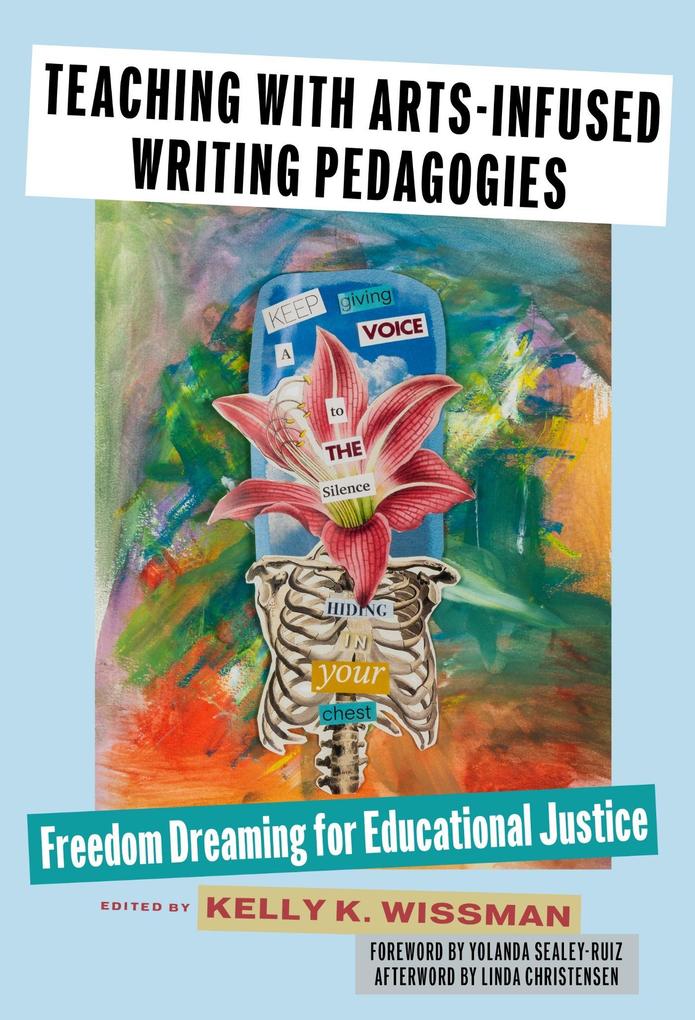
Envisioned as a story, a guide, a resource, and an aesthetic experience, this book features the work of a multigenerational collective of K-12 educators, students, and teaching artists seeking educational justice. The book provides detailed guidelines and principles for enacting arts-infused writing pedagogies, adaptable to a range of contexts.
Envisioned as a story, a guide, a resource, and an aesthetic experience, this book features the work of a multigenerational collective of K-12 educators, students, and teaching artists seeking educational justice. This multivocal approach illustrates how bringing together arts-infused writing pedagogies, with the visionary and intellectual force of freedom dreaming, can create more luminous and socially transformative educational spaces. Through vivid vignettes, compelling first-person narratives, mixed media artwork, and detailed lesson plans, readers will experience schools as places of joy, belonging, and justice. As an act of radical hope during the turmoil and trauma of post-pandemic times, this book invites readers to draw on the principles of freedom dreaming and abolitionist teaching to imagine and enact arts-infused writing pedagogies across a multitude of settings. Authors offer guidance for teachers, teacher educators, and professional development leaders wishing to take up this work in their own contexts.
Book Features:
- Provides detailed guidelines and principles for enacting arts-infused writing pedagogies, adaptable to a range of contexts.
- Showcases original artwork by K-12 students and educators, many in full color.
- Includes insights on teaching writing and engaging in inquiry-based professional learning from a local site of the National Writing Project.
- Highlights the role of teaching artists in enhancing teacher and student learning.
- Illuminates the potential of a/r/tography, affect, and wonder in qualitative inquiry.
- Contains visually arresting and narratively powerful contributions from students as young as 6 years old to teachers nearing retirement, as well as professional artists and novelists.
Inhaltsverzeichnis
- Contents
- Foreword Yolanda Sealey-Ruiz ix
- Acknowledgments xiii
- Part I. Sketching Dreamscapes of Possibilities: Creating Art and Community in the Freedom Dreaming for Educational Justice Project
- 1. "The Quality of Light": An Introduction to Freedom Dreaming for Educational Justice 3
Kelly K. Wissman - 2. Freedom Dreaming With Arts-Infused Writing Pedagogies: Ten Engagements 20
Kelly K. Wissman - 3. Seeing Students in Relation to Possibility: Imperatives for Freedom Dreaming in English Language Arts 45
Christina Pepe - 4. Becoming a Beloved Community of Diverse Educators and Mental Health Professionals: Lessons From Freedom Dreaming for Educational Justice in Intergenerational Arts-Based Inquiries 57
Tammy Ellis-Robinson and Cheryl L. Dozier - 5. Visions of Liberation: A Thematic Analysis of the Education Freedom Dreams 72
Kelly K. Wissman, Vanessia Wilkins, and Hanum Tyagita - Part II: Dreaming Together: Visions and Voices of Teachers, Students, and Teaching Artists
Kelly K. Wissman - 6. We Are Dreaming of . . . Manifesting New Educational Worlds in Dialogue Between Students and Teachers 101
- 7. We Are Dreaming of . . . Enlivening School Communities With Teaching Artists 127
- 8. We Are Dreaming of . . . Creating School Communities of Joy, Care, and Belonging 144
- 9. We Are Dreaming of . . . Fostering New Ways of Seeing and Being 156
- 10. We Are Dreaming of . . . Honoring the Ancestors 166
- Epilogue: Why Freedom Dream? 174
Leah Werther, Amy Salamone, Matt Pinchinat, Christina Pepe, and Kelly K. Wissman - Afterword Linda Christensen 182
- Index 184
- About the Editor and Contributors 189