







Das eBook.de Hörbuch Abo - jederzeit, überall, für nur 7,95 € monatlich!
Jetzt entdecken
mehr erfahren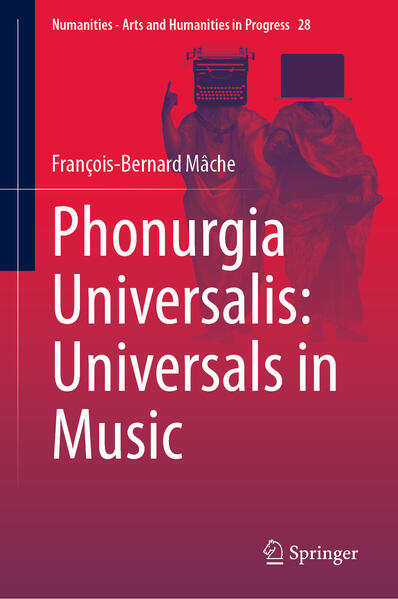
This translation of Musique au singulier (2001) from the French identifies what is common to music of all times and cultures. The author, François-Bernard Mâche is a composer and internationally renowned musicologist. He addresses the question of universals in music and demonstrates how musical play is a poetic and natural game that already takes shape in the animal world. Mâche invites the reader to reconsider the traditional opposition between nature and culture and to reflect on experiencing such intense emotions when both listening to and manipulating sounds. This title appeals to students and researchers working in musicology.
Inhaltsverzeichnis
1 Theme
The Search for the Universal
. - 2 Analysis
Distributional analysis, advantages and limitations Its provisional relevance in the search for archetypes
. - 3 Animal polyphonies
Universality of polyphonies Analogy with animal choirs and duets Possible purposes. - 4
Archetype
Where to look for the models of human musical nature?
. - 5 Convergence
Analogies or homologies between animal signals and human music The shortcomings of culturalism, and in particular of diffusionism.
- 6 Fixed forms
The formal organisations of poems are sonorous and concern the problem of the common origins of music and language The forms of repetition constitute their essential part. - 7
Genotype
Shorthand and programmes Animal and human examples of alternation and conflict.
- 8 Innate
Interaction of the innate and the acquired Archetypes as innate schemes.
- 9 Language and music
Hypothesis of common origin, explaining strong formal analogies Mantras, glossolalies, lettrism Language models for the composer.
- 10 Litany
Close union of language and music in the litany The four magical, laudative, didactic and rhetorical functions, and their links with musical forms.
- 11 Models
Pure music or external models Antiquity of problems, from Plato to Rousseau Global models and analysis.
- 12 Modernity
Modernity and individualism
Post-modernity and pastism.
- 13 Myth
Mythical level and archetype Evolutionism and transmission of archetypes Myth as a minimum common to all cultures.
- 14 Nature
Noise and nature Culturalism and naturalism Third phenomenological way.
- 15 Ostinato
Primary impulses and cultural developments of ostinato.
- 16 Phenotype:
The universality of certain sound forms refers to universal processes These alone can explain the very strong similarities found in cultures with no historical contacts.
- 17 Playing music
Communication and playing associated with the source of the music Music and sound ecology. - 18
Refrain
Refrain and stanza Formalism and expression across different languages and poetic and musical styles Problems of multiple and varied refrains The refrain as a way of controlling time.
- 19 Repetition
A musical universal of primary importance A musician s reading of some metaphysicians and aestheticians Repetition, innovation, learning: music as an image of life.
- 20 Speaking instruments
A brief overview of whistled and drummed languages, etc, at the crossroads of play, language and music.
- 21 Strophe
A universal form, also present in many bird songs Phenotype or genotype?
. - 22 Style
From impersonal archetype to originality Archetypes and stereotypes: the need for a hierarchy of values.
- 23 Universal
The need for a universal musicology Methods of approach and criteria of universality: phenotypes, genotypes, archetypes.
- 24 Variation
Synthesis of myth and history The material as a reification of schemas from the unconscious, and variation as a conscious treatment Failure of music where nothing varies as well as music where everything varies Universality of certain processes of variation.
- 25 Zoömusicology
New bioacoustic knowledge and musicological skills Distributional analysis and acoustic and functional categorisation Animal syntagms and paradigms, musical analogies.
Es wurden noch keine Bewertungen abgegeben. Schreiben Sie die erste Bewertung zu "Phonurgia Universalis: Universals in Music" und helfen Sie damit anderen bei der Kaufentscheidung.