








Das eBook.de Hörbuch Abo - jederzeit, überall, für nur 7,95 € monatlich!
Jetzt entdecken
mehr erfahren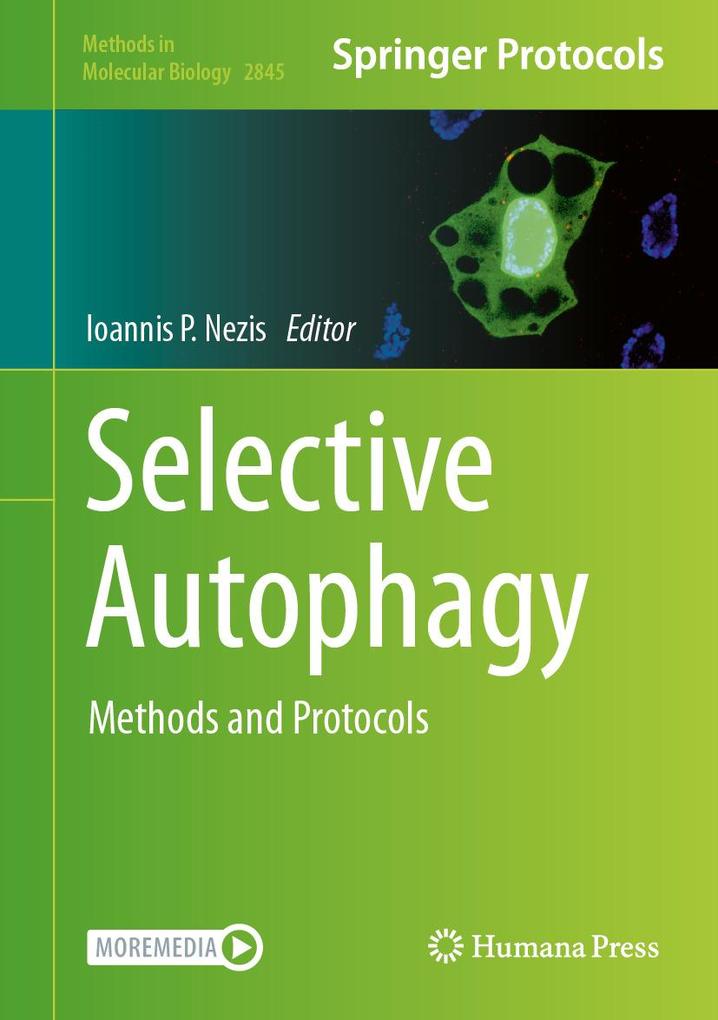
This volume presents the latest techniques used by researchers to study selective autophagy in a broad range of organisms such as yeast, plants, worms, fruit flies, and mammals. The chapters in this book cover several types of selective autophagy such as mitophagy, aggrephagy, ER-phagy, ferritinophagy, pexophagy, and nucleophagy. Written in the highly successful Methods in Molecular Biology series format, chapters include introductions to their respective topics, lists of the necessary materials and reagents, step-by-step, readily reproducible laboratory protocols, and tips on troubleshooting and avoiding known pitfalls.
Cutting-edge and comprehensive, Selective Autophagy: Methods and Protocols is a valuable resource for novice and expert researchers who want to learn more about this interesting and developing field.
Chapter 3 is available open access under a Creative Commons Attribution 4. 0 International License via link. springer. com.
Inhaltsverzeichnis
Using Fluorescence Microscopy and Immunoblotting for Monitoring Mitophagy in Budding Yeast. - Methods to Monitor Nucleophagy in Yeast. - Synthetic Dimerization Approaches for In Vivo Studies in
Saccharomyces
cerevisiae. -
Assays to Study Mitophagy in Plants. - Assessing Neuronal Mitophagy during Development in the Nematode
Caenorhabditis elegans. -
In Vivo Monitoring of Nucleophagy in
Caenorhabditis elegans. -
Analysis of Mitophagy Reporters in
Drosophila. -
Studying Selective Autophagy of Protein Aggregates using Particles Induced by Multimerization (PIMs). - Methods for Monitoring ER-phagy. - Quantitative Super-Resolution Imaging of ER-phagy Initiation in Cells. - Fluorescence Methods to Measure Pexophagy. - Methods for Monitoring Mitophagy using mt-Keima. - Monitoring Mitophagy Dynamics in Live Cells. - Methods for Monitoring NCOA4-Mediated Ferritinophagy. - Method to Purify Phase-Separated p62 Bodies using Fluorescence-Activated Particle Sorting. - In Silico Assessment of LIR Motif-Containing Proteins Binding to ATG8-Family Proteins. - High Throughput Screening for LC3/GABARAP Binders Utilizing the Fluorescence Polarization Assay. - Thermodynamic Characterization of LC3/GABARAP:Ligand Interactions by Isothermal Titration Calorimetry. - Determination of hATG8 Binding Selectivity of Autophagy-Interacting Motif (AIM) Peptides Using Native Electrospray Ionization Mass Spectrometry.
Es wurden noch keine Bewertungen abgegeben. Schreiben Sie die erste Bewertung zu "Selective Autophagy" und helfen Sie damit anderen bei der Kaufentscheidung.