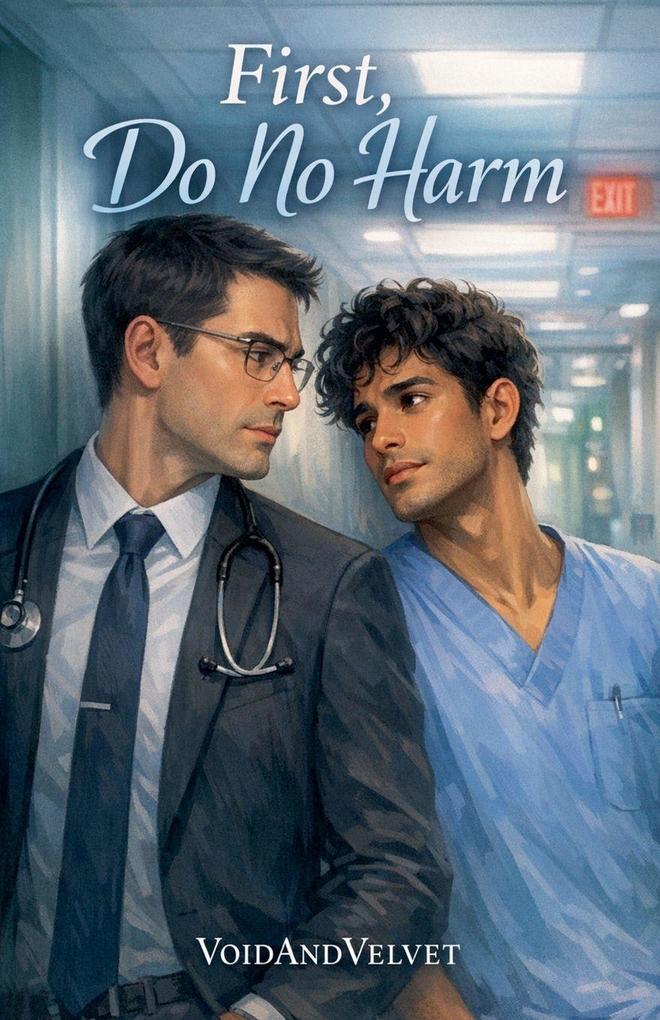
"You have something on your-" He gestured at his own temple. Owen reached up. Something sticky. He looked at his fingers and felt, with perfect clarity, that this was not how he had imagined meeting Dr. Simon Ward for the second time.
It is Owen Castillo's first day as a new resident at St. Aldric's Hospital, and it is already going badly. He arrives eight minutes late, soaks his knee with spilled coffee on the Tube, and somehow catches the cold, precise attention of the hospital's most formidable supervising consultant during orientation - not for something he did wrong, but for being exactly right. One correct answer. One brief exchange that neither of them should have been thinking about afterward.
They were both thinking about it afterward.
Dr. Simon Ward has spent eleven years building a professional life of complete, deliberate control - meticulous, guarded, and exacting in a way that colleagues mistake for coldness and patients mistake for indifference. The truth is simpler and harder: he is a single father protecting a custody arrangement carved out of pain, a man who learned long ago that stability requires the absolute management of risk. New residents are not a risk. He has supervised sixty-three cohorts. He knows exactly how to maintain the distance his position requires.
He has never supervised a resident quite like Owen Castillo.
What follows is not a romance that announces itself. It builds in the spaces hospitals create - the thirty-six-hour shifts that dissolve every carefully maintained boundary, the cup of coffee left on a desk without comment, the precise moment when a supervising consultant mentions a patient's potassium levels that he wasn't obligated to track and that Owen files away in the category of things he doesn't yet have the language to describe. It builds in the way two people who are both very good at understanding things slowly, reluctantly understand each other.
The power imbalance between them is real, and neither of them pretends otherwise. Simon knows exactly why his response to Owen is a category error - a failure of the professional architecture he has built his entire life to maintain. Owen knows exactly how this looks, what it costs, what it could take from Simon if anything went wrong. The question the book asks, quietly and with great patience, is not whether two people can fall in love. It is whether two people who understand all the reasons they shouldn't can find their way to something real without dismantling the things they've worked hardest to protect.
And there is Eli: seven years old, possessed of exact opinions about pasta shapes and earthworm distribution, and absolutely certain about people from the very first moment he meets them.
First, Do No Harm is a slow-burn romance between two men at a prestigious London teaching hospital - emotionally precise, warmly observational, and deeply committed to getting both the medicine and the people exactly right. It is a story about competence and softness, about the architecture of a careful life meeting something it wasn't designed to contain, and about the particular courage it takes to stop managing risk and simply be in something real.