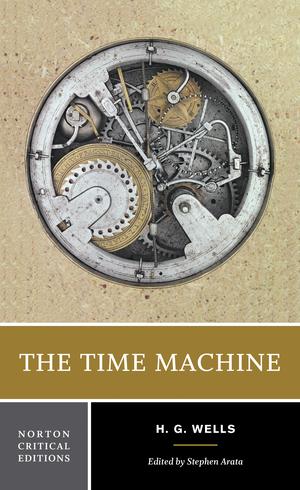
Late in the nineteenth century, a Victorian scientist shows his disbelieving dinner guests a device he claims is a Time Machine. Respectable London scarcely has the imagination to cope with such an idea. But a week later they reconvene to find their friend ragged, exhausted and garrulous. The tale he tells is of the year 802, 701, of life as it is lived in exactly the same spot, in what once had been London. He has visited the future of the human race and encountered beings thar are elfin, beautiful, vegetarian, and leading a life of splendid idleness. But this is not the only lifeform that exists in Eden - for in the tunnels beneath paradise lurks man's darker side.
Intrigued by the possibilities of time travel as a student and inspired as a journalist by the great scientific advances of the Victorian Age, Wells drew on his own scientific publications-on evolution, degeneration, species extinction, geologic time, and biology-in writing The Time Machine. This Norton Critical Edition is based on the first London edition of the novel. It is accompanied by detailed explanatory annotations and "A Note on the Text."
"Backgrounds and Contexts" is organized thematically into four sections: "The Evolution of The Time Machine" presents alternative versions and installments and excerpts of the author's time-travel story; "Wells's Scientific Journalism (1891-94)" focuses on the scientific topics central to the novel; "Wells on The Time Machine" reprints the prefaces to the 1924, 1931, and 1934 editions; and "Scientific and Social Contexts" collects five widely read texts by the Victorian scientists and social critics Edwin Ray Lankester, Thomas Henry Huxley, Benjamin Kidd, William Thomson (Lord Kelvin), and Balfour Stewart and Peter Guthrie Tait.
"Criticism" includes three important early reviews of The Time Machine from the Spectator, the Daily Chronicle, and Pall Mall Magazine as well as eight critical essays that reflect our changing emphases in reading and appreciating this futuristic novel. Contributors include Yevgeny Zamyatin, Bernard Bergonzi, Kathryn Hume, Elaine Showalter, John Huntington, Paul A. Cantor and Peter Hufnagel, Colin Manlove, and Roger Luckhurst.
A Chronology and Selected Bibliography are also included.