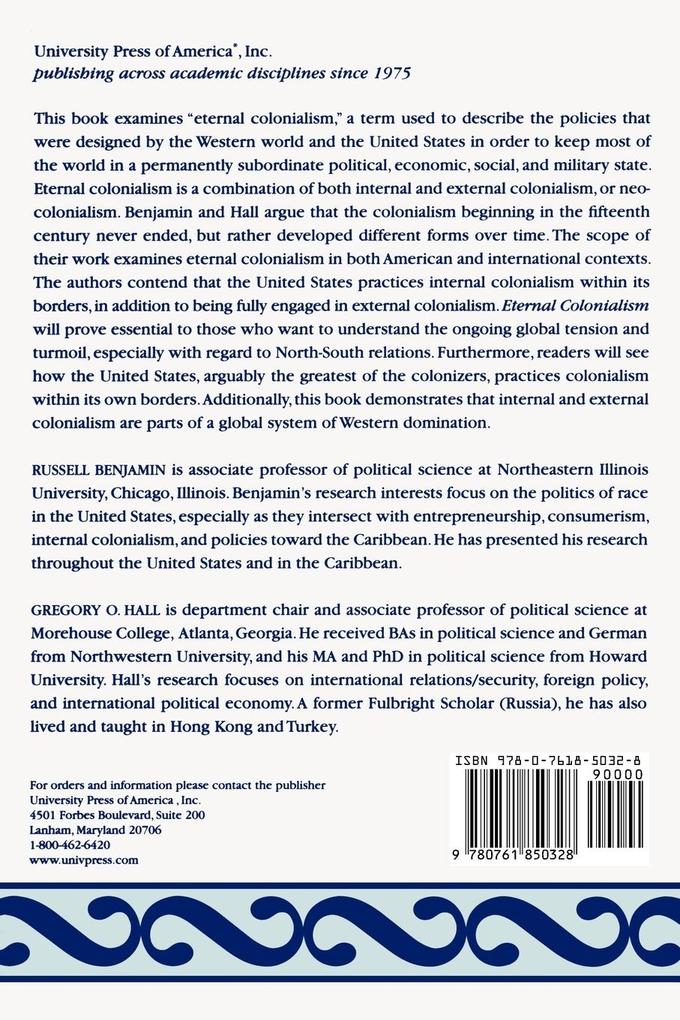
This book examines 'eternal colonialism,' which describes policies designed by the Western world and United States to keep most of the world in a permanently subordinate political, economic, social, and military state. The authors argue that colonialism beginning in the fifteenth century never ended, but developed different forms over time.
Inhaltsverzeichnis
Chapter 1 Acknowledgments
Chapter 2 Introduction
Part 3 Part I. The Domestic Dimension of Eternal Colonialism: Internal Colonialism in the United States
Chapter 4 1: The American Internal Colonial Environment
Chapter 5 2: Going Beyond the Accepted: Black Politics and Enduring Colonialism
Chapter 6 3: The Legacy of U.S. Internal Colonialism and the Struggle for Democracy
Chapter 7 4: Battling Neocolonialism: A Guevarian Model of Social Action
Part 8 Part II. The Global Dimension of Eternal Colonialism: External Colonialism
Chapter 9 5: The New North-South Dealignment in International Relations and the Impact on Regional and Global Affairs
Chapter 10 6: Globalization's Gendered Consequences for the Caribbean
Chapter 11 7: Africa in Fragments: Justice, Politics, and Transformation
Chapter 12 8: Democracy by Coup: A Colonial Legacy? Western Hegemony, Indigenous Sovereignty, and Governance in Mutliethnic Fiji
Chapter 13 9. Conclusion
Chapter 14 Index
Chapter 15 About the Contributors