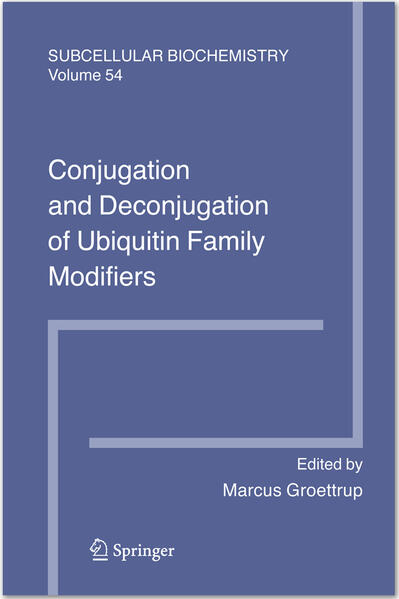
The articles in this book are focused on the modifiers ubiquitin, SUMO1/2/3, NED 8, ISG15 and FAT10. They discuss how conjugation enzymes determine specific linkages and how they are interpreted by ubiquitin binding domains.
1 a a 4 17 10 15 ubiquitin; and of 16 VCP 17 18 20 33 34 34 36 p domain. 41 42 42 43 P U 42 47 binding. C. elegans 16 In 21 22 50 51 52 53 13 and UFD 4 10 of Cdc48. 18 30 of Ufd2. COFACTORS 47 23 13 47 47 47 72 15 15 and of Spt23 p90. Ufd2 and Cdc48. In C. elegans 74 16 75 75 76 76 Ufd2 25 54 54 7 56 p47 7 7 80 30 30 81 82 82 but and CD3 26 DUB COFACTORS 30 UFD3 OTU1 4 Cdc48 30 4 OLE1. 15 27 87 REFERENCES 30 REGULATION OF UBIQUITIN MONOUBIQUITINATION UBIQUITINATION 1 32 7 S) d 33 12 13 14 15 18 19 15 20 21 35 15 15 27 15 31 32 31 33 36 monoubiquitination of pol pol 34 37 34 monoubiquitination. 20 35 trans 3 15 REFERENCES by monoubiquitination. Mol Cell; 2009. UBIQUITIN LIGASE ACTIVITY BY Nedd 1 2 of 41 5 6 8 fold. 9 13 14 edd 43 18 18 K M and k 18 22 23 K M 24 25 K M 26 edd 45 18 27 K M K D 18 25 . 8 10 M 21 28 MECHANISM AND REGULATION OF CRLs 34 41 34 edd 47 48 S. pombe 49 51 p27 and I by SCF and SCF 57 58 59 60 CTD CTD CTD CTD in Cul5 CTD CTD CTD 60 18
Inhaltsverzeichnis
Activation of Ubiquitin and Ubiquitin-Like Proteins. - Control of Ubiquitin Conjugation by Cdc48 and Its Cofactors. - Regulation of Ubiquitin Receptors by Coupled Monoubiquitination. - Control of Cullin-Ring Ubiquitin Ligase Activity by Nedd8. - Control of Deneddylation by the COP9 Signalosome. - Mechanism, Specificity and Structure of the Deubiquitinases. - Ubiquitin Conjugation and Deconjugation in NF-? B Signaling. - Functions of Linear Ubiquitin Chains in the NF-? B Pathway. - Assembly of K11-Linked Ubiquitin Chains by the Anaphase-Promoting Complex. - Ubiquitin Family Members in the Regulation of the Tumor Suppressor p53. - Ubiquitylation in the ERAD Pathway. - Pupylation. - Sumo Control. - The In Vivo Functions of Desumoylating Enzymes. - Regulatory Functions of Ubiquitin and SUMO in DNA Repair Pathways. - Sumoylation as a Signal for Polyubiquitylation and Proteasomal Degradation. - In Vivo Functions of Isgylation. - Identification and Validation of ISG15 Target Proteins. - FAT10.