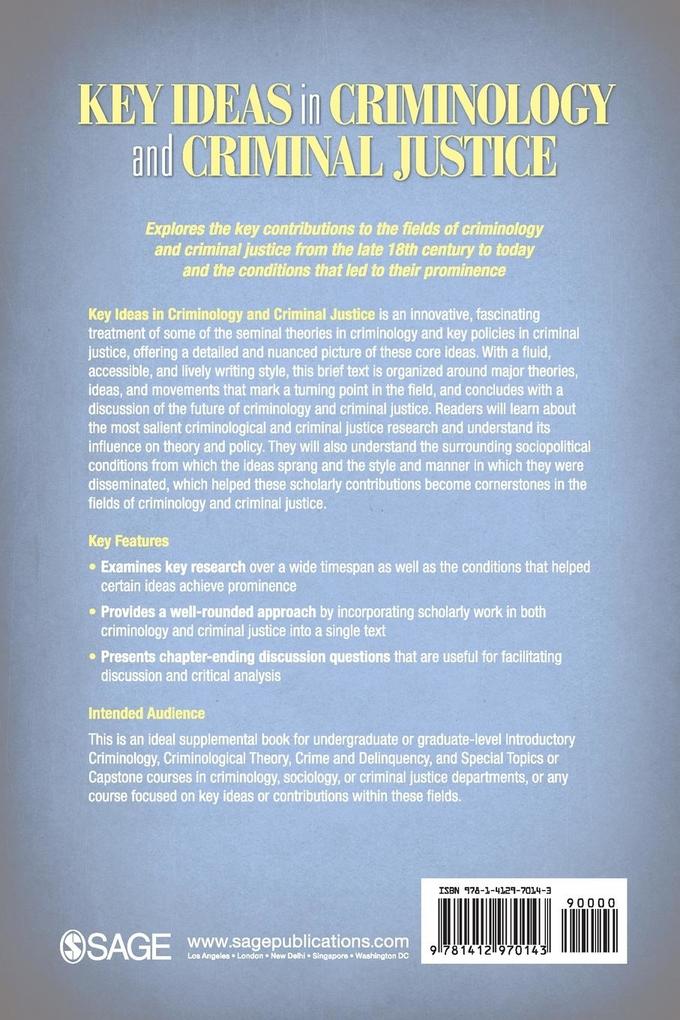
By focusing on key ideas in both criminology and criminal justice, this book brings a new and unique perspective to understanding critical research in criminology and criminal justice -- heretofore, the practice has been to separate criminology and criminal justice. However, given their interconnected nature, this book brings both together cohesively. In going beyond simply identifying and discussing key contributions and their effects by giving students a broader socio-political context for each key idea, this book concretely conceptualizes the key ideas in ways that students will remember and understand.
Inhaltsverzeichnis
1. Introduction
2. Key Idea: Rational Offending and Rational Punishment
The Social Context of Criminal Punishment
Beccaria's Proposal
Why it Caught On
Influence: The Rise of the Classical School of Criminology
Empirical Analyses and Critiques of Free Will, Rationality, and Deterrence
3. Key Idea: The Science of Criminal Behavior
The Social Context: A Time Without Criminology
The Road to Lombroso
Lombroso and the Body of the Criminal
The Dissemination of Lombroso's Theories
Criticisms of Lombroso's Theories
Lombroso's Influence
4. Key Idea: Understanding Crime and Society
The Social Context of the Early Twentieth Century
Social Disorganization and Anomie/Strain Theories
Rejecting Individualism
The Legacy of Anomie/Strain and Social Disorganization Theories
5. Key Idea: Hirschi's Social Bond/Social Control Theory
The Social Context of the 1960s
Social Bond/Social Control Theory
The Marketing of Social Bond/Social Control Theory
The Legacy of Social Bond/Social Control Theory
6. Key Idea: Rehabilitation is Dead
The Martinson Report
Social Context
Getting the Word Out
The Influence of the Martinson Report
7. Key Idea: Crime Control Through Selective Incapacitation
The Context: Criminology, Criminal Justice Policy, and Society in the 1970s
James Q. Wilson's Thinking About Crime
Why it Caught on
Selective Incapacitation's Effect on Criminal Justice and Criminology: Empirical Tests, Empirical Critiques, and Ethical Dilemmas
8. Key Idea: The Police Can Control Crime
The Context of Criminology and Policing
Broken Windows Theory: Revamping the Police Role
How Broken Windows Theory Reached its Audience
The Influence of Broken Windows Theory
Empirical Tests and Critiques of Broken Windows Theory and Policing
9. Key Idea: The War on Drugs
Winning the War is Easy - Just Say No!
The 1980s in Context
The Magic in "Just Say No"
The Impact of "Just Say No"
10. Key Idea: Rehabilitation-Not Dead Yet
The Principles of Risk, Need, and Responsivity
Social Context
Disseminating the Principles of Effective Rehabilitation
The Impact of Meta-Analysis and the Principles of Effective Rehabilitation
11. Key Idea: Crime and the Life Course
The Criminological Context of the Early 1990s
Life Course Theories in Criminology
Constructing Testable Theories
Life Course Theory Catches On
12. Looking Back, Looking Forward: Conclusions
Looking Back: The Glaring Omissions?
The Legitimate Contenders
Looking Forward: The Future of Criminology and Criminal Justice