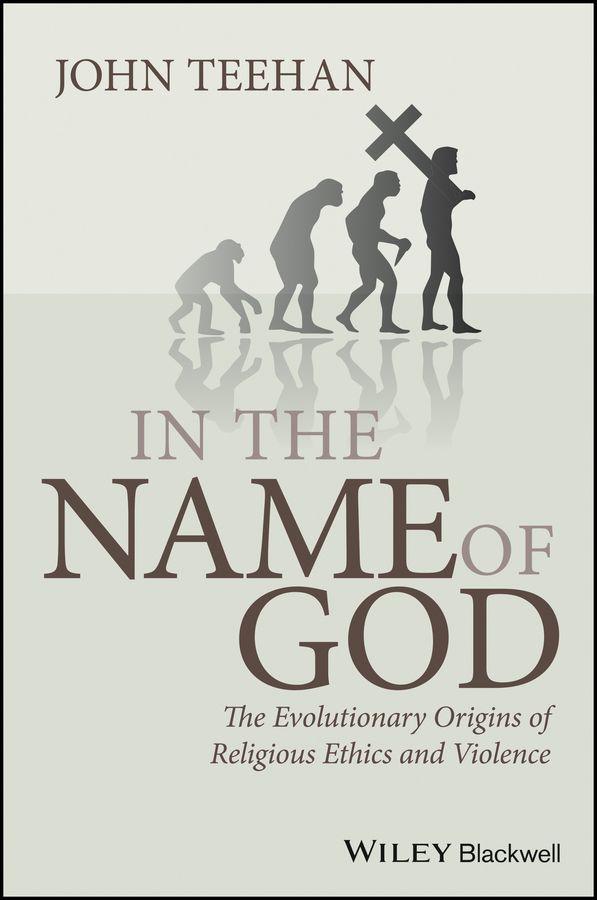
"In terms of specifically "religious" expressions of social solidarity. His account of the dynamics of varying coalitions of them and us would be compatible with, and perhaps even mildly supplement, the standard social scientific understanding of the sources of group violence, for example, in international relations". (Times Literary Supplement, 17 December 2010) "On the whole, this is a fascinating book, an easy recommendation and good, accessible read." (Metapsychology, January 2011) "Teehan (Hofstra) examines the shadow side of religious morality from the perspective of evolutionary psychology. As he indicates, violence grounded in religious communities is not simply an aberration of morality; rather, religious moral systems evolve so as to preserve cultural "fitness" according to Darwinian principles of inheritance, variation, and competition. Morality evolves naturally, as boundaries between in-groups and out-groups create preferences for those on the inside while eliminating competition from outside threats--with violence, if necessary. Such religious exclusivity is problematic in all three monotheistic traditions. Teehan calls for a more pragmatic approach to enlarge the sphere of moral concern, proposing, for example, that people be introduced to alternative religious worldviews that promote critical discussions of religion. Although the two chapters on Judaism and Christianity provide carefully nuanced analyses of the roots of religious violence, the author devotes only five pages to an exploration of the roots of violence in Islam. Since 911 1 is so central to Teehan's analysis, one wonders why he did not undertake a more complete analysis of Islam using his theory of evolved morality. This is an exceedingly provocative study and one that merits careful attention from general readers and scholars alike." (CHOICE, December 2010)"This is an exceedingly provocative study and one that merits careful attention from general readers and scholars alike. Summing Up: Highly recommended. Lower-level undergraduates through researchers/faculty; general readers." (Choice (American Library Assoc.), 1 December 2010) "This is an excellent book. It gives a good summary of current scientific understanding of evolution of morality and religion. It discusses religious violence as the other side of the moral coin. And there is a useful discussion of the problem of religion in modern society and ways we can overcome the negative aspects of our evolved moral and cognitive systems." (Open Parachute, July 2010) "Drawing on evolutionary assumptions and evidence, Teehan (religion, Hofstra Univ.) argues that religion can be understood within the context of the natural development of human moral systems ... .He succinctly and helpfully summarizes his evolutionary approach to the origins of human religiousness. Then he uses it to analyze the (Jewish) Ten Commandments and the (Christian) ethical teachings of Jesus and, finally, to show that religious violence is inherent in the in-group/out-group nature of religion itself. Teehan's naturalism is commendable ... .An informative ... study, best for specialists." (Library Journal, July 2010) “Teehan … offers provocative discussion about the role of these exciting sub-disciplines of psychology in explaining religion and violence. Teehan illustrates that we can come to some very similar conclusions by using a secular approach to religious violence. In sum, this book is very useful in exploring the potential of evolutionary psychology in explaining religious violence." (Free Inquiry, August/September 2010)