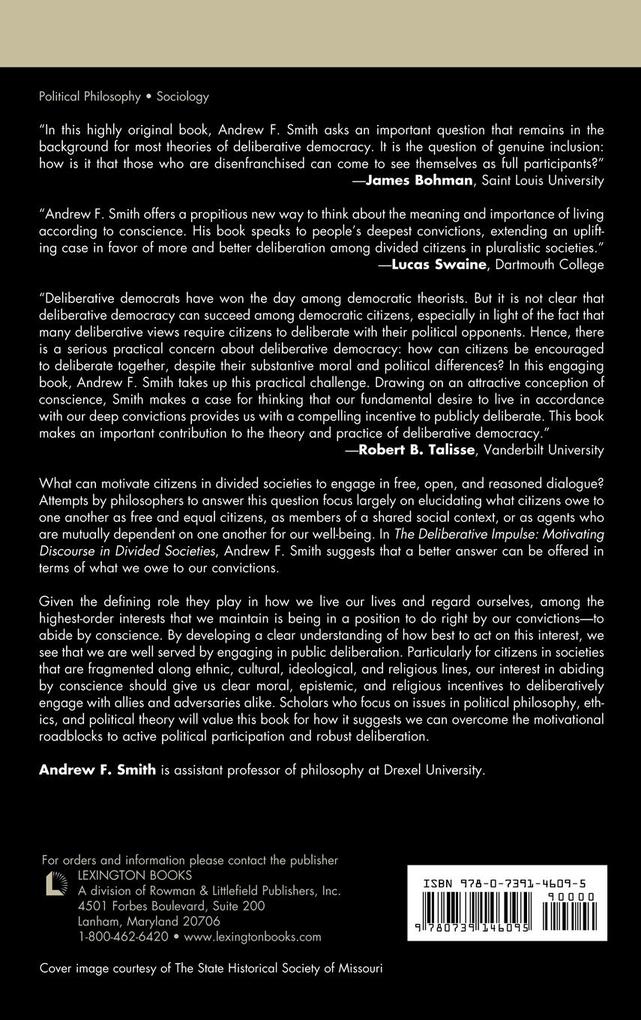
Andrew F. Smith argues that citizens of divided societies have three powerful incentives to engage in public deliberation_in free, open, and reasoned dialogue aimed at contributing to the establishment of well-developed laws. When contesting for political influence, or pursuing the enshrinement of one's convictions in law, deliberating publicly is a necessary condition for taking oneself to be a responsible moral, epistemic, and religious agent.
Inhaltsverzeichnis
Chapter 1 Preface
Chapter 2 Chapter 1. Introduction: On the Deliberative Impulse
Chapter 3 Chapter 2. In Defense of Abiding by Conscience
Chapter 4 Chapter 3. Catalysts of Conflict and the Facilitation of Deliberation
Chapter 5 Chapter 4. Liberty of Conscience and Discursive Control: On the Moral Incentive to Deliberate Publicly
Chapter 6 Chapter 5. Doubt, Insistence, and Validation: On the Epistemic Incentives to Deliberate Publicly
Chapter 7 Chapter 6. Commitment, Criticism, and Restraint: On a Religious Incentive to Deliberate Publicly
Chapter 8 Epilogue