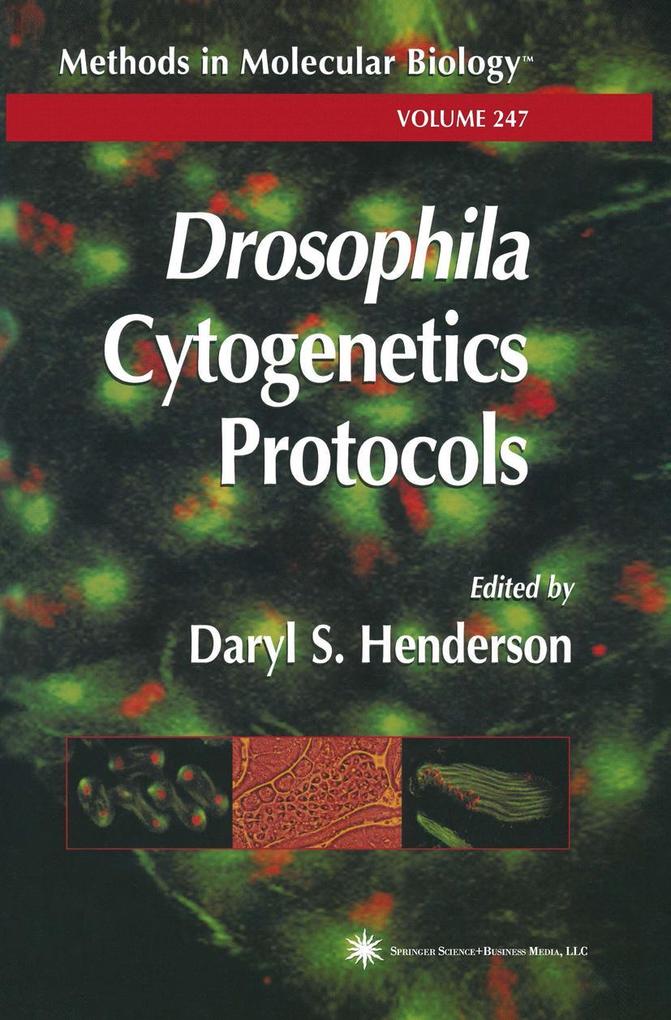
Leading drosophilists describe in step-by-step detail all the essential techniques for studying Drosophila chromosomes and suggest new avenues for scientific exploration. The chapters emphasize specimen preparation (from dissection to mounting) and cover both polytene and mitotic/meiotic chromosomes in depth. Each fully tested and readily reproducible protocol offers a background introduction, equipment and reagent lists, and tips on troubleshooting and avoiding pitfalls. A cutting-edge FISH and immunolocalization technique will be important for discovering how DNA sequence influences higher-order chromosome architecture and ultimately gene expression.
Probably no single experimental organism has contributed as much to our understanding of the structure, function, and mechanism of transmission of eukaryotic chromosomes as has the fruit fly, Drosophila melanogaster. In Drosophila Cytogenetics Protocols, leading drosophilists describe, in step-by-step detail, all the essential techniques for studying Drosophila chromosomes and suggest new avenues for scientific exploration. General areas covered include analyses of nuclei and chromosomes in spermatogenesis and oogenesis, fluorescence-activated cell sorting of ovarian follicle cells, analyses of nuclear division cycles in embryos, and analyses of programmed cell death. In addition, there are conventional light-, electron-, and immunofluorescence-microscopic analyses of polytene chromosomes; cytological analyses of larval brains, imaginal discs, and histoblasts; and nonfluorescent and fluorescent in situ hybridization (FISH) to both polytene and mitotic chromosomes. A cutting-edge combined FISH and immunolocalization protocol will be important for discovering how DNA sequence influences higher-order chromosome architecture and ultimately gene expression. Each readily reproducible protocol offers a background introduction, equipment and reagent lists, and tips on troubleshooting and avoiding pitfalls.
Readily accessible and highly practical, Drosophila Cytogenetics Protocols provides a comprehensive cytogenetics laboratory manual for Drosophila investigators, one that is suitable not only for novices, but also highly informative for seasoned investigators.
Inhaltsverzeichnis
The Chromosomes of Drosophila melanogaster. - Spermatogenesis. - Time-Lapse Imaging of Male Meiosis by Phase-Contrast and Fluorescence Microscopy. - Immunocytological Analysis of Oogenesis. - Cytological Analysis of Oogenesis. - Polytene Chromosomes From Ovarian Nurse Cells of Drosophila melanogaster otu Mutants. - Feulgen-DNA Cytophotometry for Estimating C Values. - Fluorescent BrdU Labeling and Nuclear Flow Sorting of the Drosophila Ovary. - Studying Nuclear Organization in Embryos Using Antibody Tools. - Whole-Mount Fluorescence In Situ Hybridization to Chromosomes of Embryos. - Orcein Staining and the Identification of Polytene Chromosomes. - Salivary Chromosome Analysis of Aberrations. - In Situ Hybridization to Polytene Chromosomes. - Combined Immunostaining and FISH Analysis of Polytene Chromosomes. - Electron Microscopy of Polytene Chromosomes. - Analysis of Mitosis in Squash Preparations of Larval Brains. - Analyzing Chromosome Function by High Frequency Formation of Dicentric Chromosomes In Vivo. - Analysis of Chromosomes of the Larval CNS by FISH and BrdU Labeling. - Immunostaining of Squash Preparations of Chromosomes of Larval Brains. - Visualizing Mitosis in Whole-Mount Larval Brains. - Immunostaining of Whole-Mount Imaginal Discs. - Wing Somatic Mutation and Recombination Test. - Analysis of Histoblasts. - Visualizing Apoptosis. - RNAi in Cultured Drosophila Cells.