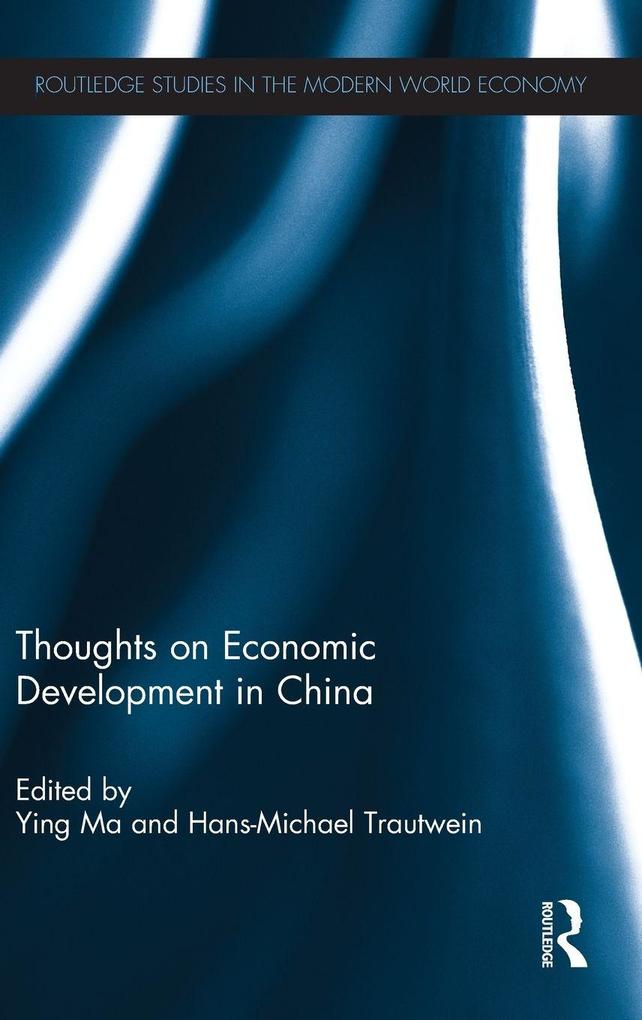
This book is about mutual influences of thinking about economic development in China and in the West, from the 18th century until the present. Its chapters are contributed by development economists and historians of thought from China and other parts of the world.
Inhaltsverzeichnis
1. Introduction, Ying Ma and Hans-Michael Trautwein 2. Physiocracy and the Chinese Model: Was Europe Borrowing from Chinese Political Economy?, Stephan Gaarsmand Jacobsen 3. The Reception of Adam Smith in East Asia: A Comparative Perspective, Qunyi Liu 4. Commodities, Natural Resources and Growth: A Study through the History of Economics, Mauro Boianovsky 5. Yan Fu, Individualism and Social Order: Translating Western Ideas at the Dawn of the 20th Century, Yang Cui and Evelyn Forget 6. Three Influent Western Thinkers during the Breakup Period in China: Eucken, Bergson and Dewey, Gilles Campagnolo 7. Chinese Tradition Meets Western Economics: Tang Qingzeng and his Legacy, Olga Borokh 8. He Lian, a Founder and Practitioner of Chinization of Western Economics: A Study with a Focus on his Activities at the Nankai Institute of Economics, Jianbo Zhou, Liu Yang and Jingyu Feng 9. Chinese Economics Students in America - with a Focus on Doctoral Dissertations prior to 1949, Jinwen Zou and Lizhi Song 10. Development Theory and Transition, Massimo Ricottilli 11. Thirty Years of Disputes on China's Economic Reform, Xibao Guo and Ping Zhang 12. Northian Perspectives on China's Economic Reform, Weisen Li and Hans Michael Trautwein 13. Chinese Reform and Schools of Thought in Western Economics: Chicago School versus Principal Agent Theory, Matthias Klaes and Yi Zhang 14. The East Asian Development Model Reconsidered: Which Lessons for China?, Yongqin Wang 15. The Changing Status of Western Economics in China, Fuqian Fang 16. The Transmission of Heterodox Economics in China, 1949-2009, Lin Zhang and Yingli Xu