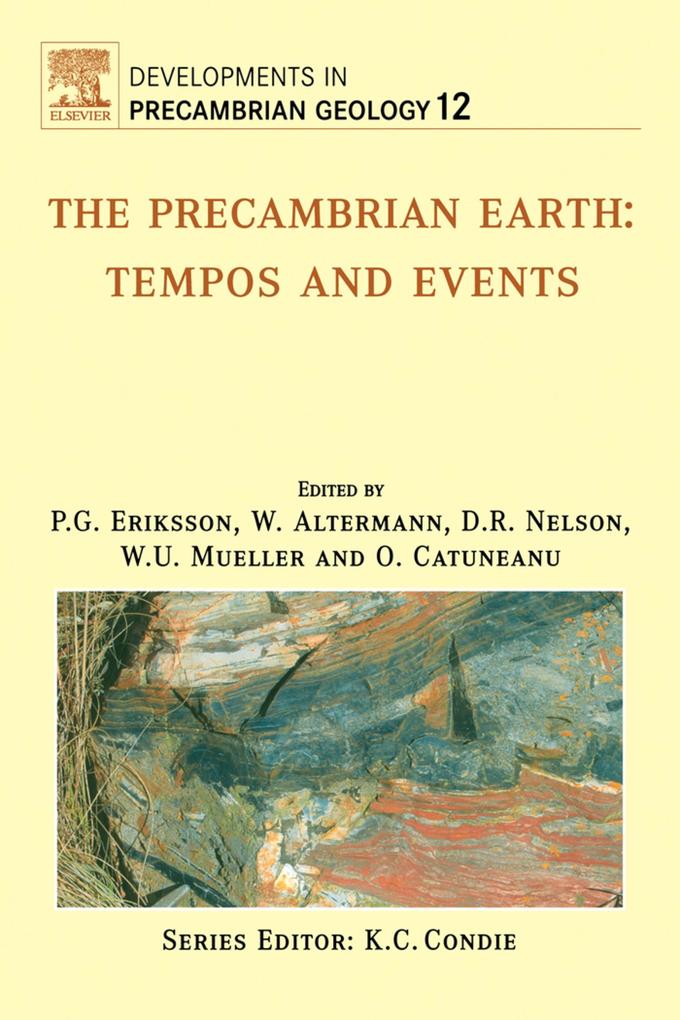
In this book the editors strive to cover all primary (i. e. non-applied) topics in Precambrian geology in a non-partisan way, by using a large team of international authors to present their datasets and highly divergent viewpoints. The chapters address: celestial origins of Earth and succeeding extraterrestrial impact events; generation of continental crust and the greenstone-granite debate; the interaction of mantle plumes and plate tectonics over Precambrian time; Precambrian volcanism, emphasising komatiite research; evolution and models for Earth's hydrosphere and atmosphere; evolution of life and its influence on Precambrian ocean chemistry and chemical sedimentation; sedimentation through Precambrian time; the application of sequence stratigraphy to the Precambrian rock record. Each topic is introduced and a non-partisan closing commentary provided at the end of each chapter. The final chapter blends the major geological events and rates at which important processes occurred into a synthesis, which postulates a number of "event clusters" in the Precambrian when significant changes occurred in many natural systems and geological environments. Also available in paperback, ISBN: 0-444-51509-7
Inhaltsverzeichnis
1;Front Cover;1 2;The Precambrian Earth: Tempos and Events;4 3;Copyright Page;5 4;Contents;12 5;Contributing Authors;6 6;PREFACE;18 7;Chapter 1. THE EARLY EARTH;26 7.1;1.1. Introduction;26 7.2;1.2. Earth's Formation and First Billion Years;28 7.3;1.3. The Early Precambrian Stratigraphic Record of Large Extraterrestrial Impacts;52 7.4;1.4. Strategies for Finding the Record of Early Precambrian Impact Events;70 7.5;1.5. Commentary;87 8;Chapter 2. GENERATION OF CONTINENTAL CRUST;90 8.1;2.1. Introduction;90 8.2;2.2. Isua Enigmas: Illusive Tectonic, Sedimentary, Volcanic and Organic Features of the > 3.7 Ga Isua Greenstone Belt, Southwest Greenland;91 8.3;2.3. Geochemical Diversity in Volcanic Rocks of the > 3.7 Ga Isua Greenstone Belt, Southern West Greenland: Implications for Mantle Composition and Geodynamic Processes;99 8.4;2.4. Abitibi Greenstone Belt Plate Tectonics: The Diachrononous History of Arc Development, Accretion and Collision;113 8.5;2.5. Granite Formation and Emplacement as Indicators of Archaean Tectonic Processes;128 8.6;2.6. Diapiric Processes in the Formation of Archaean Continental Crust, East Pilbara GraniteGreenstone Terrane, Australia;143 8.7;2.7. Early Archaean Crustal Collapse Structures and Sedimentary Basin Dynamics;164 8.8;2.8. Crustal Growth Rates;180 8.9;2.9. Commentary;183 9;Chapter 3. TECTONISM AND MANTLE PLUMES THROUGH TIME;186 9.1;3.1. Introduction;186 9.2;3.2. Precambrian Superplume Events;188 9.3;3.3. Large Igneous Province Record through Time;198 9.4;3.4. Episodic Crustal Growth During Catastrophic Global-Scale Mantle Overturn Events;205 9.5;3.5. An Unusual Palaeoproterozoic Magmatic Event, the Ultrapotassic Christopher Island Formation, Baker Lake Group, Nunavut, Canada: Archaean Mantle Metasomatism and Palaeoproterozoic Mantle Reactivation;208 9.6;3.6. A Commentary on Precambrian Plate Tectonics;226 9.7;3.7. Precambrian Ophiolites;238 9.8;3.8. The Limpopo Belt of Southern Africa: A Neoarchaean to Palaeoproterozoic Orogen;242 9.9;3
.9. Geodynamic Crustal Evolution and Long-Lived Supercontinents During the Palaeoproterozoic: Evidence from GranuliteGneiss Belts, Collisional and Accretionary Orogens;248 9.10;3.10. Formation of a Late Mesoproterozoic Supercontinent: The South AfricaEast Antarctica Connection;265 9.11;3.11. A Mechanism for Explaining Rapid Continental Motion in the Late Neoproterozoic;280 9.12;3.12. Commentary;292 10;Chapter 4. PRECAMBRIAN VOLCANISM: AN INDEPENDENT VARIABLE THROUGH TIME;296 10.1;4.1. Introduction;296 10.2;4.2. Terminology of Volcaniclastic and Volcanic Rocks;298 10.3;4.3. Komatiites: Volcanology, Geochemistry and Textures;302 10.4;4.4. Archaean and Proterozoic Greenstone Belts: Setting and Evolution;336 10.5;4.5. Explosive Subaqueous Volcanism;359 10.6;4.6. Archaean Calderas;370 10.7;4.7. Commentary;381 11;Chapter 5. THE EVOLUTION OF THE PRECAMBRIAN ATMOSPHERE: CARBON ISOTOPIC EVIDENCE FROM THE AUSTRALIAN CONTINENT;384 11.1;5.1. Introduction;384 11.2;5.2. Archaean Atmosphere, Hydrosphere and Biosphere;386 11.3;5.3. Evolution of the Precambrian Atmosphere: Carbon Isotopic Evidence from the Australian Continent;413 11.4;5.4. Precambrian Iron-Formation;428 11.5;5.5. The Precambrian Sulphur Isotope Record of Evolving Atmospheric Oxygen;446 11.6;5.6. Earth's Two Great Precambrian Glaciations: Aftermath of the "Snowball Earth" Hypothesis;465 11.7;5.7. The Paradox of Proterozoic Glaciomarine Deposition, Open Seas and Strong Seasonality Near the Palaeo-Equator: Global Implications;473 11.8;5.8. Neoproterozoic Sedimentation Rates and Timing of GlaciationsA Southern African Perspective;484 11.9;5.9. Earth's Precambrian Rotation and the Evolving Lunar Orbit: Implications of Tidal Rhythmite Data for Palaeogeophysics;498 11.10;5.10. Ancient Climatic and Tectonic Settings Inferred from Palaeosols Developed on Igneous Rocks;507 11.11;5.11. Aggressive Archaean Weathering;519 11.12;5.12. Commentary;530 12;Chapter 6. EVOLUTION OF LIFE AND PRECAMBRIAN BIO-GEOLOGY;538 12.1;6.1. Introd
uction;538 12.2;6.2. Earth's Earliest Biosphere: Status of the Hunt;541 12.3;6.3. Evolving Life and Its Effect on Precambrian Sedimentation;564 12.4;6.4. Microbial Origin of Precambrian Carbonates: Lessons from Modern Analogues;570 12.5;6.5. Precambrian Stromatolites: Problems in Definition, Classification, Morphology and Stratigraphy;589 12.6;6.6. Precambrian Geology and Exobiology;600 12.7;6.7. Commentary;612 13;Chapter 7. SEDIMENTATION THROUGH TIME;618 13.1;7.1. Introduction;618 13.2;7.2. Sedimentary Structures: An Essential Key for Interpreting the Precambrian Rock Record;627 13.3;7.3. Archaean Sedimentary Sequences;638 13.4;7.4. Discussion of Selected Techniques and Problems in the Field Mapping and Interpretation of Archaean Clastic Metasedimentary Rocks of the Superior Province, Canada;650 13.5;7.5. Precambrian Tidalites: Recognition and Significance;656 13.6;7.6. Sedimentary Dynamics of Precambrian Aeolianites;667 13.7;7.7. Early Precambrian Epeiric Seas;682 13.8;7.8. Precambrian Rivers;685 13.9;7.9. Microbial Mats in the Siliciclastic Rock Record: A Summary of Diagnostic Features;688 13.10;7.10. Microbial Mat Features in Sandstones Illustrated;698 13.11;7.11. Sedimentation Rates;700 13.12;7.12. Commentary;702 14;Chapter 8. SEQUENCE STRATIGRAPHY AND THE PRECAMBRIAN;706 14.1;8.1. Introduction;706 14.2;8.2. Concepts of Sequence Stratigraphy;710 14.3;8.3. Development and Sequences of the Athabasca Basin, Early Proterozoic, Saskatchewan and Alberta, Canada;730 14.4;8.4. Third-Order Sequence Stratigraphy in the Palaeoproterozoic Daspoort Formation (Pretoria Group, Transvaal Supergroup), Kaapvaal Craton;749 14.5;8.5. Commentary;760 15;Chapter 9. TOWARDS A SYNTHESIS;764 15.1;9.1. Evolution of the Solar System and the Early Earth;764 15.2;9.2. Generation of Continental Crust;768 15.3;9.3. Tectonism and Mantle Plumes through Time;772 15.4;9.4. Precambrian Volcanism, an Independent Variable;774 15.5;9.5. Evolution of the Hydrosphere and Atmosphere;776 15.6;9.6. Evolut
ion of Precambrian Life and Bio-Geology;780 15.7;9.7. Sedimentation Regimes through Time;783 15.8;9.8. Sequence Stratigraphy through Time;786 15.9;9.9. Tempos and Events in Precambrian Time;787 16;References;796 17;Subject Index;948