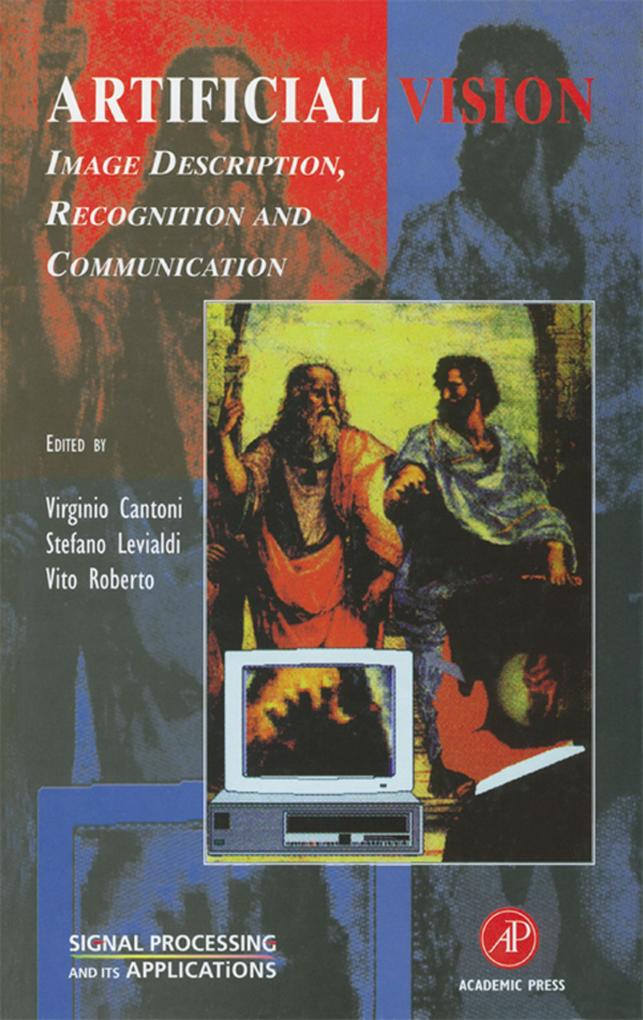
Artificial Vision is a rapidly growing discipline, aiming to build computational models of the visual functionalities in humans, as well as machines that emulate them. Visual communication in itself involves a numberof challenging topics with a dramatic impact on contemporary culture where human-computer interaction and human dialogue play a more and more significant role.
This state-of-the-art book brings together carefully selected review articles from world renowned researchers at the forefront of this exciting area. The contributions cover topics including image processing, computational geometry, optics, pattern recognition, and computer science. The book is divided into three sections. Part I covers active vision; Part II deals with the integration of visual with cognitive capabilities; and Part III concerns visual communication.
Artificial Vision will be essential reading for students and researchers in image processing, vision, and computer science who want to grasp the current concepts and future directions of this challenging field.
This state-of-the-art book brings together selected review articles and accounts of current projects from world-renowned researchers at the forefront of this exciting area. The contributions cover topics such as:
- Psychology of perception
- Image processing
- Computational geometry
- Visual knowledge representation and languages
It is this truly multi-disciplinary approach that has produced successful theories and applications for the subject.
Inhaltsverzeichnis
1;Cover;1 2;Contents;8 3;Series Preface;6 4;Contributors;10 5;Preface;14 6;Part I: Active Vision;16 6.1;Chapter 1. Attentional Engagement in Vision Systems;18 6.2;Chapter 2. Attentional Mechanisms in Computer Vision;58 6.3;Chapter 3. The Active Vision Idea;68 6.4;Chapter 4. Active Model Acquisition and Sensor Planning;80 6.5;Chapter 5. The Regularization of Early Vision;102 7;Part II: Integrating Visual Modules;120 7.1;Chapter 6. Geometric Modelling and Spatial Reasoning;122 7.2;Chapter 7. Vision as Uncertain Knowledge;150 7.3;Chapter 8. Distributed Systems for Fusion of Visual Information;176 7.4;Chapter 9. Hybrid Computation and Reasoning for Artificial Vision;208 8;Part III: Visual Communication;240 8.1;Chapter 10. Illusion and Difference;242 8.2;Chapter 11. Computing with/on Images;254 8.3;Chapter 12. Visual Databases;282 8.4;Chapter 13. Visual Languages for Tele-action Objects;296 9;Index;318