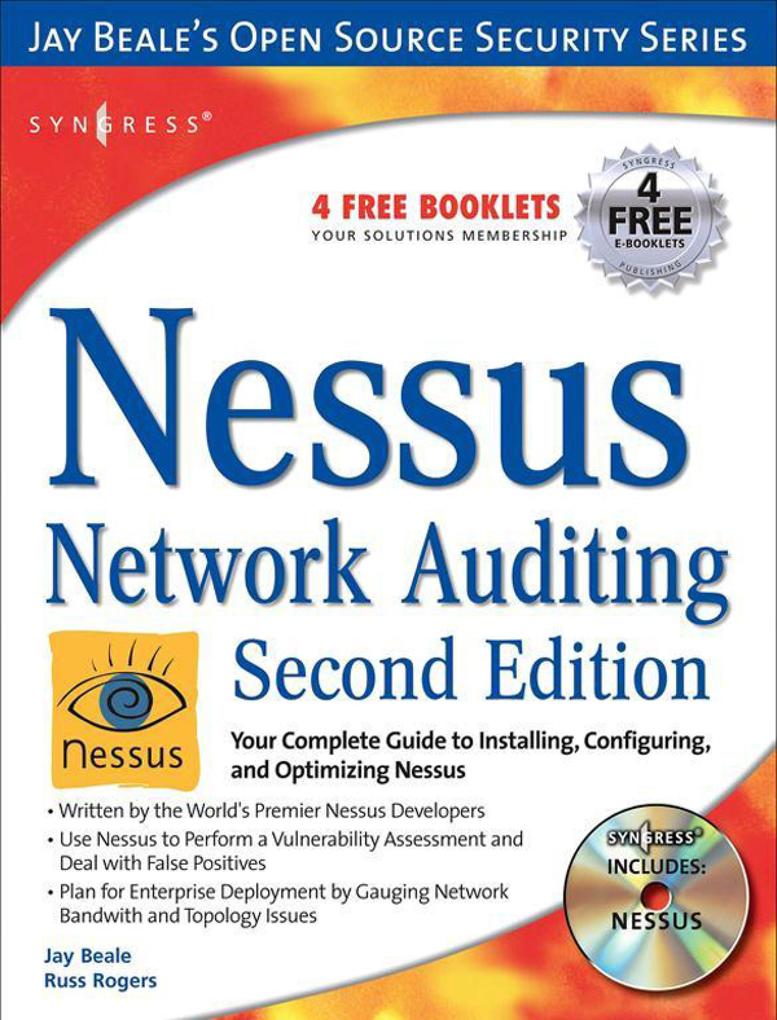
The Updated Version of the Bestselling Nessus Book. This is the ONLY Book to Read if You Run Nessus Across the Enterprise. Ever since its beginnings in early 1998, the Nessus Project has attracted security researchers from all walks of life. It continues this growth today. It has been adopted as a de facto standard by the security industry, vendor, and practitioner alike, many of whom rely on Nessus as the foundation to their security practices. Now, a team of leading developers have created the definitive book for the Nessus community. Perform a Vulnerability AssessmentUse Nessus to find programming errors that allow intruders to gain unauthorized access. Obtain and Install NessusInstall from source or binary, set up up clients and user accounts, and update your plug-ins. Modify the Preferences TabSpecify the options for Nmap and other complex, configurable components of Nessus. Understand Scanner Logic and Determine Actual RiskPlan your scanning strategy and learn what variables can be changed. Prioritize VulnerabilitiesPrioritize and manage critical vulnerabilities, information leaks, and denial of service errors. Deal with False PositivesLearn the different types of false positives and the differences between intrusive and nonintrusive tests. Get Under the Hood of NessusUnderstand the architecture and design of Nessus and master the Nessus Attack Scripting Language (NASL). Scan the Entire Enterprise NetworkPlan for enterprise deployment by gauging network bandwith and topology issues.
- Nessus is the premier Open Source vulnerability assessment tool, and has been voted the "most popular" Open Source security tool several times.
- The first edition is still the only book available on the product.
- Written by the world's premier Nessus developers and featuring a foreword by the creator of Nessus, Renaud Deraison.
Inhaltsverzeichnis
1;Fornt Cover;1 2;Nessus Network Auditing, Second Edition;2 3;Copyright Page;3 4;Technical Editor;4 5;Contributing Authors;5 6;Contents;8 7;Chapter 1: Vulnerability Assessment;16 7.1;Introduction;17 7.2;What Is a Vulnerability Assessment?;17 7.2.1;Why a Vulnerability Assessment?;18 7.2.2;Assessment Types;20 7.2.2.1;Host Assessments;20 7.2.2.2;Network Assessments;21 7.3;Automated Assessments;22 7.3.1;Stand-Alone vs. Subscription;22 7.3.2;The Assessment Process;23 7.3.2.1;Detecting Live Systems;24 7.3.2.2;Identifying Live Systems;24 7.3.2.3;Enumerating Services;24 7.3.2.4;Identifying Services;26 7.3.2.5;Identifying Applications;26 7.3.2.6;Identifying Vulnerabilities;27 7.3.2.7;Reporting Vulnerabilities;27 7.4;Two Approaches;28 7.4.1;Administrative Approach;29 7.4.2;The Outsider Approach;30 7.4.3;The Hybrid Approach;30 7.5;Realistic Expectations;32 7.6;Summary;36 7.7;Solutions Fast Track;37 7.8;Frequently Asked Questions;38 8;Chapter 2: Introducing Nessus;40 8.1;Introduction;41 8.2;What Is It?;41 8.3;The De Facto Standard;42 8.4;History;44 8.5;Basic Components;46 8.5.1;Client and Server;46 8.5.2;The Plugins;49 8.5.3;The Knowledge Base;50 8.6;Summary;51 8.7;Solutions Fast Track;51 8.8;Frequently Asked Questions;53 9;Chapter 3: Installing Nessus;54 9.1;Introduction;55 9.2;Nessus Version Comparison;55 9.3;Picking a Server;56 9.3.1;Supported Operating Systems;57 9.3.2;Minimal Hardware Specifications;58 9.3.3;Network Location;59 9.4;Nessus 2.2.x Install Guide;60 9.4.1;Nessus Install Script;60 9.4.2;Installation from Source;64 9.4.3;./configure;64 9.5;Nessus 3 Install Guide;68 9.5.1;Mac OS X Install Process;68 9.5.2;UNIX Install Process;72 9.5.3;Fresh Installation;72 9.5.3.1;Red Hat and SUSE;72 9.5.3.2;Debian;73 9.5.3.3;Solaris;73 9.5.3.4;FreeBSD;73 9.5.4;Upgrading from Nessus 2;73 9.6;Configuring Nessus for UNIX;74 9.6.1;Creating a User Account;76 9.6.2;Windows Install Process;79 9.7;Final Steps;82 9.8;Installing a Client;89 9.9;Summary;91 9.10;Solutions Fast Track;91 9.11;
Frequently Asked Questions;93 10;Chapter 4: Running Your First Scan;94 10.1;Introduction;95 10.2;Preparing for Your First Scan;95 10.2.1;Authorization;95 10.2.2;Risk vs. Benefit;96 10.2.2.1;Denial of Service;96 10.2.2.2;Missing Information;97 10.2.2.3;Providing Authentication Information;97 10.2.2.4;Plugin Selection;98 10.3;Starting the Nessus Client;98 10.4;Policies;102 10.4.1;Policy Tab;104 10.4.2;Options Tab;104 10.4.3;Credentials Tab;109 10.4.4;Plugin Selection Tab;112 10.4.5;Network Tab;116 10.4.6;Advanced Tab;118 10.5;Target Selection;130 10.6;Starting the Scan;134 10.7;Nessus Command Line;137 10.8;Summary;139 10.9;Solutions Fast Track;139 10.10;Frequently Asked Questions;142 11;Chapter 5: Interpreting Results;144 11.1;Introduction;145 11.2;The Nessus UI Basics;145 11.2.1;Viewing Results Using the Nessus 3 Client for Linux/UNIX and Windows;145 11.2.1.1;Using the Basic Report Viewer;146 11.2.1.2;Saving and Exporting to Other Formats;147 11.2.1.3;Loading and Importing Reports;151 11.3;Reading a Nessus Report;153 11.3.1;Understanding Vulnerabilities;153 11.3.2;Understanding Risk;154 11.3.3;Understanding Scanner Logic;156 11.3.4;Key Report Elements;159 11.3.4.1;Asking the Right Questions;165 11.4;Factors that Can Affect Scanner Output;169 11.4.1;Plugin Selection;169 11.4.2;The Role of Dependencies;170 11.4.3;Safe Checks;170 11.4.4;no404.nasl;171 11.4.5;Ping the Remote Host;172 11.4.6;Portscanner Settings;172 11.4.7;Proxies, Firewalls, and TCP Wrappers;172 11.4.8;Valid Credentials;173 11.4.9;KB Reuse and Differential Scanning;173 11.4.10;And Many More...;173 11.4.11;Scanning Web Servers and Web Sites;174 11.4.12;Web Servers and Load Balancing;174 11.4.13;Bugs in the Plugins;175 11.4.14;Additional Reading;176 11.4.15;Configuration Files;176 11.4.16;NASL;178 11.4.17;The Nessus KB;178 11.4.18;The Nessus Logs;178 11.5;Forums and Mailing Lists;179 11.6;Summary;180 11.7;Solutions Fast Track;180 11.8;Frequently Asked Questions;182 12;Chapter 6: Vulnerability Types;184 12.
1;Introduction;185 12.2;Critical Vulnerabilities;185 12.2.1;Buffer Overflows;187 12.2.2;Directory Traversal;188 12.2.3;Format String Attacks;189 12.2.4;Default Passwords;190 12.2.5;Misconfigurations;191 12.2.6;Known Backdoors;191 12.3;Information Leaks;192 12.3.1;Memory Disclosure;193 12.3.2;Network Information;194 12.3.3;Version Information;194 12.3.4;Path Disclosure;195 12.3.5;User Enumeration;196 12.4;Denial of Service;196 12.5;Best Practices;198 12.6;Summary;200 12.7;Solutions Fast Track;200 12.8;Frequently Asked Questions;202 13;Chapter 7: False Positives;204 13.1;Introduction;205 13.2;What Are False Positives?;205 13.2.1;A Working Definition of False Positives;205 13.3;Why False Positives Matter;208 13.3.1;False Positives Waste Your Time;208 13.3.2;False Positives Waste Others' Time;208 13.3.3;False Positives Cost Credibility;209 13.3.4;Generic Approaches to Testing;209 13.3.4.1;An Overview of Intrusive Scanning;209 13.3.4.2;An Overview of Nonintrusive Scanning;210 13.3.5;The Nessus Approach to Testing;211 13.4;Dealing with False Positives;213 13.4.1;Dealing with Noise;214 13.4.2;Analyzing the Report;215 13.4.3;False Positives, and Your Part in Their Downfall;218 13.5;Dealing with a False Positive;218 13.5.1;Disabling a Nessus Plugin;219 13.5.1.1;Disabling a Plugin with Nessus 3;219 13.5.1.2;Disabling a Plugin Under Unix;223 13.5.1.3;Marking a Result as a False Positive with NessusWX;226 13.5.2;False Positives and Web Servers-Dealing with Friendly 404s;228 13.6;Summary;231 13.7;Solutions Fast Track;231 13.8;Frequently Asked Questions;232 14;Chapter 8: Under the Hood;234 14.1;Introduction;235 14.2;Nessus Architecture and Design;236 14.3;Host Detection;239 14.4;Service Detection;243 14.5;Information Gathering;246 14.6;Vulnerability Fingerprinting;249 14.7;Denial-of-Service Testing;251 14.8;Putting It All Together;253 14.9;Summary;259 14.10;Solutions Fast Track;259 14.11;Frequently Asked Questions;261 15;Chapter 9: The Nessus Knowledge Base;262 15.1;Introduction;
263 15.2;Knowledge Base Basics;263 15.2.1;What Is the Knowledge Base?;263 15.2.1.1;A word about the "Policy.xml" file;264 15.2.2;Where the Knowledge Base Is Stored;265 15.2.3;Using the Knowledge Base;266 15.3;Information Exchange;274 15.3.1;How Plugins Use the Knowledge Base to Share Data;274 15.3.2;The Type of Data that Is Stored;282 15.3.3;Dependency Trees;283 15.4;Limitations;283 15.4.1;Using get_kb_item and fork;283 15.5;Summary;287 15.6;Solutions Fast Track;287 15.7;Frequently Asked Questions;289 16;Chapter 10: Enterprise Scanning;290 16.1;Introduction;291 16.2;Planning a Deployment;291 16.2.1;Define Your Needs;291 16.2.1.1;Planning;291 16.2.1.2;Preparation;294 16.2.1.3;Segmentation;295 16.2.2;Network Topology;296 16.2.3;Bandwidth Requirements;298 16.2.3.1;Portscanning Phase;299 16.2.3.2;Testing Phase;301 16.2.4;Automating the Procedure;303 16.3;Configuring Scanners;306 16.3.1;Assigning the Tasks;306 16.3.2;System Requirements;308 16.3.3;Scanning for a Specific Threat;311 16.3.4;Best Practices;313 16.3.4.1;Divide and Conquer;313 16.3.4.2;Segregate and Limit;313 16.3.4.3;Certificates for the Forgetful;314 16.3.4.4;Speed Is Not Your Enemy;314 16.3.4.5;Keep a Watchful Eye;315 16.4;Data Correlation;315 16.4.1;Combining Reports;315 16.4.1.1;Preparing Your Database;315 16.5;Differential Reporting;322 16.6;Filtering Reports;331 16.7;Third-Party Tools;333 16.7.1;Extracting Information from a Saved Session Prior to Version 2.2.0 of Nessusd Using sd2nbe;333 16.7.2;Nessus Integration with Perl and Net::Nessus::ScanLite Prior to Version 3.0.0;333 16.7.3;Nessus NBE Report Parsing Using Parse::Nessus::NBE;335 16.8;Common Problems;335 16.8.1;Aggressive Scanning;335 16.8.2;Volatile Applications;336 16.8.3;Printer Problems;338 16.8.4;Scanning Workstations;339 16.9;Summary;341 16.10;Solutions Fast Track;341 16.11;Frequently Asked Questions;343 17;Chapter 11: NASL;346 17.1;Introduction;347 17.2;Why NASL?;347 17.2.1;Why Do You Want to Write (and Publish) Your Own NASL Scripts?;350
17.3;Structure of a NASL Script;350 17.3.1;The Description Section;351 17.4;An Introduction to the NASL Language;355 17.4.1;Writing Your First Script;356 17.4.1.1;Assuming that the FTP Server Is Listening on Port 21;362 17.4.1.2;Establishing a Connection to the Port Directly;363 17.4.1.3;Respecting the FTP Protocol;363 17.4.1.4;Wrapping It Up;364 17.5;More Advanced Scripting;365 17.5.1;String Manipulation;365 17.5.1.1;How Strings Are Defined in NASL;365 17.5.1.2;String Addition and Subtraction;366 17.5.1.3;String Search and Replace;366 17.5.2;Regular Expressions in NASL;366 17.6;The NASL Protocol APIs;368 17.6.1;HTTP;368 17.6.2;FTP;370 17.6.3;NFS;370 17.6.4;Other Protocol API Libraries;372 17.7;The Nessus Knowledge Base;376 17.8;Summary;377 17.9;Solutions Fast Track ;377 17.10;Frequently Asked Questions;379 18;Chapter 12: The Nessus User Community;380 18.1;Introduction;381 18.2;The Nessus Mailing Lists;382 18.2.1;Subscribing to a Mailing List;383 18.2.2;Sending a Message to a Mailing List;386 18.2.3;Accessing a List's Archives;387 18.3;The Online Plug-In Database;389 18.3.1;Staying Abreast of New Plug-Ins;391 18.4;Reporting Bugs via Bugzilla;391 18.4.1;Querying Existing Bug Reports;391 18.4.2;Creating and Logging In to a Bugzilla Account;394 18.4.3;Submitting a Bug Report;396 18.5;Submitting Patches and Plug-Ins;399 18.5.1;Submitting Patches;399 18.5.2;Submitting Plug-Ins;399 18.6;Where to Get More Information and Help;400 18.7;Summary;401 18.8;Solutions Fast Track;401 18.9;Frequently Asked Questions;403 19;Chapter 13: Compliance Monitoring with Nessus 3;406 19.1;Introduction;407 19.2;Understanding Compliance;407 19.2.1;HIPAA;408 19.2.2;Payment Card Industry (PCI);408 19.2.3;FERPA;408 19.2.4;NERC;409 19.2.5;ISO/IEC 27002:2005;409 19.2.6;NIST 800 Series;409 19.3;The Nessus Compliance Engine;409 19.3.1;Compliance with Nessus;410 19.3.2;Types of audits;410 19.3.3;.audit Files;411 19.3.3.1;How .audit Files Work;413 19.3.3.2;Examples;413 19.4;Using Nessus 3 Auditing;417
19.4.1;Updating Nessus 3 Plugins;417 19.4.2;Creating a New Policy;419 19.4.3;Starting Your Audit;429 19.5;Nessus 3 Reporting;431 19.6;Summary;437 19.7;Solutions Fast Track;437 19.8;Frequently Asked Questions;439 20;Index;440