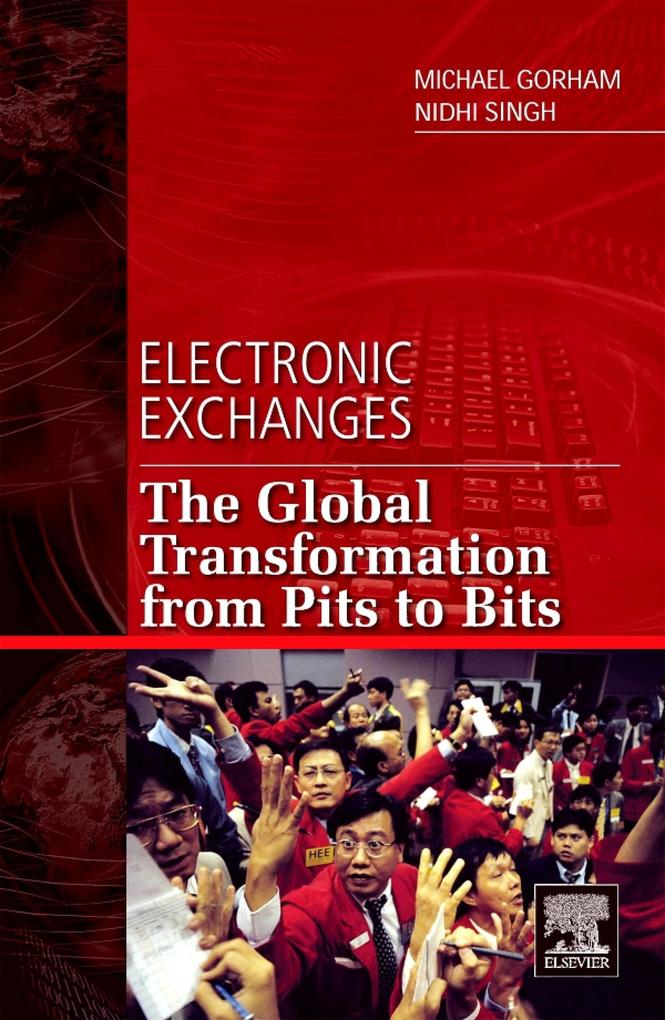
Anyone reading the business section of a newspaper lately knows that the financial exchanges--stock, bonds, FX, commodities, and so forth--are undergoing tremendous transformations. Fund managers, market makers, traders, exchange professionals, marekt data providers and analyzers, investors--anyone involved with the financial exchanges needs to understand the major forces pushing this transformation in order to position themselves and their institutions to the best advantage. In this book, veteran exchange expert Michael Gorham joins his twenty-five years of experience with CME and CBOT to the technical expertise of Nidhi Singh of Goldman Sachs to write a book that tells the story of this dramatic transformation. They chronicle the shift:--from floors to screens--from private clubs to public companies, and--from local and national to global competition. They analyze each of these shifts, identify the drivers behind them and look forward to the implications arising out of them for exchange business in the future. They also explore several key trends:--an increase in product innovation--the integration of markets from all over the world onto a single screen, --the rise of the modular exchange--the outsourcing of various exchange functions, and--the difficulty of transcending geography for regulatory purposes. So join Gorham and Singh in learning the story of this fundamental transformation. As old ways of working are being destroyed, entirely new types of jobs are being created, and new ways of working with exchanges. This book will help you chart the way forward to financial success.
- Gorham is an exchange expert and Singh is an electronic trading expert, they combine their expertise to reveal the inner workings of the exchanges and where they will go in the future
- Only book to point to new skills needed and new ways of making money for users of exchange services
Inhaltsverzeichnis
1;Front cover;1 2;Half title page;2 3;Title page;4 4;Copyright page;5 5;Dedication;6 6;Table of contents;8 7;Acknowledgments;14 8;1 An Era of Creative Destruction;16 8.1;Introduction;16 8.2;Trading: Simple Concept, Complex Process;17 8.3;The Birth of Exchanges;18 8.4;Open Outcry Trading;20 8.5;The Clearing and Settlement Process;22 8.6;Technology and Its Impact on Financial Markets;25 8.7;The Decade that Changed the Financial World;27 8.8;The First Electronic Market;28 8.9;Electronic Communication Networks and U.S. Equity Markets;29 8.10;Technology Advances in the Financial Industry;30 8.11;Outsourcing;35 8.12;The Transformation of Exchanges: Basic Themes;36 8.13;Implications of the Transformation;39 8.14;Endnotes;40 9;Part One: The Four Basic Transformations;42 9.1;2 From Floor to Screen: The Electronic Pioneers;44 9.1.1;Introduction;44 9.1.2;OM: The First Successful Screen-Based Exchange;50 9.1.3;Melbourne Tries Screens12;52 9.1.4;SOFFEX: Unexpectedly Electronic;52 9.1.5;DTB: The Other Half of the Worlds Biggest Exchange;53 9.1.6;SOFFEX + DTB = Eurex;56 9.1.7;SAFEX: An Electronic Success from an Unexpected Corner of the World19;57 9.1.8;Asian Early Adopters;58 9.1.9;Conclusion;61 9.1.10;Endnotes;61 9.2;3 Floor to Screen: The Second Wave;64 9.2.1;Introduction;64 9.2.2;Late Arrivals Get Absorbed;65 9.2.3;Last to the Party;70 9.2.4;GLOBEX;72 9.2.5;Stock Exchanges Move to Screens;81 9.2.6;Conclusion;91 9.2.7;Endnotes;92 9.3;4 Floors to Screens: Nuts and Bolts;94 9.3.1;The Financial Trade Cycle;94 9.3.2;Electronic Trading Architecture;96 9.3.3;Side-by-Side and Hybrid Systems;102 9.3.4;The CBOEs Hybrid System6;102 9.3.5;New Players Solidifying the Single-Screen Concept;105 9.3.6;Endnotes;105 9.4;5 From Private Club to Public Company;108 9.4.1;Introduction;108 9.4.2;The Member-Owned Exchange: The Good, the Bad, and the Ugly;108 9.4.3;The Last Step: The IPO;134 9.4.4;Conclusion;135 9.4.5;Endnotes;135 9.5;6 From National to Global Competition;140 9.5.1;Securities vs. Deriv
atives Exchanges: Fees and Revenues;145 9.5.2;Local to Regional Competition;146 9.5.3;Competition and Clearing;147 9.5.4;Competition in Options;150 9.5.5;Global Competition: The Past;153 9.5.6;The New Global CompetitionKill the Competitor;159 9.5.7;Conclusion;167 9.5.8;Endnotes;167 9.6;7 Smaller to Larger: Through Organic Growth and M&A;170 9.6.1;Organic Growth: New Contracts;170 9.6.2;Organic Growth: New Users;175 9.6.3;Growth via Mergers and Acquisitions;176 9.6.4;The New Era of Exchange M&A;181 9.6.5;The Future;192 9.6.6;Endnotes;193 10;Part Two: Implications of the Four Basic Transformations;196 10.1;8 A New Wave of Product Innovation;198 10.1.1;Innovation Acceleration in Futures Products;200 10.1.2;The Old World: Launching New Products on Trading Floors;201 10.1.3;The New World: Launching New Products on Electronic Exchanges;204 10.1.4;Some Things Havent Changed;207 10.1.5;Regulatory Change Drives Product Innovation;208 10.1.6;The Rest of the World;212 10.1.7;A Note on Innovations in Equities;215 10.1.8;Conclusion;217 10.1.9;Endnotes;218 10.2;9 Building Modular Exchanges via Partnerships and Outsourcing;220 10.2.1;Modular Exchange: Building Blocks;221 10.2.2;CBOT: Cautious Migration by Outsourcing Technology;223 10.2.3;Partnership with Eurex: First Alliance;224 10.2.4;Partnership with LIFFE;225 10.2.5;The Final Move;227 10.2.6;The Rise and Fall of Eurex Us: Outsourcing Technology and Services;227 10.2.7;Battle in the Energy Markets;230 10.2.8;NYMEX: Outsourcing New Product Listing;232 10.2.9;Leasing Technology;232 10.2.10;Early Pioneers: Technology Providers;233 10.2.11;Collaboration: Blurring the Lines between Exchanges;233 10.2.12;Leasing Clearing Services;235 10.2.13;Collocation;236 10.2.14;CME and LNET;238 10.2.15;The Modern Modular Exchange;239 10.2.16;Endnotes;239 10.3;10 Regulators: Leadership and Reaction;242 10.3.1;Introduction;243 10.3.2;The Electronic Driver and Overall Regulatory Design;245 10.3.3;Screen-Based Trading and the Concept of Regulation b
y Principle;246 10.3.4;Regulation and the Evolving Architecture of Markets;249 10.3.5;Private Club to Public Company;254 10.3.6;Ownership and Governance of For-Profit, Demutualized Markets;255 10.3.7;Globalization and the Accelerating Effect of Electronic Technology;260 10.3.8;Global Competition and Mergers and Acquisitions48;264 10.3.9;The Attraction of the Federal Model;264 10.3.10;Implications of Market Conglomerates for Further Regulatory Integration;265 10.3.11;National Interests;266 10.3.12;A Word about Regulatory Structure and Philosophy;267 10.3.13;Conclusion;269 10.3.14;Endnotes;269 10.4;11 Electronic Exchanges and Trading: Benefits;276 10.4.1;Globalization: Bringing the World Closer Together;277 10.4.2;Surge in Volume;280 10.4.3;Volume Growth around the World;282 10.4.4;Innovative Products Increasing Growth;285 10.4.5;Data, Data, and More Data;285 10.4.6;Risk Management;290 10.4.7;Competition;291 10.4.8;Automated Trading: Replacing Humans;295 10.4.9;Conclusion;299 10.4.10;Endnotes;300 10.5;12 Electronic Exchanges and Trading: Challenges;302 10.5.1;Dependency on Each Other;303 10.5.2;Technology Glitches;303 10.5.3;The Impact of Real-Time Data Availability;309 10.5.4;Inefficiency: Out-Trades in the Electronic Trading World;313 10.5.5;Endnotes;317 10.6;13 The Future of Financial Markets;320 10.6.1;Exchange Consolidation;320 10.6.2;In Response to Exchange Consolidation;322 10.6.3;Transparency and Speed;323 10.6.4;Partnership and Alliances;325 10.6.5;Clearing: Next Transformation;326 10.6.6;Global Financial Market for the Next Century;327 10.6.7;Common Platforms;328 10.6.8;Looking Ahead;329 10.6.9;Endnotes;330 11;Appendix A Abbreviations Used;332 12;Appendix B Technology Terminology;336 13;Appendix C Markets Glossary;338 14;Index;342