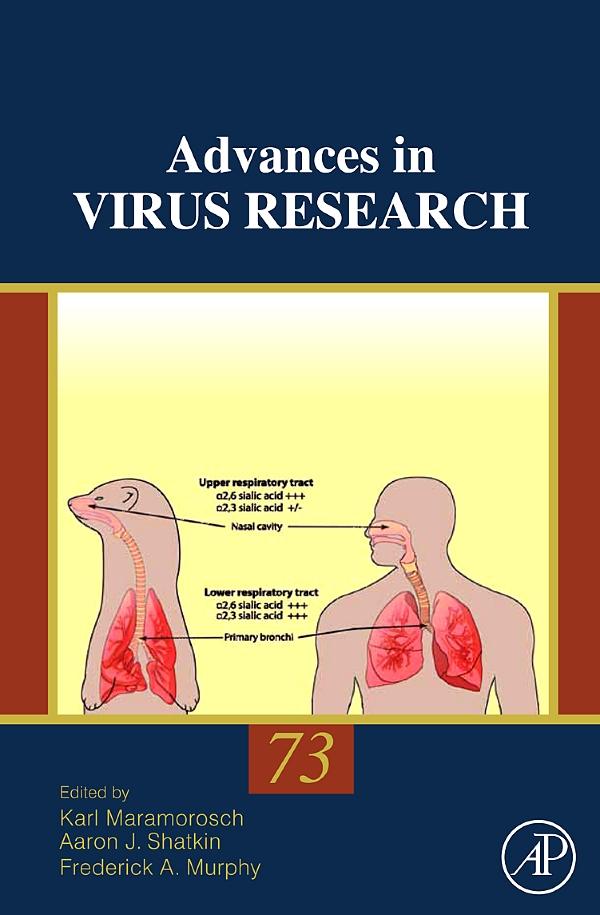
Published since 1953, Advances in Virus Research covers a diverse range of in-depth reviews providing a valuable overview of the current field of virology. The impact factor for 2007 is 3. 120, placing it 9th in the highly competitive category of virology.
- Contributions from leading authorities
- Informs and updates on all the latest developments in the field
Inhaltsverzeichnis
1;Front Cover ;1 2;Advances in Virus Research ;4 3;Copyright Page ;5 4;Contents ;6 5;Chapter 1: Looking Back in 2009 at the Dawning of Antiviral Therapy Now 50 Years Ago: An Historical Perspective ;8 5.1;I. Introduction ;10 5.2;II. Thiosemicarbazones: The First Antiviral Drugs Found Active Against the Poxvirus Vaccinia Virus ;11 5.3;III. Renaissance of the Poxvirus Inhibitors: Antiviral Drugs Against a Bioterrorist Poxvirus (Variola Virus) Attack ;13 5.4;IV. Benzimidazole Derivatives: Second Attempt to Launch the Antiviral Chemotherapy Era ;15 5.5;V. Renaissance of the Benzimidazole Derivatives: Now Turning into Lead Candidates for the Treatment of Human CMV Infections ;18 5.6;VI. 5-Substituted 2'-Deoxyuridines: Idoxuridine (IDU) and Trifluridine (TFT), the Third and Definitive Attempt to Unleash Antiviral Chemotherapy ;20 5.7;VII. 5-Substituted 2'-Deoxyuridines: IDU (and TFT) as the Starting Point(s) for Other 5-Substituted 2'-Deoxyuridines, that is, BVDU [(E)-5-(2-Bromovinyl)-2'-Deoxyuridine] ;22 5.8;VIII. Arabinosyladenine (ara-A), Originally Conceived as an Antitumor Agent, the First Antiviral Drug Licensed and Used for Systemic Treatment ;23 5.9;IX. Acyclovir: The Start of the Selective Antiviral Chemotherapy Era, and Still the ``Gold Standard for HSV Therapy ;25 5.10;X. Anti-influenza Virus Therapy: A First Attempt (DRB), Followed by a Second (Amantadine) and a Third Attempt (Neuraminidase Inhibitors) ;27 5.11;XI. Ribavirin and Interferon, Two ``Old-Timers, Joining Forces in the Treatment of a Relatively New Disease, Hepatitis C ;29 5.12;XII. (S)-9-(2,3-Dihydroxypropyl)adenine (DHPA), the First Acyclic Adenosine Analog, Leading to S-Adenosylhomocysteine (SAH) Hydrol Inhibitors as Broad-Spectrum Antiviral Agents ;30 5.13;XIII. (S)-9-(2,3-Dihydroxypropyl)adenine (DHPA) Leading to the First Acyclic Nucleoside Phosphonate, (S)-9-(3-hydroxy-2-phosphonylmethoxypropyl)Adenine (HPMPA), As a Broad-Spectrum Antiviral Agent ;32 5.14;XIV. 9-(2-Phosphonylmethoxyethyl)adeni
ne (PMEA), the Sister Compound of HPMPA ;33 5.15;XV. From PMEA (Adefovir) to PMPA (tenofovir): It All Depends on the Substitution of a Methyl Group for a Hydrogen ;35 5.16;XVI. Suramin, the First Antiviral Drug Ever Shown to Inhibit HIV Infection Both in vitro and in vivo ;36 5.17;XVII. The Nucleoside Reverse Transcriptase Inhibitors (NRTIs) with Azidothymidine (AZT) as the Starting Point ;37 5.18;XVIII. The Non-Nucleoside Reverse Transcriptase Inhibitors (NNRTIs), with the HEPT and TIBO Derivatives as the Starting Point ;39 5.19;XIX. The HIV Protease Inhibitors (PIs), Hailed From Their Inception, as Resulting from rational design ;41 5.20;XX. New HIV Inhibitors, Targeted at Either Fusion (Enfuvirtide), Coreceptor usage (maraviroc), or Integrase (Raltegravir) ;47 5.21;XXI. Conclusion ;49 5.22;Acknowledgment;50 5.23;References;50 6;Chapter 2: Use of Animal Models to Understand the Pandemic Potential of Highly Pathogenic Avian Influenza Viruses ;62 6.1;I. Introduction ;63 6.2;II. Influenza A Virus Subtypes and Host Range ;64 6.3;III. Avian Influenza A Virus in Humans ;67 6.4;IV. Use of the Mouse Model to Study Influenza Virus Pathogenesis ;70 6.4.1;A. Mouse model for human influenza A virus pathogenesis ;70 6.4.2;B. Mouse model for H5N1 virus pathogenesis ;72 6.4.3;C. Mouse model for H7 virus pathogenesis ;74 6.4.4;D. Gene knockout mice in the study of avian influenza ;75 6.4.5;E. Tropism of avian influenza viruses ;77 6.5;V. Use of the Ferret Model to Study Influenza Virus Pathogenesis ;78 6.5.1;A. Ferret model for human influenza A virus pathogenesis ;78 6.5.2;B. Ferret model for H5N1 virus pathogenesis ;79 6.5.3;C. Ferret model for H7 virus pathogenesis ;80 6.5.4;D. Transmissibility of avian influenza viruses ;81 6.6;VI. Molecular Basis of Avian Influenza Pathogenesis ;82 6.6.1;A. Hemagglutinin cleavage site ;83 6.6.2;B. Surface glycoproteins (HA and NA) ;84 6.6.3;C. Polymerase complex ;85 6.6.4;D. PB2 protein ;86 6.6.5;E. PB1-F2 protein ;88 6.6.6;F. NS1 protein ;8
8 6.7;VII. Conclusions ;89 6.8;Acknowledgments;91 6.9;References;91 7;Chapter 3: Virus Versus Host Cell Translation: Love and Hate Stories ;106 7.1;I. Introduction ;110 7.2;II. Regulation Prior to Translation ;111 7.2.1;A. Editing ;111 7.2.1.1;1. Editing by nucleotide modification ;111 7.2.1.2;2. Editing by nucleotide addition ;113 7.2.2;B. Splicing ;115 7.2.3;C. Subgenomic RNA synthesis ;117 7.3;III. Initiation of Translation ;118 7.3.1;A. Cap-dependent initiation ;118 7.3.2;B. Closed-loop model or circularization ;119 7.3.3;C. VPg and initiation ;122 7.3.4;D. IRES-directed initiation ;123 7.3.5;E. Non-AUG initiation codons ;126 7.3.6;F. Multiple reading frames ;129 7.3.6.1;1. Leaky scanning ;129 7.3.6.1.1;a. In-frame initiation ;130 7.3.6.1.2;b. Overlapping ORFs ;130 7.3.6.2;2. Reinitiation ;132 7.3.6.3;3. Shunting ;134 7.3.7;G. Modification of cell factors involved in initiation ;135 7.3.7.1;1. Phosphorylation of eIF2alpha ;136 7.3.7.2;2. Modification of eIF4E and 4E-BP ;138 7.3.7.2.1;a. Dephosphorylation of eIF4E and of 4E-BP1 ;139 7.3.7.2.2;b. Phosphorylation of eIF4E and 4E-BP1 ;141 7.3.7.3;3. Modification of eIF4G ;141 7.3.7.3.1;a. Cleavage of eIF4G ;141 7.3.7.3.2;b. Phosphorylation of eIF4G ;142 7.3.7.4;4. Cleavage of PABP ;143 7.3.7.5;5. Substitution of PABP ;143 7.3.7.6;6. Cleavage of PBCP2 ;144 7.4;IV. Elongation of Translation ;144 7.4.1;A. Frameshift ;144 7.4.2;B. Modification of elongation factors ;147 7.5;V. Termination of Translation ;148 7.5.1;A. Readthrough ;148 7.5.2;B. Suppressor tRNAs ;152 7.5.2.1;1. Suppressors of UAG/UAA codons ;152 7.5.2.2;2. Suppressors of UGA codons ;152 7.5.3;C. Binding of release factors ;153 7.6;VI. Conclusions ;153 7.7;Acknowledgments;154 7.8;References;154 8;Index ;178