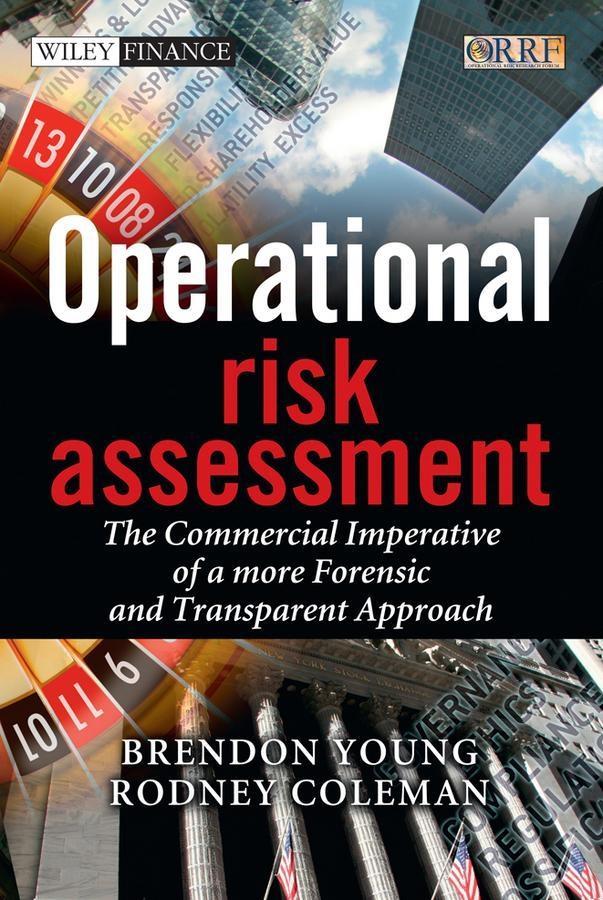
Operational risk assessment
The Commercial Imperative of a More Forensic and Transparent
Approach
Brendon Young and Rodney Coleman
"Brendon Young and Rodney Coleman's book is extremely
timely. There has never been a greater need for the financial
industry to reassess the way it looks at risk. [. . .] They are
right to draw attention to the current widespread practices of risk
management, which [. . .] have allowed risk to become underpriced
across the entire industry."
Rt Hon John McFall MP, Chairman,
House of Commons Treasury Committee
Failure of the financial services sector to properly understand
risk was clearly demonstrated by the recent 'credit crunch'. In its
2008 Global Stability Report, the IMF sharply criticised banks and
other financial institutions for the failure of risk management
systems, resulting in excessive risk-taking. Financial sector
supervision and regulation was also criticised for lagging behind
shifts in business models and rapid innovation.
This book provides investors with a sound understanding of
the approaches used to assess the standing of firms and determine
their true potential (identifying probable losers and potential
longer-term winners). It advocates a 'more forensic' approach
towards operational risk management and promotes transparency,
which is seen as a facilitator of competition and efficiency as
well as being a barrier to fraud, corruption and financial
crime.
Risk assessment is an integral part of informed decision making,
influencing strategic positioning and direction. It is fundamental
to a company's performance and a key differentiator between
competing management teams. Increasing complexity is resulting in
the need for more dynamic, responsive approaches to the assessment
and management of risk. Not all risks can be quantified; however,
it remains incumbent upon management to determine the impact of
possible risk-events on financial statements and to indicate the
level of variation in projected figures.
To begin, the book looks at traditional methods of risk
assessment and shows how these have developed into the approaches
currently being used. It then goes on to consider the more advanced
forensic techniques being developed, which will undoubtedly
increase understanding. The authors identify 'best practice' and
address issues such as the importance of corporate governance,
culture and ethics. Insurance as a mitigant for operational risk is
also considered. Quantitative and qualitative risk assessment
methodologies covered include: Loss-data analysis; extreme value
theory; causal analysis including Bayesian Belief Networks; control
risk self-assessment and key indicators; scenario analysis; and
dynamic financial analysis.
Views of industry insiders, from organisations such as Standard
& Poors, Fitch, Hermes, USS, UN-PRI, Deutsche Bank, and Alchemy
Partners, are presented together with those from experts at the
FSA, the International Accounting Standards Board (IASB), and the
Financial Reporting Council.
In addition to investors, this book will be of interest to
actuaries, rating agencies, regulators and legislators, as well as
to the directors and risk managers of financial institutions in
both the private and public sectors. Students requiring a
comprehensive knowledge of operational risk management will also
find the book of considerable value.