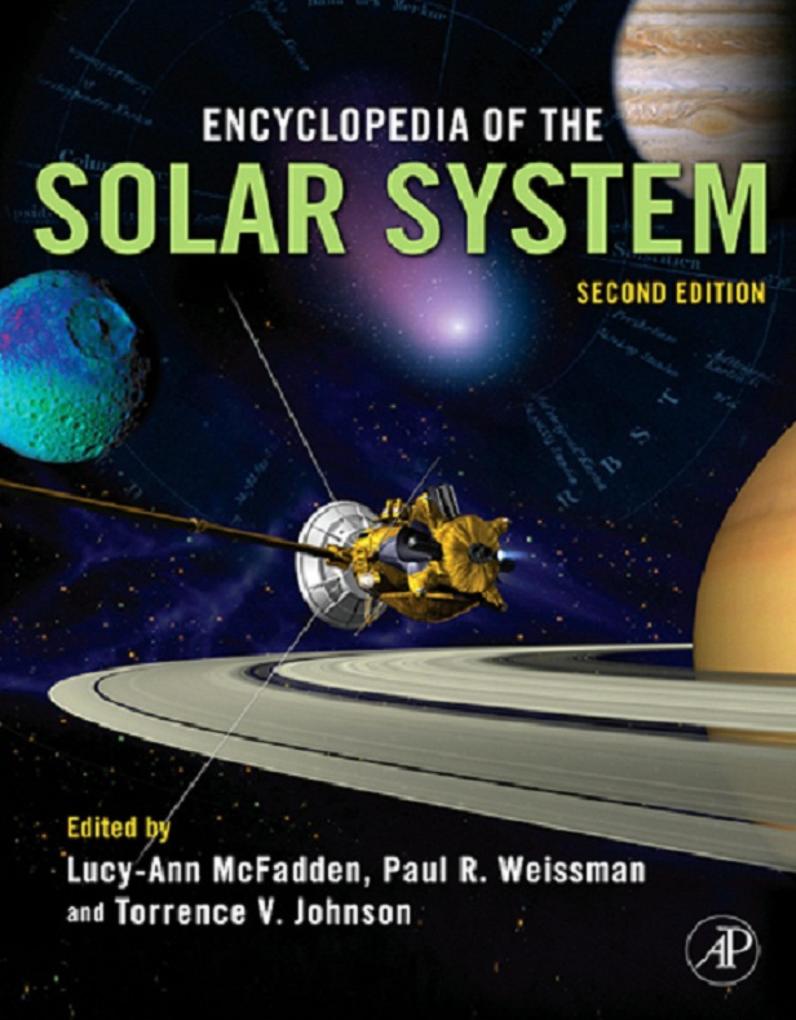
Long before Galileo published his discoveries about Jupiter, lunar craters, and the Milky Way in the Starry Messenger in 1610, people were fascinated with the planets and stars around them. That interest continues today, and scientists are making new discoveries at an astounding rate. Ancient lake beds on Mars, robotic spacecraft missions, and new definitions of planets now dominate the news. How can you take it all in? Start with the new Encyclopedia of the Solar System, Second Edition. This self-contained reference follows the trail blazed by the bestselling first edition. It provides a framework for understanding the origin and evolution of the solar system, historical discoveries, and details about planetary bodies and how they interact-and has jumped light years ahead in terms of new information and visual impact. Offering more than 50% new material, the Encyclopedia includes the latest explorations and observations, hundreds of new color digital images and illustrations, and more than 1, 000 pages. It stands alone as the definitive work in this field, and will serve as a modern messenger of scientific discovery and provide a look into the future of our solar system. · Forty-seven chapters from 75+ eminent authors review fundamental topics as well as new models, theories, and discussions· Each entry is detailed and scientifically rigorous, yet accessible to undergraduate students and amateur astronomers· More than 700 full-color digital images and diagrams from current space missions and observatories amplify the chapters· Thematic chapters provide up-to-date coverage, including a discussion on the new International Astronomical Union (IAU) vote on the definition of a planet· Information is easily accessible with numerous cross-references and a full glossary and index
Inhaltsverzeichnis
1;Front Cover;1 2;Encyclopedia of the Solar System;4 3;Copyright Page;5 4;Contents;6 5;Contributors;10 6;About the Editors;14 7;Foreword;16 8;Preface to the Second Edition;18 9;Preface to the First Edition;20 10;Chapter 1. The Solar System and its Place in the Galaxy;22 11;Chapter 2. The Origin of the Solar System;50 12;Chapter 3. A History of Solar System Studies;74 13;Chapter 4. The Sun;92 14;Chapter 5. The Solar Wind;120 15;Chapter 6. Mercury;138 16;Chapter 7. Venus: Atmosphere;160 17;Chapter 8. Venus: Surface and Interior;170 18;Chapter 9. Earth as a Planet: Atmosphere and Oceans;190 19;Chapter 10. Earth as a Planet: Surface and Interior;210 20;Chapter 11. The SunEarth Connection;234 21;Chapter 12. The Moon;248 22;Chapter 13. Meteorites;272 23;Chapter 14. Near-Earth Objects;304 24;Chapter 15. Mars Atmosphere: History and Surface Interactions;322 25;Chapter 16. Mars: Surface and Interior;336 26;Chapter 17. Mars: Landing Site Geology, Mineralogy, and Geochemistry;352 27;Chapter 18. Main-Belt Asteroids;370 28;Chapter 19. Planetary Satellites;386 29;Chapter 20. Atmospheres of the Giant Planets;404 30;Chapter 21. Interiors of the Giant Planets;424 31;Chapter 22. Io: The Volcanic Moon;440 32;Chapter 23. Europa;452 33;Chapter 24. Ganymede and Callisto;470 34;Chapter 25. Titan;488 35;Chapter 26. Triton;504 36;Chapter 27. Planetary Rings;524 37;Chapter 28. Planetary Magnetospheres;540 38;Chapter 29. Pluto;562 39;Chapter 30. Physics and Chemistry of Comets;578 40;Chapter 31. Comet Populations and Cometary Dynamics;596 41;Chapter 32. Kuiper Belt: Dynamics;610 42;Chapter 33. Kuiper Belt Objects: Physical Studies;626 43;Chapter 34. Solar System Dust;642 44;Chapter 35. X-Rays in the Solar System;658 45;Chapter 36. The Solar System at Ultraviolet Wavelengths;680 46;Chapter 37. Infrared Views of the Solar System from Space;702 47;Chapter 38. The Solar System at Radio Wavelengths;716 48;Chapter 39. New Generation Ground-Based Optical/ Infrared Telescopes;740 49;Chapter 40. Plane
tary Radar;756 50;Chapter 41. Remote Chemical Sensing Using Nuclear Spectroscopy;786 51;Chapter 42. Solar System Dynamics: Regular and Chaotic Motion;808 52;Chapter 43. Planetary Impacts;834 53;Chapter 44. Planetary Volcanism;850 54;Chapter 45. Astrobiology;870 55;Chapter 46. Planetary Exploration Missions;890 56;Chapter 47. Extrasolar Planets;908 57;Appendix;924 58;Glossary;940 59;Index;960