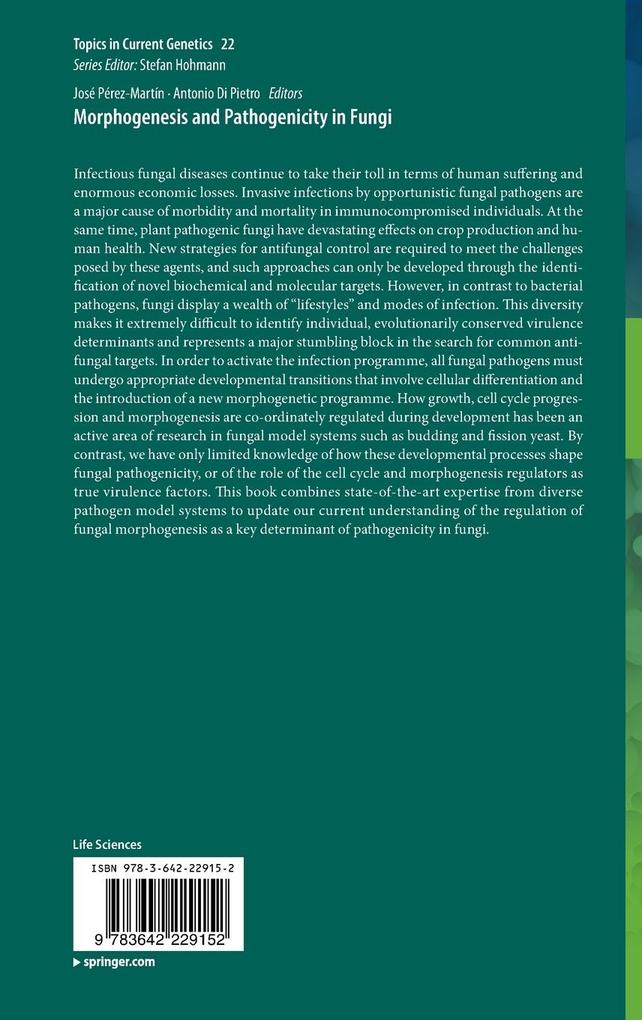
Infectious fungal diseases continue to take their toll in terms of human suffering and enormous economic losses. Invasive infections by opportunistic fungal pathogens are a major cause of morbidity and mortality in immuno-compromised individuals. At the same time, plant pathogenic fungi have devastating effects on crop production and human health. New strategies for antifungal control are required to meet the challenges posed by these agents, and such approaches can only be developed through the identification of novel biochemical and molecular targets. However, in contrast to bacterial pathogens, fungi display a wealth of "lifestyles" and modes of infection. This diversity makes it extremely difficult to identify individual, evolutionarily conserved virulence determinants and represents a major stumbling block in the search for common antifungal targets. In order to activate the infection programme, all fungal pathogens must undergo appropriate developmental transitions that involve cellular differentiation and the introduction of a new morphogenetic programme. How growth, cell cycle progression and morphogenesis are co-ordinately regulated during development has been an active area of research in fungal model systems such as budding and fission yeast. By contrast, we have only limited knowledge of how these developmental processes shape fungal pathogenicity, or of the role of the cell cycle and morphogenesis regulators as true virulence factors. This book combines state-of-the-art expertise from diverse pathogen model systems to update our current understanding of the regulation of fungal morphogenesis as a key determinant of pathogenicity in fungi.
Inhaltsverzeichnis
Molecular basis of morphogenesis in fungi. - Tropic orientation responses of pathogenic fungi. - Hyphal fusion. - Signalling of infectious growth in
Fusarium oxysporum. -
Integrating Cdk signaling in
Candida albicans
environmental sensing networks. - Cell cycle and morphogenesis connections during the formation of the infective filament in
Ustilago maydis. -
Appressorium Function in
Colletotrichum orbiculare
and Prospect for Genome Based Analysis. - Morphogenesis in
Candida albicans
: How to stay focused. - Morphogenesis in
Paracoccidioides brasiliensi. -
Morphogenesis of
Cryptococcus neoformans. -
Morphogenesis and infection in
Botrytis cinere. -
Morphogenesis, growth and development of the grass symbiont
Epichlöe festucae. - Cryptococcus
-neutrophil interaction. -
From the reviews:
This book describes the molecular basis of morphogenesis and pathogenicity in the fungi and highlights new approaches. All the chapters are well organized and each chapter contains an introduction at the beginning and a conclusion at the last that can be very useful for the reader. This book is very important to scientists, researchers and teachers as well as students who are interested in fungal morphogenesis and pathogenicity. Therefore this book should be available in all schools, research laboratories, community and university libraries. (Kasun M. Thambugala, Fungal Diversity, Vol. 57 (1), November, 2012)
Es wurden noch keine Bewertungen abgegeben. Schreiben Sie die erste Bewertung zu "Morphogenesis and Pathogenicity in Fungi" und helfen Sie damit anderen bei der Kaufentscheidung.