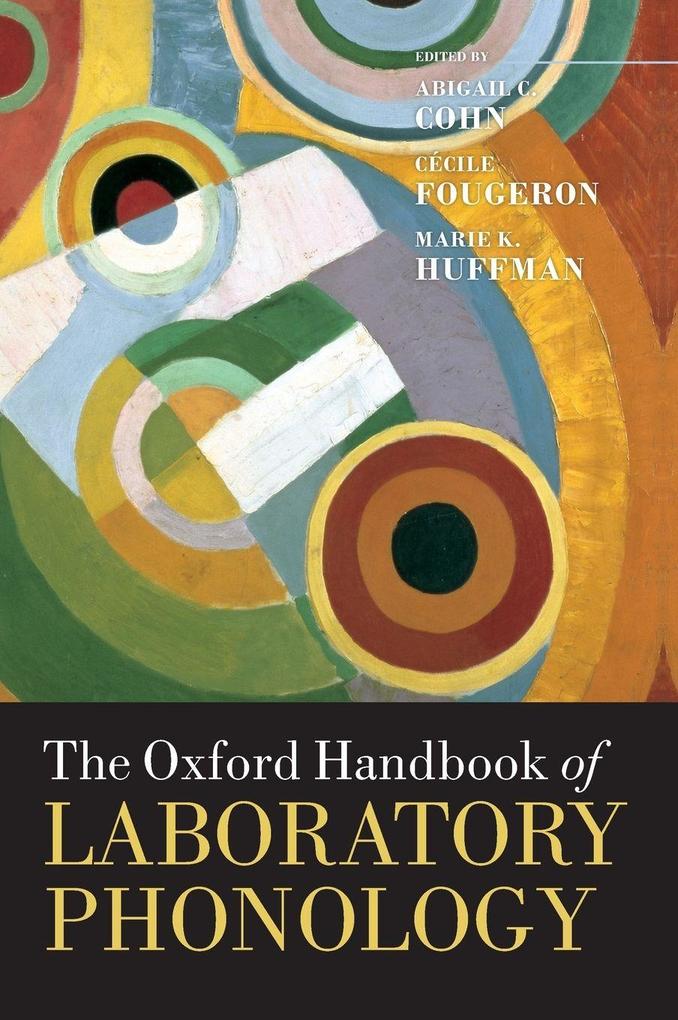
This book provides state-of-the-art coverage of research in laboratory phonology, an interdisciplinary research perspective which brings a wide range of experimental and analytic tools to bear on the central questions of how knowledge of spoken language is structured, learned, and used. The book presents works illustrating how laboratory phonology is practiced and highlights promising areas of current research.
Contributions address how laboratory phonology approaches and methodologies have provided insight into human speech and sound structure. Part one introduces the history, nature, and aims of laboratory phonology. The remaining four parts cover central issues in research done within this perspective, as well as methodological resources used for investigating these issues. This Handbook, the first specifically dedicated to the laboratory phonology approach, builds on the foundation of
knowledge amassed in linguistics, speech research and allied disciplines. With the varied interdisciplinary contributions collected, the Handbook showcases work in this vibrant field.
Inhaltsverzeichnis
- Part I: Introduction
- 1: Abigail C. Cohn, Cécile Fougeron, and Marie K. Huffman: Introduction
- 2: Mary E. Beckman and John Kingston: Introduction, Papers in Laboratory Phonology I: Between the Grammar and Physics of Speech
- 3: Janet B. Pierrehumbert, Mary E. Beckman, and D. Robert Ladd: Conceptual Foundations of Phonology as a Laboratory Science
- Part II: Nature and Types of Variation: Their interpretation within a laboratory phonology perspective
- 4: Gerard Docherty and Norma Mendoza-Denton: Speaker-related Variation - sociophonetic factors
- 5: Andries W. Coetzee and Arto Anttila: Integrating Variation in Phonological Analysis
- 6: Mirjam Ernestus and Yiya Chen: Message-related Variation
- 7: Philip Hoole, Barbara Kühnert, and Marianne Pouplier: System-related Variation
- Part III: Multidimensional Representations of Knowledge of Sound Structure
- 8: Adam Albright, Aditi Lahiri, Sarah Hawkins, and Janet B. Pierrehumbert: Lexical Representations
- 9: Jeff Mielke, Elizabeth C. Zsiga, and Paul Boersma: Phonological Elements
- 10: Adamantios Gafos, Louis Goldstein, Marie-Hélène Côté, and Alice Turk: Organization of Phonological Eelments
- 11: Sónia Frota, Amalia Arvaniti, and Mariapaola D'Imperio: Prosodic Representations
- 12: Benjamin Munson, Jan Edwards, and Mary E. Beckman: Phonological Representations in Language Acquisition: Climbing the ladder of abstraction
- 13: Ioana Chitoran, Jonathan Harrington, and Robert Kirchner: Changes in Representations
- Part IV: Integrating Different Perspectives: Insights from production, perception, and acquisition
- 14: Lori L. Holt and Noël Nguyen: Insights From Perception and Comprehension
- 15: Bob McMurray and Ashley Farris-Trimble: Emergent Information-level Coupling Between Perception and Production
- 16: Katherine Demuth, Jae Yung Song, Paola Escudero, and Rajka Smiljanic: Insights From Acquisition and Learning
- Part V: Methodologies and Resources
- 17: Jennifer Cole, Mark Hasegawa-Johnson, Dan Loehr, Linda Van Guilder, Henning Reetz, and Stefan A. Frisch: Corpora, Databases, and Internet Resources
- 18: Khalil Iskarous, Lisa Davidson, Helen M. Hanson, and Christine H. Shadle: Articulatory Analysis and Acoustic Modeling
- 19: Pilar Prieto, Brechtje Post, and Francis Nolan: Prosodic Analysis
- 20: Jessica Maye, Niels O. Schiller, Paul Iverson, Shari R. Speer, William Idsardi, and David Poeppel: Encoding, Decoding, and Acquisition
- 21: James M. Scobbie, Jane Stuart-Smith, Natasha Warner, Paul Warren, and Jennifer Hay: Experimental Design and Data Collection
- 22: John Kingston, Harald Baayen, and Cynthia G. Clopper: Statistical Analyses