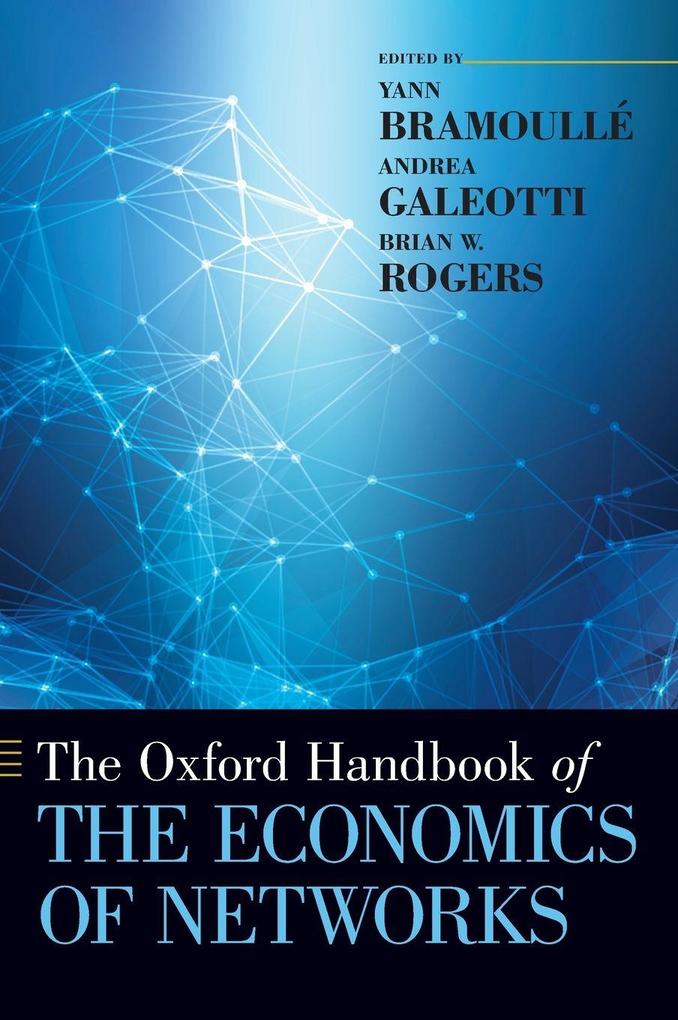
The Oxford Handbook of the Economics of Networks represents the frontier of research into how and why networks form, how they influence behavior, how they help govern outcomes in an interactive world, and how they shape collective decision making, opinion formation, and diffusion dynamics. From a methodological perspective, the contributors to this volume devote attention to theory, field experiments, laboratory experiments, and econometrics. Theoretical
work in network formation, games played on networks, repeated games, and the interaction between linking and behavior is synthesized.
The Oxford Handbook of the Economics of Networks represents the frontier of research into how and why networks form, how they influence behavior, how they help govern outcomes in an interactive world, and how they shape collective decision making, opinion formation, and diffusion dynamics. From a methodological perspective, the contributors to this volume devote attention to theory, field experiments, laboratory experiments, and econometrics. Theoretical work in network formation, games played on networks, repeated games, and the interaction between linking and behavior is synthesized.
A number of chapters are devoted to studying social process mediated by networks. Topics here include opinion formation, diffusion of information and disease, and learning. There are also chapters devoted to financial contagion and systemic risk, motivated in part by the recent financial crises. Another section discusses communities, with applications including social trust, favor exchange, and social collateral; the importance of communities for migration patterns; and the role that networks and communities play in the labor market.
A prominent role of networks, from an economic perspective, is that they mediate trade. Several chapters cover bilateral trade in networks, strategic intermediation, and the role of networks in international trade. Contributions discuss as well the role of networks for organizations. On the one hand, one chapter discusses the role of networks for the performance of organizations, while two other chapters discuss managing networks of consumers and pricing in the presence of network-based spillovers.
Finally, the authors discuss the internet as a network with attention to the issue of net neutrality.
Inhaltsverzeichnis
- I. INTRODUCTION
- 1. Introduction: Yann Bramoullé, Andrea Galeotti and Brian Rogers
- II. PERSPECTIVES
- 2. Networks: A Paradigm Shift for Economics?: Alan Kirman
- 3. Networks in Economics: A Perspective on the Literature: Sanjeev Goyal
- 4. The Past and Future of Network Analysis in Economics: Matthew Jackson
- III. NETWORK GAMES AND NETWORK FORMATION
- 5. Games Played on Networks: Yann Bramoullé and Rachel Kranton
- 6. Repeated Games and Networks: Francesco Nava
- 7. Stochastic Network Formation and Homophily: Paolo Pin and Brian Rogers
- 8. Network Formation Games: Ana Mauleon and Vincent Vannetelbosch
- 9. Links and Actions in Interplay: Fernando Vega-Redondo
- 10. Conflict and Networks: Marcin Dziubinski, Sanjeev Goyal, and Adrien Vigier
- 11. Key Players: Yves Zenou
- IV. EMPIRICS AND EXPERIMENTS
- 12. Some Challenges in the Empirics of the Effects of Networks: Vincent Boucher and Bernard Fortin
- 13. Econometrics of Network Formation: Arun Chandrasekhar
- 14. Small World Networks: Duncan Watts
- 15. Networked Experiments: A Review of Methods and Innovations: Sinan Aral
- 16. Field Experiments, Social Networks, and Development: Emily Breza
- 17. Networks in the Laboratory: Syngjoo Choi, Edoardo Gallo, and Shachar Kariv
- V. DIFFUSION, LEARNING AND CONTAGION
- 18. Diffusion in Networks: PJ Lamberson
- 19. Learning in Social Networks: Ben Golub and Evan Sadler
- 20. Financial Contagion in Networks: Antonio Cabrales, Douglas Gale, and Piero Gottardi
- 21. Networks, Shocks, and Systemic Risk: Daron Acemoglu, Asu Ozdaglar, and Alireza Tahbaz-Salehi
- VI. COMMUNITIES
- 22. Informal Transfers in Social Networks: Markus Mobius and Tanya Rosenblat
- 23. Community Networks and Migration: Kaivan Munshi
- 24. Social Networks and the Labor Market: Lori Beaman
- VII. ORGANIZATIONS AND MARKETS
- 25. Attention in Organizations: Wouter Dessein and Andrea Prat
- 26. Models of Bilateral Trade in Networks: Mihai Manea
- 27. Strategic Models of Intermediation Networks: Daniele Condorelli and Andrea Galeotti
- 28. Networks in International Trade: Thomas Chaney
- 29. Targeting and Pricing in Social Networks: Francis Bloch
- 30. Managing Social Interactions: Dina Mayzlin
- 31. Economics Features of the Internet and Network Neutrality: Nicholas Economides




























![The [Oxford] Handbook of the History of Education](/_next/image?url=https%3A%2F%2Fmedia2.ebook.de%2Fshop%2Fcoverscans%2F373%2F37304882_9780199340033_xl.jpg&w=3840&q=75)