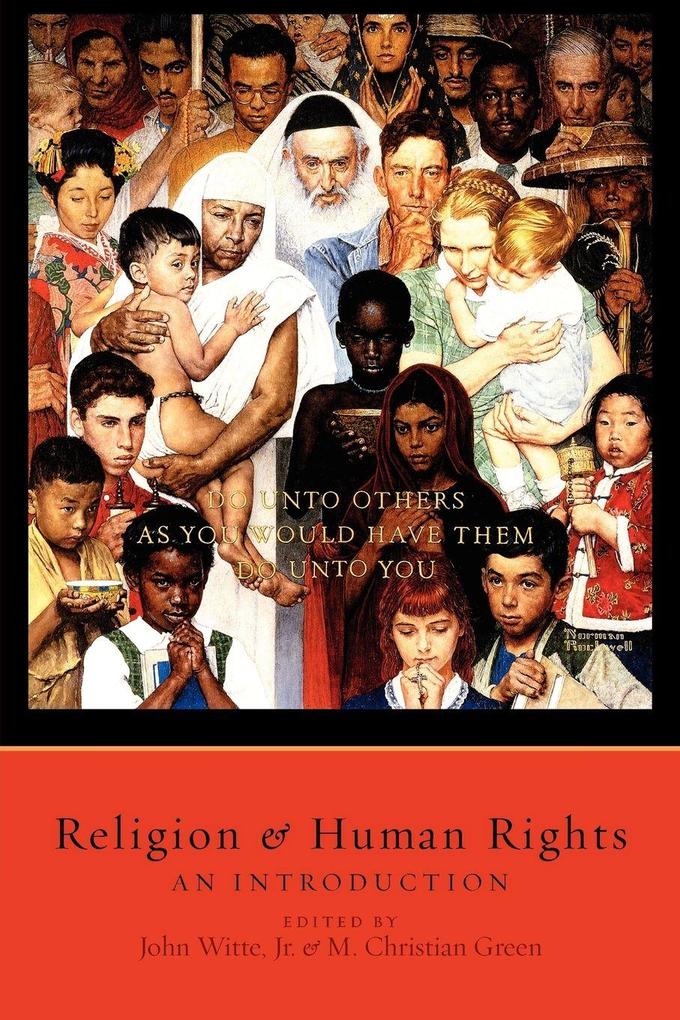
This volume examines the relationship between religion and human rights in seven major religious traditions, as well as key legal concepts, contemporary issues, and relationships among religion, state, and society in the areas of human rights and religious freedom.
Inhaltsverzeichnis
- Preface and Acknowledgements
- Contributors
- Introduction - John Witte, Jr. and M. Christian Green, Emory University
- Part I: Human Rights and Religious Traditions
- 1. A Jewish Theory of Human Rights - David Novak
- 2. Christianity and Human Rights - Nicholas P. Wolterstorff
- 3. Islam and Human Rights: Framing and Reframing the Discourse - Abdullahi Ahmed An-Na'im
- 4. Hinduism and Human Rights - Werner Menski
- 5. Confucianism and Human Rights - Joseph Chan
- 6. Buddhism and Human Rights - Sallie B. King
- 7. Indigenous Religion and Human Rights - Ronald Niezen
- 8. Religion, Human Rights, and Public Reason: The Role and Limits of a Secular Rationale - David Little
- Part II: Religion and Modern Human Rights Issues
- 9. The Phases and Functions of Freedom of Conscience - Steven D. Smith
- 10. Religion and Freedom of Choice - Paul Taylor
- 11. Religion and Freedom of Expression - Carolyn Evans
- 12. Religion, Equality, and Non-Discrimination - Nazila Ghanea
- 13. Religion and Freedom of Association - Natan Lerner
- 14. The Right to Self-Determination of Religious Communities - Johan D. van der Vyver
- 15. Permissible Limitations on Religion - T. Jeremy Gunn
- 16. From Religious Freedom to Moral Freedom - Michael J. Perry
- 17. Keeping Faith: Reconciling Women's Human Rights and Religion - Madhavi Sunder
- 18. Religion and Children's Rights - Barbara Bennett Woodhouse
- 19. Religion and Economic, Social, and Cultural Rights - Ingvill Thorson Plesner
- 20. Religion and Environmental Rights - Willis Jenkins
- 21. Religion, Violence, and the Right to Peace - R. Scott Appleby
- 22. Patterns of Religion State Relations - W. Cole Durham, Jr.
- Index