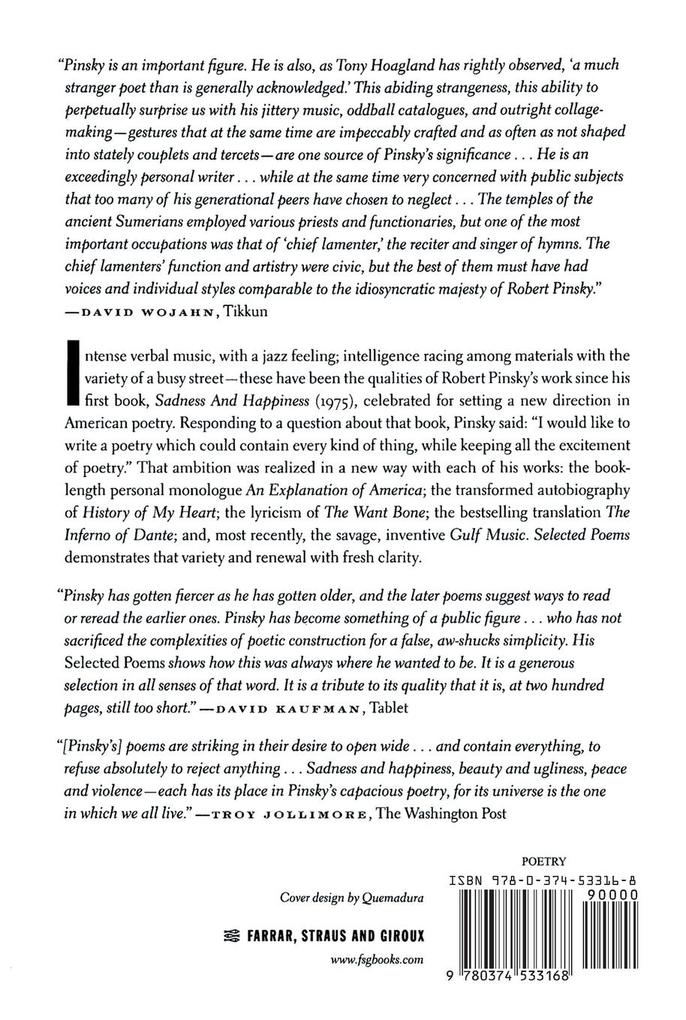
"Simply said, Robert Pinsky is one of the few literary artists working in our language whose work is unquestionably major work." --Louise Gluck"[Pinksy's] poems are striking in their desire to open wide ... and contain everything, to refuse absolutely to reject anything ... Pinsky's poems rarely lend themselves to easy and decisive interpretation. (For this reason they tend to grow rather than wither with rereading.) One might say of his work, as one would say of jazz, that the point is less to interpret or understand it than to enjoy the sound and energy and mad improvisation ... Sadness and happiness, beauty and ugliness, peace and violence--each has its place in Pinsky's capacious poetry, for its universe is the one in which we all live." --Troy Jollimore, "The Washington Post""One might say that Pinsky has attended well Hamlet's advice to the players, and, in the very tempest of his passion and inspiration, acquires and begets a temperance to give all smoothness. The pleasures of Pinsky's poems are found in their capable smoothness, their balance, and, here and there, little fillips that smack the ear and jar the mind." --Donald Brown, "The Quarterly Conversation""Pinsky is an important figure. He is also, as Tony Hoagland has rightly observed, 'a much stranger poet than is generally acknowledged.' This abiding strangeness, this ability to perpetually surprise us with his jittery music, oddball catalogues, and outright collage-making--gestures that at the same time are impeccably crafted and as often-as-not shaped into stately couplets and tercets--are one source of Pinsky's significance. He has also, as the new volume eloquently attests, remade himself several times as a poet, and with each change moved closer to a goal of being at once wholly idiosyncratic and highly accessible. He is an exceedingly personal writer--this trait especially manifests itself in his capacities as an elegist--while at the same time very concerned with public subjects tha