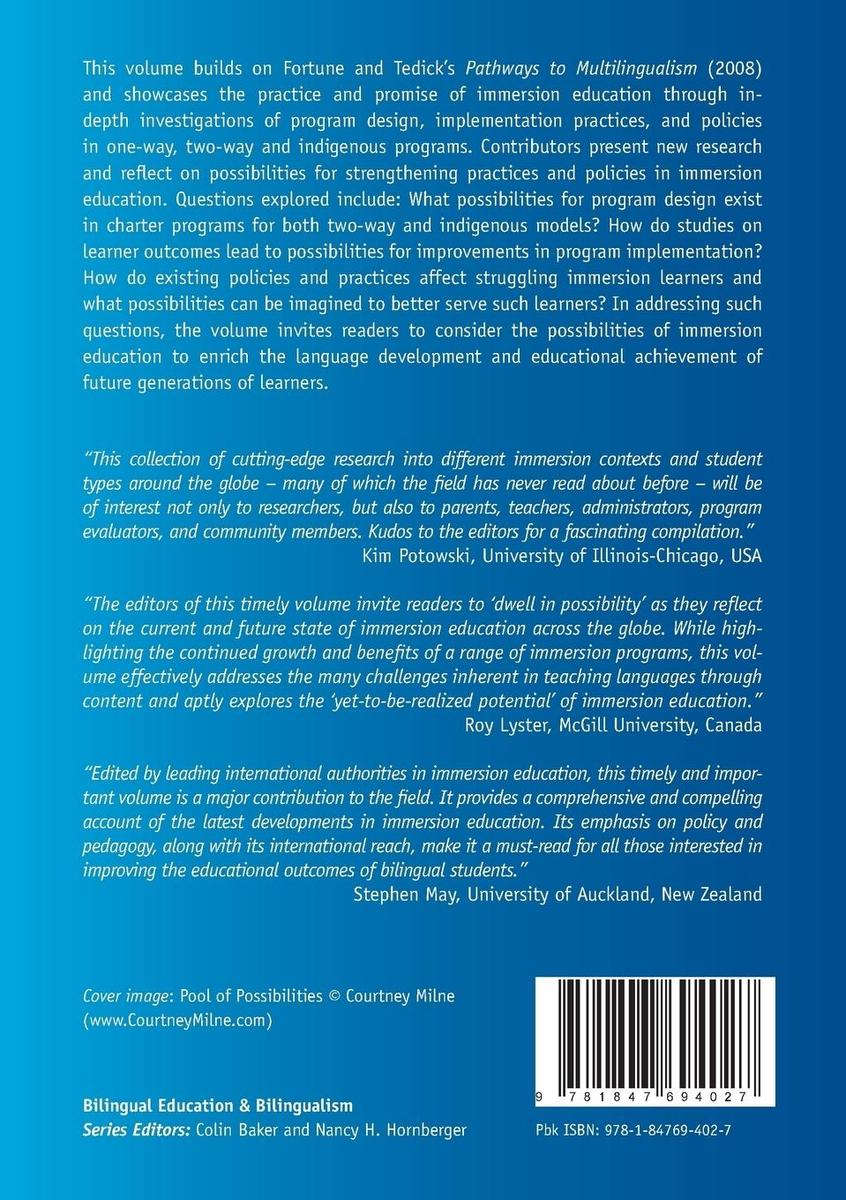
This volume builds on Fortune and Tedick's 2008 Pathways to Multilingualism: Evolving Perspectives on Immersion Education and showcases the practice and promise of immersion education through in-depth investigations of program design, implementation practices, and policies in one-way, two-way and indigenous programs. Contributors present new research and reflect on possibilities for strengthening practices and policies in immersion education. Questions explored include: What possibilities for program design exist in charter programs for both two-way and indigenous models? How do studies on learner outcomes lead to possibilities for improvements in program implementation? How do existing policies and practices affect struggling immersion learners and what possibilities can be imagined to better serve such learners? In addressing such questions, the volume invites readers to consider the possibilities of immersion education to enrich the language development and educational achievement of future generations of learners.
Inhaltsverzeichnis
Merrill Swain: ForewordDiane J. Tedick, Donna Christian and Tara Williams Fortune: Acknowledgements Introduction to the VolumeDiane J. Tedick, Donna Christian and Tara Williams Fortune: The Future of Immersion Education: An Invitation to 'Dwell in Possibility'Section I: Practices in Immersion Program Design Siv Bjorklund and Karita Mard-Miettinen: Integrating Multiple Languages in Immersion: Swedish Immersion in FinlandWilliam H. Wilson and Kauanoe Kaman?: Insights from Indigenous Language Immersion in Hawai?i: The Case of N?wah? SchoolGareth Diaz Zehrbach: Two-Way Immersion Charter Schools: An Analysis of Program Characteristics and Student Body CompositionsSection II: Program Outcomes and Implications for Practice Kathryn Lindholm-Leary: Student Outcomes in Chinese Two-Way Immersion Programs: Language Proficiency, Academic Achievement, and Student AttitudesEster J. de Jong and Carol I. Bearse: The Same Outcomes for All? High School Students Reflect on Their Two-Way Immersion Program ExperiencesSandra Burger, Alysse Weinberg, Carla Hall, Parvin Movassat, and Amelia Hope: French Immersion Studies at the University of Ottawa: Program Evaluation and Pedagogical ChallengesSection III: Language Use and Assessment Practices in Immersion ProgramsPadraig O Duibhir: 'I thought that we had good Irish': Irish Immersion Students' Insights into Their Target Language UseMaggie Broner and Diane J. Tedick: Talking in the 5th Grade Classroom: Language Use in an Early, Total Spanish Immersion ProgramLizette Peter, Gloria Sly and Tracy Hirata-Edds: Using Language Assessment to Inform Instruction in Indigenous Language ImmersionSection IV: Policy and Practice in Immersion EducationPhilip Hoare: Context and Constraints: Immersion in Hong Kong and Mainland ChinaLisa Dorner: US Immigrants and Two-Way Immersion Policies: The Mismatch between District Designs and Family ExperiencesTara Williams Fortune: Struggling Learners and the Language Immersion ClassroomConcluding Synthesis Chapter for the VolumeFred Genesee: Reflecting on Possibilities for Immersion