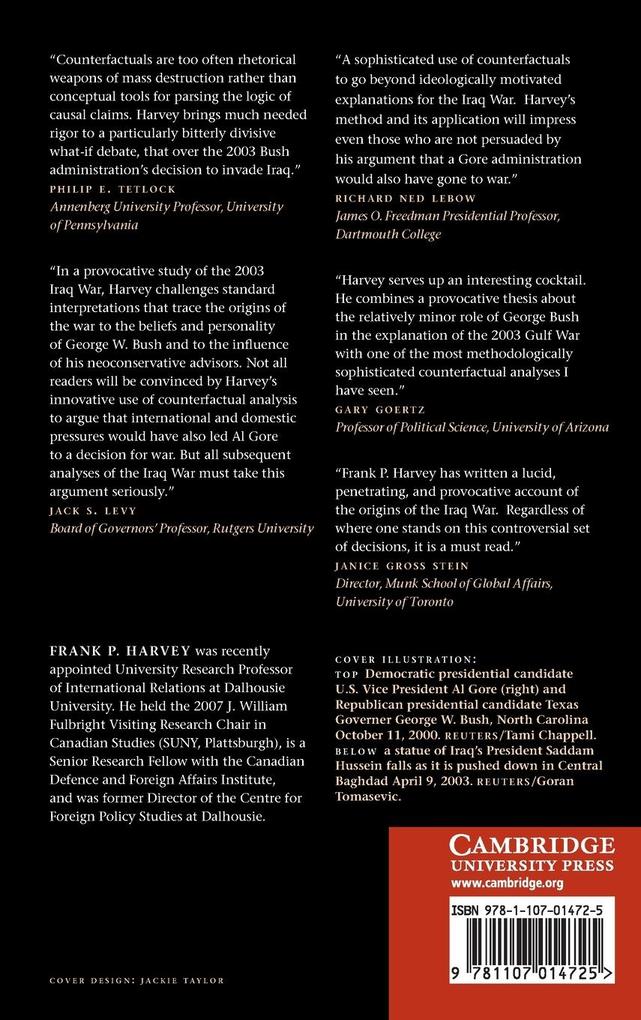
'Counterfactuals are too often rhetorical weapons of mass destruction rather than conceptual tools for parsing the logic of causal claims. Harvey brings much needed rigor to a particularly bitterly divisive what-if debate, that over the 2003 Bush administration's decision to invade Iraq.' Philip E. Tetlock, Annenberg University Professor, University of Pennsylvania 'A sophisticated use of counterfactuals to go beyond ideologically motivated explanations for the Iraq War. Harvey's method and its application will impress even those who are not persuaded by his argument that a Gore administration would also have gone to war.' Richard Ned Lebow, James O. Freedman Presidential Professor, Dartmouth College 'In a provocative study of the 2003 Iraq War, Harvey challenges standard interpretations that trace the origins of the war to the beliefs and personality of George W. Bush and to the influence of his neoconservative advisors. Not all readers will be convinced by Harvey's innovative use of counterfactual analysis to argue that international and domestic pressures would have also led Al Gore to a decision for war. But all subsequent analyses of the Iraq War must take this argument seriously.' Jack S. Levy, Board of Governors' Professor, Rutgers University 'Harvey serves up an interesting cocktail. He combines a provocative thesis about the relatively minor role of George Bush in the explanation of the 2003 Gulf War with one of the most methodologically sophisticated counterfactual analyses I have seen.' Gary Goertz, Professor of Political Science, University of Arizona 'Frank P. Harvey has written a lucid, penetrating, and provocative account of the origins of the Iraq War. Regardless of where one stands on this controversial set of decisions, it is a must read.' Janice Gross Stein, Director, Munk School of Global Affairs