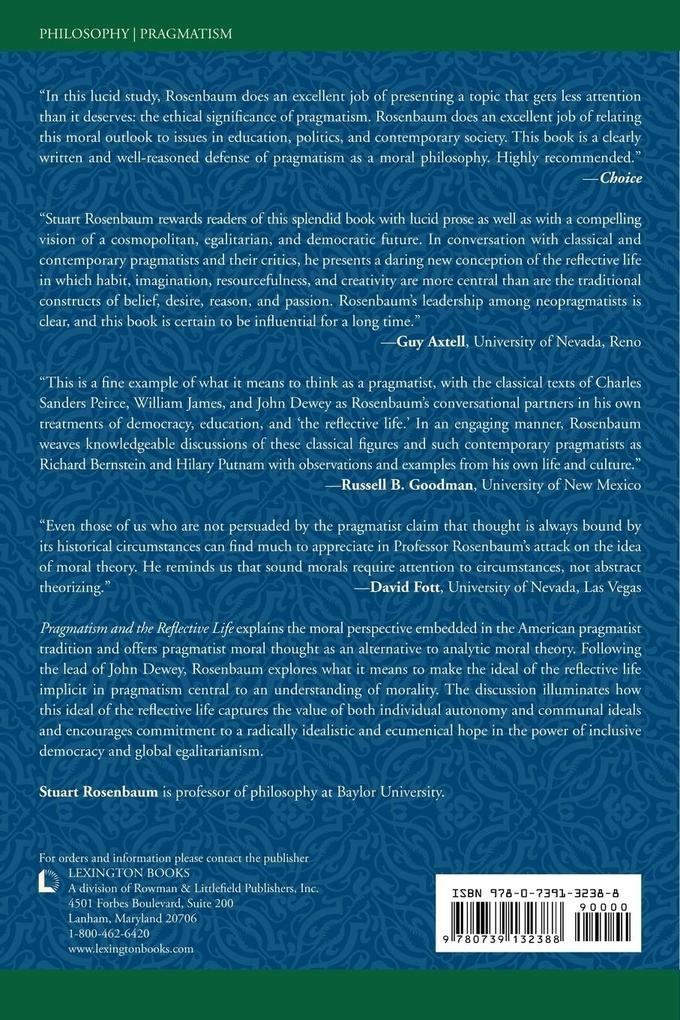
Rosenbaum rewards readers of this splendid book with lucid prose as well as with a compelling vision of a cosmopolitan, egalitarian, and democratic future. In conversation with classical and contemporary pragmatists and their critics, he presents a daring new conception of the reflective life in which habit, imagination, resourcefulness, and creativity are more central than are the traditional constructs of belief, desire, reason, and passion. Rosenbaum's leadership among neo-pragmatists is clear, and this book is certain to be influential for a long time. -- Guy Axtell, University of Nevada-Reno This is a fine example of what it means to think as a pragmatist, with the classical texts of Charles Sanders Peirce, William James, and John Dewey as Rosenbaum's conversational partners in his own treatments of democracy, education, and 'the reflective life.' In an engaging manner, Rosenbaum weaves knowledgeable discussions of these classical figures and such contemporary pragmatists as Richard Bernstein and Hilary Putnam with observations and examples from his own life and culture. -- Russell B. Goodman, University of New Mexico In this lucid study, Rosenbaum does an excellent job of presenting a topic that gets less attention than it deserves: the ethical significance of pragmatism. Rosenbaum does an excellent job of relating this moral outlook to issues in education, politics, and contemporary society. This book is a clearly written and well-reasoned defense of pragmatism as a moral philosophy. Highly recommended. CHOICE, February 2010 Even those of us who are not persuaded by the pragmatist claim that thought is always bound by its historical circumstances can find much to appreciate in Professor Rosenbaum's attack on the idea of moral theory. He reminds us that sound morals require attention to circumstances, not abstract theorizing. -- David Fott, University of Nevada, Las Vegas In the brief autobiographical remarks found in the preface of Stuart Rosenbaum's Pragmatism and the Reflective Life, we discover that Rosenbaum began his philosophical career in the tradition of analytic philosophy. It is precisely this background in the analytic tradition that gives weight to the powerful criticisms he levels against that tradition as he wends his way through his newfound love, American pragmatism...In sum, Rosenbaum esteems pragmatism's account of the reflective life for its ecumenical spirit toward the varieties of human experience. American Journal of Theology and Philosophy