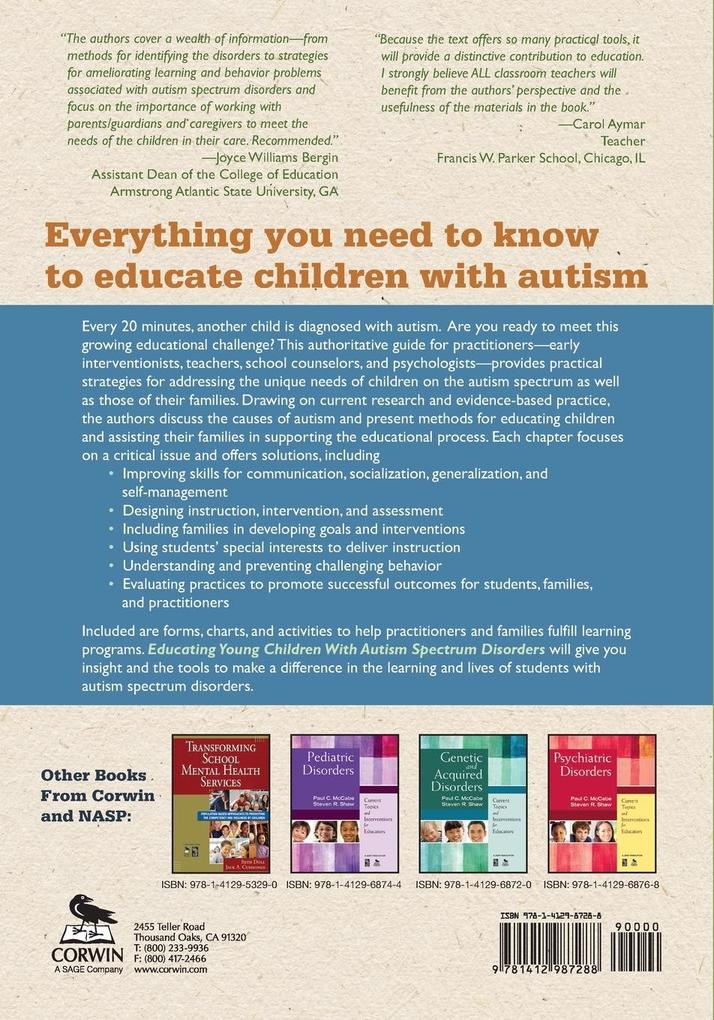
Everything you need to know to educate students with autism
Every 20 minutes, another child is diagnosed with autism. Are you ready to meet this growing educational challenge? This authoritative guide is for practitioners—early interventionists, teachers, school counselors, psychologists—who are committed to the education and dignity of students with autism in preschool and elementary grades. Each chapter focuses on a critical issue and offers solutions, including: Improving communication, social, generalization and self-management skills
Designing instruction, intervention, and assessment
Including families in developing goals and interventions
Using students’ special interests to deliver instruction
Understanding and preventing challenging behavior
Evaluating practices to promote successful outcomes for students, families and practitioners
Inhaltsverzeichnis
Acknowledgments
About the Authors
1. Classification of Autism in Young Children
2. Early Detection and Medical Classification
3. Educational Eligibility
4. Writing Effective Educational Goals
5. Essential Components of Educational Programs
6. Designing and Evaluating Instruction Based on Student Skills and Responses
7. Evidence-Based Strategies for Teaching Children with Autism Spectrum Disorders: Skill Acquisition and Fluency
8. Evidence-based Strategies for Maintenance, Generalization, and Self-management
9. Evidence-based Practices for Communication Skill Acquisition
10. Evidence-based Practices for Social Skill Acquisition
11. Designing Instruction and Supports to Prevent and Decrease Problem Behavior
12. Maximizing Implementation of Evidence-Based Strategies in the Classroom
Master List of Acronyms
NASP References
Index