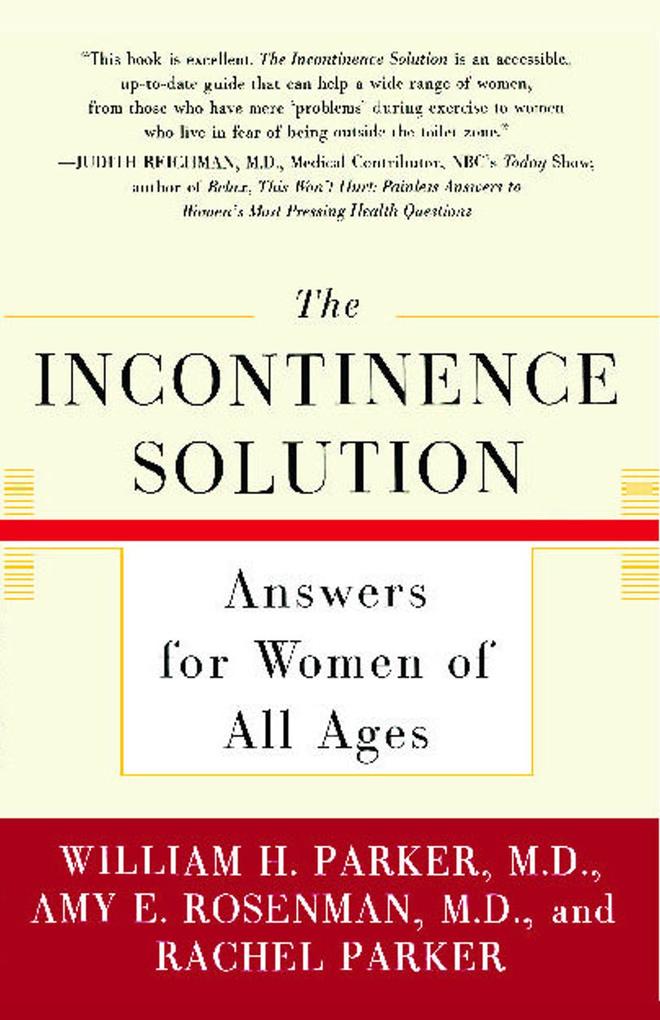
Millions of women experience difficulties controlling their bladders but suffer in silence, reluctant to speak to their doctors -- or even to their best friends -- about the problem. Here, at last, women will find the most up-to-date medical explanations and state-of-the-art solutions, including: Controversial links between current childbirthing practices -- like episiotomy, the use of forceps, and long labor -- and the development of incontinence later in life. Advanced diagnostic tests that enable women to quickly find the most effective treatment. Nonsurgical treatments: pelvic muscle exercises and oral medications that really work. Surgical options featuring new minimally invasive outpatient procedures.
Inhaltsverzeichnis
Contents
Introduction
Defining Incontinence
How the Bladder Normally Works
Diagnosing Incontinence
Childbirth and Incontinence
Treating Incontinence Without Surgery
Treating Incontinence with Surgery
Interstitial Cystitis (with Leslie Kaplan, M.D.)
Defining and Diagnosing Prolapse (Pelvic Relaxation)
Treating Prolapse Without Surgery
Treating Prolapse with Surgery
Anal Incontinence (with Tracy Childs, M.D.)
Sexuality
Finding the Right Doctor
References
Resources
Index