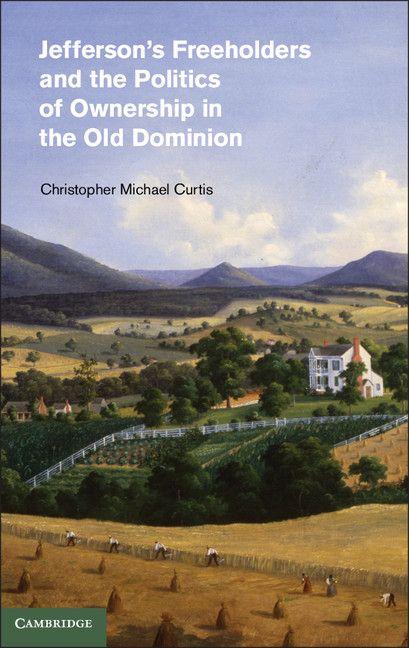
"Christopher Curtis's book is a remarkable and welcome hybrid, its research meticulous and exhaustive. Curtis's judgments about the evidence are judicious and balanced. His arguments and conclusions are important and portable, for he demonstrates how the cultural and legal effects of commercial developments remapped Virginians' understanding of the justification of popular political participation, and even of political legitimacy. The concluding chapter on a 'new jurisprudence' is a tour de force. Jefferson's Freeholders is a book for many seasons." -Gerard V. Bradley, Unviersity of Notre Dame Law School "In recent decades a number of talented scholars have greatly enriched our understanding of both the political and the legal history of the antebellum South. Most of these scholars, however, have concentrated on either the political or the legal rather than weaving together developments in both realms. Chris Curtis's new book, Jefferson's Freeholders and the Politics of Ownership in the Old Dominion, is the exception to the rule. In this rigorously argued study, Curtis details the manner in which changing conceptions of property and changes in the legal system at once underpinned and reinforced changes in politics and the political order in one key southern state. Curtis's estimable scholarship will compel all students of southern history to rethink the material and moral bases upon which the region was grounded." -Peter A. Coclanis, Albert R. Newsome Distinguished Professor of History, University of North Carolina at Chapel Hill Christopher Michael Curtis's Jefferson's Freeholders and the Politics of Ownership in the Old Dominion is nothing short of seminal. It will compel the re-study of development of slave society not only in Virginia, but, with appropriate adjustments, for the Old South. Rarely do we find legal, intellectual, and economic history so well integrated and graced by such penetrating insight. The implications of the shif in the nature of property relations illuminate the evolution of the yeomanry as readily as they do that of the planters." -Eugene D. Genovese, co-author with Elizabeth Fox-Genovese of The Mind of the Master Class, Slavery in White and Black, and Fatal Self-Deception "This book is impressive from various perspectives. Chris Curtis has written an engaging historical treatise on Virginian property relations and law from colonial days to the ante-bellum era. He adroitly demonstrates how local legal history provides a window into law and legal change regionally, nationally and internationally, in the Common Law world. Moreover, by tapping political, economic and social records he has produced a rich narrative of the changing imperatives of political thought and action and economic realities that influenced the development of local law in this slave holding jurisdiction, and explain its inner contradictions. This book merits a broad readership." -John McLaren, Emeritus Professor of Law, University of Victoria "Christopher Curtis's provocative new book is a welcome addition to the literature on Revolutionary and antebellum Virginia. Focusing on land law, Jefferson's Freeholders charts the Old Dominion's progress from the agrarian commonwealth Jefferson envisioned in 1776 to the slave-based democracy of the 1851 state constitution. White manhood suffrage marked both the triumph of democracy in Virginia and Virginia's emergence as a slave state committed to the peculiar institution's perpetuation. Curtis's smart and original study deserves a wide readership." -Peter S. Onuf, University of Virginia, author of Jefferson's Empire: The Language of American Nationhood "Essential." -Choice