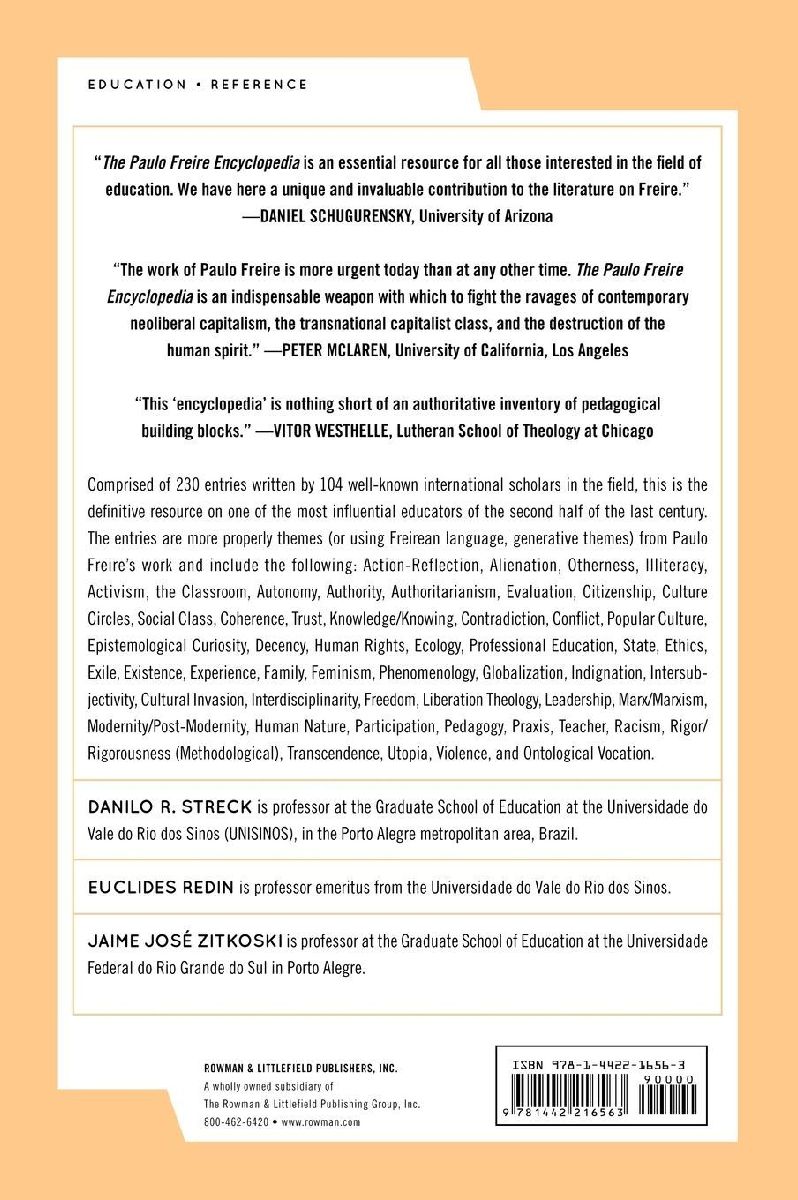
Paulo Freire was paramount seminal thinker, philosopher, pedagogue, and theologian, a canonic practitioner of the art of education, for whom the word that spells the truth is 'pregnant with the world.' Nothing would have pleased him (and the privileged readers of this volume) more than an encyclopedia containing those words in labor. This 'dictionary,' as it is called in the original Portuguese edition, is nothing short of an authoritative inventory of pedagogical building blocks. The editors and over a hundred international scholars collected and explained them offering the bricks through which other scholars and educators will 'reinvent,' construct (not simply to repeat Freire, as he would insist) to give birth to another world that is possible. -- Vitor Westhelle, Lutheran School of Theology at Chicago The Paulo Freire Encyclopedia is an essential resource for all those interested in the field of education. With over 230 entries prepared by over 100 contributors, this book provides a fantastic opportunity to access Freire's educational, political and philosophical ideas through his words, expressions and concepts. Such a herculean and comprehensive effort took a decade to assemble, but it was worth the wait! We have in front of us a unique and invaluable contribution to the literature on Freire. -- Daniel Schugurensky, University of Arizona The work of Paulo Freire is more urgent today than at any other time. The Paulo Freire Encyclopedia is an indispensable weapon with which to fight the ravages of contemporary neoliberal capitalism, the transnational capitalist class and the destruction of the human spirit. -- Peter McLaren, University of California, Los Angeles and distinguished fellow in critical studies, Chapman University This dictionary, written by three professors and professor emeritus from Latin American universities, provides encyclopedic entries for all of the key terms used in Freire's key texts and writings. All terms are related to education by many present political, sociological, and humanitarian concepts as well, including Alienation, Illiteracy, Culture Circles, Contradiction, Epistemological Curiosity, Feminism, Phenomenology, Globalization, Marx/Marxism, and Utopia. Each definition is several pages in length and includes references. They are written in a scholarly manner that will be most useful to graduate level students and above studying education, philosophy, and critical pedagogy. Although a highly specialized work in the field of education, this title provides detailed definitions that will be difficult to find in other sources. American Reference Books Annual