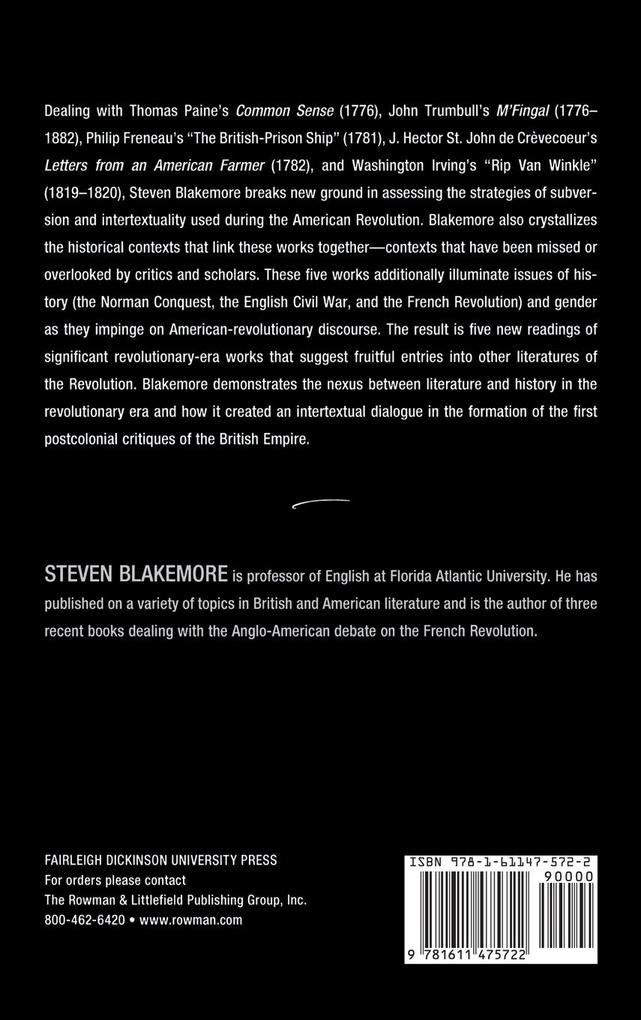
Blakemore (Florida Atlantic Univ.) asserts that the American Revolution was waged intertextually across and through "voluminous tissues of allusions" to shared modes of Anglo-American history and cultural representation--a common frame now largely neglected. He resuscitates the historical contexts and the common representational strategies from within which US writers wrested their political and aesthetic independence, focusing on five key works from the Revolutionary and early national eras: Paine's Common Sense, Trumbull's M'Fingal, Freneau's "The British Prison-Ship," Crevecoeur's Letters from an American Farmer, and Irving's Rip Van Winkle. Although Blakemore identifies these works as similar in their self-conscious and subversive responsiveness to context, he focuses his efforts on individual chapters dedicated to the distinct modes, techniques, and targets through which each author articulated his vision of American independence. Scholars of American literary history are likely familiar with the works by Irving, Crevecoeur, and Paine, but Blakemore's skillful new readings of them, along with his inclusion of Trumbull's and Freneau's often-overlooked poems, richly reward the reader. In the current climate of transatlantic and comparative cultural studies, Blakemore's study offers a model of insightful scholarship and attention to contextual particularity. Summing Up: Highly recommended. Upper-division undergraduates through faculty CHOICE