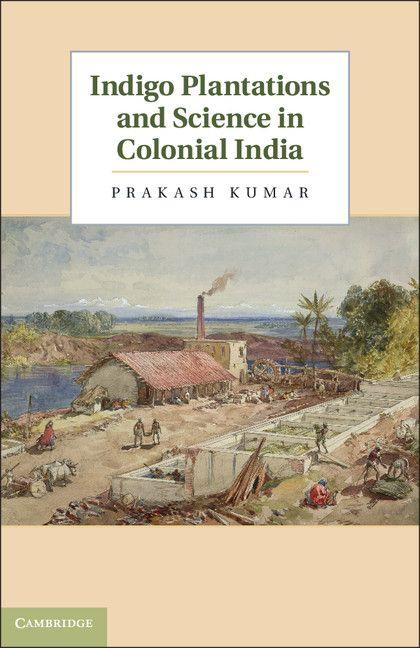
'In examining the history of indigo cultivation and agricultural science in India, Kumar lucidly explores the intersection between imperial systems, technological modernity, and global knowledge diasporas. The book combines exemplary research with insightful and challenging theorization about the application and understanding of science in a colonial setting.' David Arnold, Emeritus Professor of Asian and Global History, University of Warwick 'In his insightful history of modern indigo, Prakash Kumar nicely demonstrates that knowledge of the blue dye was fluid and fugitive, mobile and global.' Joyce Chaplin, Harvard University 'Professor Kumar has brought an entirely fresh perspective to the subject of indigo in India by examining the science and the patronage of science involved in the 'improvement' of indigo over several hundred years and by placing his study in a truly global framework. This book is a major contribution both to the history of modern South Asia and to the history of science.' Douglas E. Haynes, Dartmouth College 'Professor Kumar's book is a scholarly work of profound erudition. It is a masterful analysis of the complex and shifting interactions between agricultural practices, relations between European planters and Indian farmers, scientific research in Britain and India, and the role of the colonial state in Indian agriculture. Scholars interested in agriculture and science in colonial India will consult this work for years to come.' Daniel Headrick, Professor Emeritus of Social Science and History, Roosevelt University 'Prakash Kumar writes a new kind of history of indigo cultivation in British India, focusing on the vast mobility of productive scientific knowledge and its localization at the agrarian foundations of India's modern development regime in Bengal.' David Ludden, New York University 'This book is the first full-scale study of the odyssey of natural indigo manufacturing by European entrepreneurs and planters in South Asia across three centuries, as seen from the point of view of technical knowledge and efforts at 'improvement'. Its particular merit is that it analyzes the complex interplay between metropolitan science and local practice in the colony within a wider context of transnational market connections and cosmopolitan knowledge circulation at the global scale. This is a landmark study, based on wide-ranging and diversified sources, and written with impeccable clarity.' Jacques Pouchepadass, Emeritus Research Director, CNRS, Paris