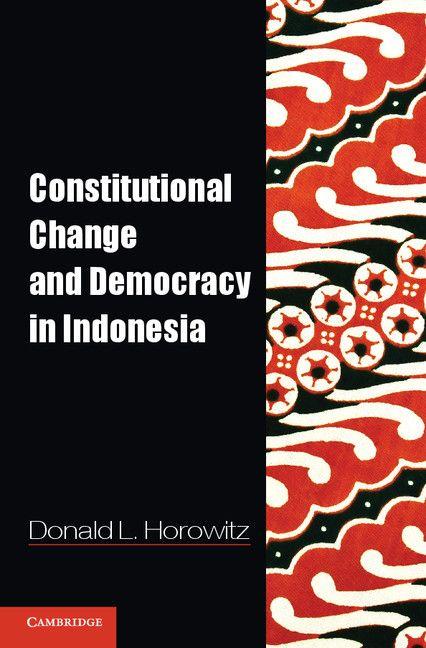
"This is a wonderful book. The author has a reputation as one of the world's foremost scholars of ethnic conflict and its relations to political institutions, and in this book he demonstrates why he deserves this reputation. The book presents a coherent and even gripping narrative about Indonesian constitutional and political reform, navigating its way through a complex cast of characters and institutions to present an account that engages the reader at every step of the story. The book is animated by a strong central argument that the incremental, insider-dominated and gradualist nature of Indonesian reform, with elections preceding democratic change, succeeded in bringing about democratization and steered Indonesia away from the dangers of polarization and violence. A compelling narrative, based on a strong empirical grasp of the events under discussion, within an explicit theoretical and comparative framework." - Edward Aspinall, Australian National University "How is it that Indonesia transformed itself from an autocratic dictatorship to a respectably open democracy in less than a decade, during a time when so many other developing countries were stalled or backsliding in making democratic transitions? A large part of the answer can be found in its ability to effect the relatively smooth constitutional changes that Donald Horowitz explores here in detail. This is a must-have book for any serious student of modern Indonesia." - Harry Blair, Yale University "In the wake of a massive economic collapse, rising separatist sentiment, and the spread of ethnic and religious tensions, Indonesia's apparently entrenched military-dominated regime seemed an unlikely candidate for democratization when the Soeharto regime fell in 1998. In this book Donald Horowitz explains how Indonesia's sharply divided political elite managed to reach improbable compromises that laid the foundations for the strengthening of democratic institutions." - Harold Crouch, Australian National University "In this volume, one of the great figures in comparative politics turns his powerful analytic vision to the emergence of constitutional democracy in Indonesia. According to the conventional wisdom, Indonesia did everything wrong but nevertheless managed to produce a vibrant constitutional democracy. Horowitz brilliantly elucidates the logic behind this story, emphasizing the roles of context, consensus, and enduring memory in shaping choices and outcomes." - Tom Ginsburg, University of Chicago Law School