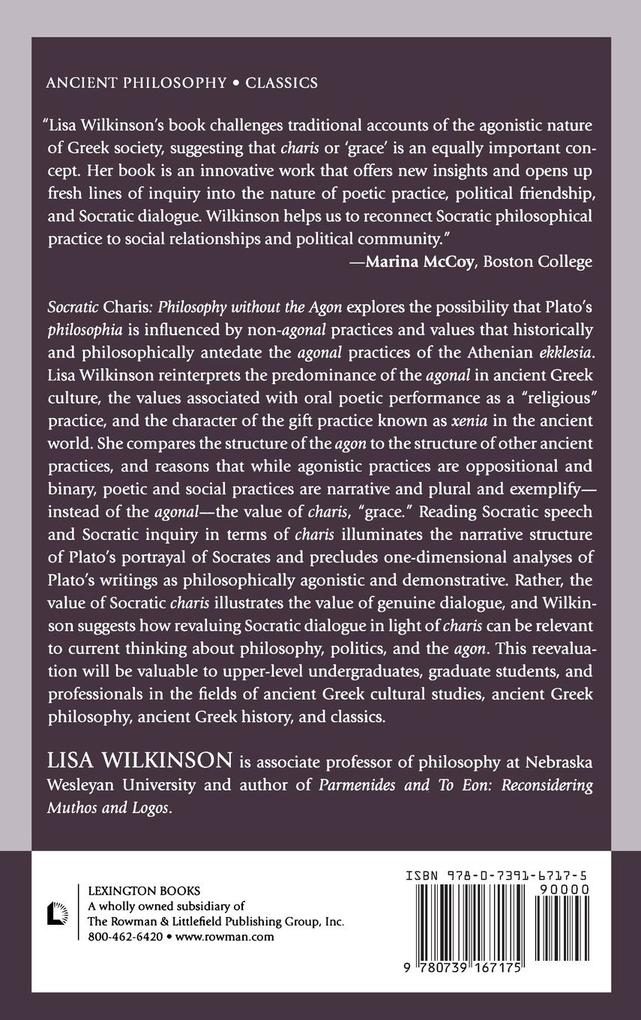
This work offers an evaluation of Plato’s portrayal of "Socrates" in relation to models of the ancient Greek "agon", oral poetic performance, and the practices of "xenia". The author reinterprets the values of the oral tradition and xenia as non-agonistic, and shows how these values can illuminate the dramatic and philosophical import of Plato’s Socrates in ways potentially relevant to current thinking about "demokratia".
Inhaltsverzeichnis
Introduction - Gold for Bronze
Chapter 1: Troubling the Agon
The Myth of the Agon
The Politics of the Agon
The History of the Agon
Chapter 2: Non-Agonistic Practices
Who and What is Zeus?
Muses
Non-Agonistic Speech
Chapter 3: Xenia: An economy of Charis
Gift Practices
Xenia
God for Bronze
Chapter 4: The "Gift" of Socrates
Interregnum
Who and What is Socrates?
Socrates as Gift
The Economy of Philosophy
Chapter 5: Socratic Charis
Poetic Charis
Cephalus: A Graceful Head?
Socratic Charis
Epilogue - Listening for the Tyrant
Bibliography
Index