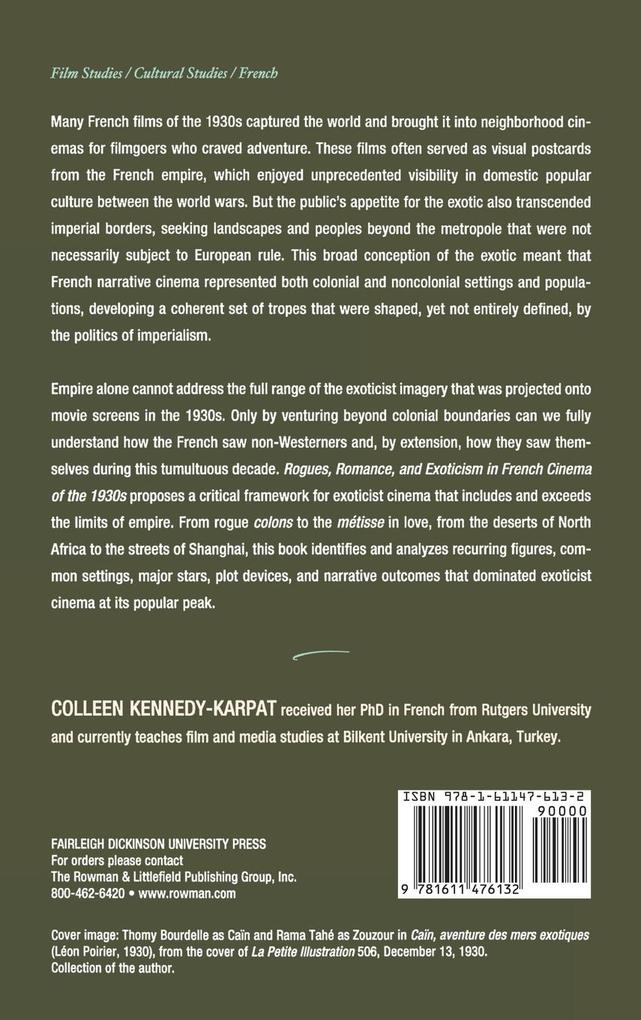
Empire alone cannot contain the range of the exoticist imaginary in French fiction cinema of the 1930s. Rogues, Romance, and Exoticism in French Cinema of the 1930s proposes a critical framework for exoticist cinema that subsumes and exceeds colonial territory, analyzing the recurring figures, common settings, major stars, key plot devices, and narrative outcomes that dominated exoticist cinema at its popular peak.
Inhaltsverzeichnis
CONTENTS< BR> Acknowledgments< BR> Exoticism in 1930s France: The Colonial and Beyond< BR> < BR> PART ONE: Men Outside the Mainstream< BR> < BR> Chapter 1: Jean Gabin, le cafard, and Western Solidarity< BR> La Bandera (1935): Cultural Cohesion and Colonial Mercenaries< BR> Pépé le Moko (1937) and the Multiethnic Exotic< BR> Le Messager (1937): Failure to Adapt< BR> < BR> Chapter 2: Assimilation Anxiety and Rogue Colons< BR> Men Who Stayed Too Long< BR> El Guelmouna, marchand de sable (1931): Rivalry (and Russians) in Rural Algeria< BR> Amok (1934): Cultural Readmission at All Costs< BR> L'Esclave blanc (1936): Segregationist Parable< BR> < BR> PART TWO: Romancing the Exotic< BR> < BR> Chapter 3: Tragedy and Triumph for Interracial Love< BR> Caïn, aventure des mers exotiques (1930) and Baroud (1932): Lasting Love in the Colonies< BR> Le Simoun (1933) and Yamilé sous les cèdres (1939): Triumph, Tragedy, Responsibility< BR> Women's Agency and Exoticist Romance< BR> < BR> Chapter 4: Métissage and Cultural Repatriation< BR> La Dame de Malacca (1937): European Frog, Exotic Prince< BR> (Re)claiming French Identity in La Maison du Maltais (1938)< BR> L'Esclave blanche (1939): A Westerner in the Harem< BR> Redefining Exoticist Romance< BR> < BR> PART THREE: France Imagines the Far East< BR> < BR> Chapter 5: Shanghai Fantasies and the Geishas of Joinville< BR> Mollenard (1938) and Le Drame de Shanghaï (1938): Exiled in (and from) the East< BR> Yoshiwara (1936) and La Bataille (1934): Lovers and Fighters in the Land of the Rising Sun< BR> < BR> Chapter 6: Sessue Hayakawa's French Resurrection, 1936-1939< BR> Forfaiture (1937): A Legend Revised, a Legacy Reborn< BR> Patrouille blanche (1939/1942): Bringing the Other Back Home < BR> Macao, l'enfer du jeu (1939/1942): The Exotic Father< BR> < BR> Exoticism in Transition< BR> L'Homme du Niger (1940): Patriotism and Paternalism in Africa< BR> Malaria (1943): Imperial Stasis< BR> Descendants of Interwar Exoticism from Decolonization to the New Century< BR> < BR> Annotated Filmography< BR> Bibliography< BR> Index