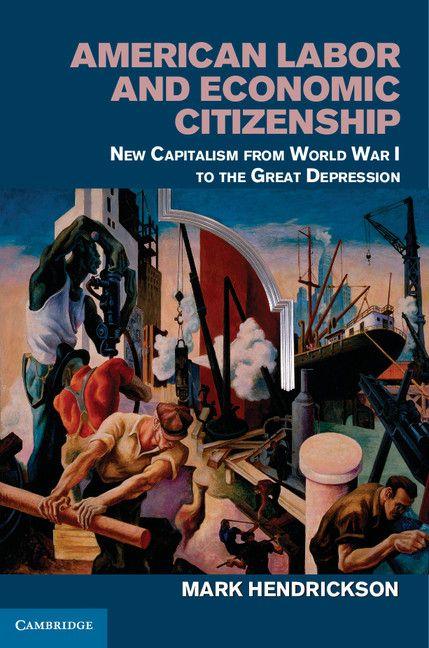
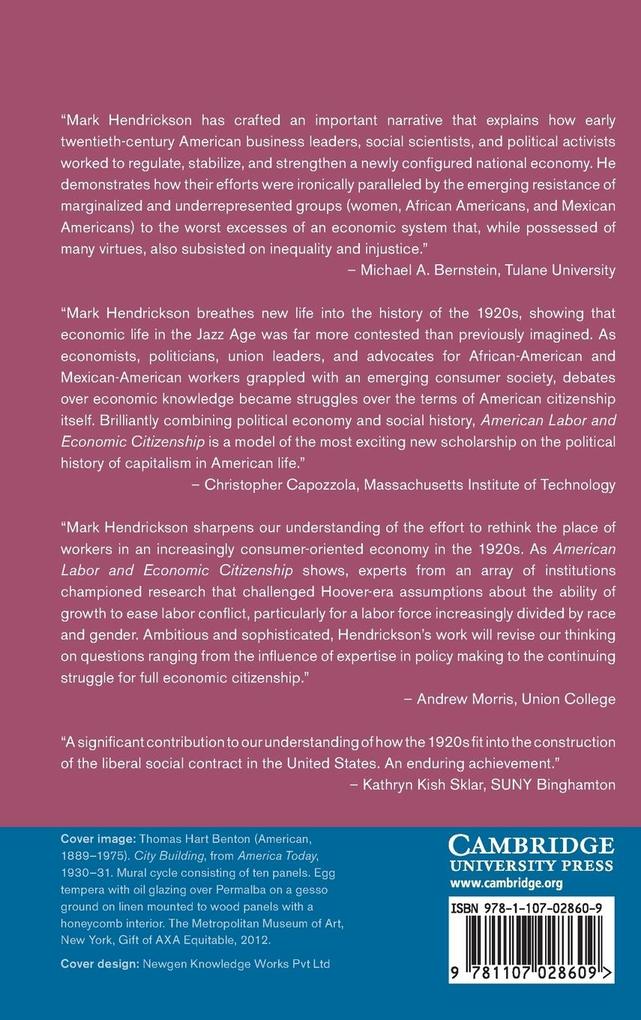
'Mark Hendrickson has crafted an important narrative that explains how early twentieth-century American business leaders, social scientists, and political activists worked to regulate, stabilize, and strengthen a newly configured national economy. He demonstrates how their efforts were ironically paralleled by the emerging resistance of marginalized and underrepresented groups (women, African Americans, and Mexican Americans) to the worst excesses of an economic system that, while possessed of many virtues, also subsisted on inequality and injustice.' Michael A. Bernstein, Tulane University 'Mark Hendrickson breathes new life into the history of the 1920s, showing that economic life in the Jazz Age was far more contested than previously imagined. As economists, politicians, union leaders, and advocates for African-American and Mexican-American workers grappled with an emerging consumer society, debates over economic knowledge became struggles over the terms of American citizenship itself. Brilliantly combining political economy and social history, American Labor and Economic Citizenship is a model of the most exciting new scholarship on the political history of capitalism in American life.' Christopher Capozzola, Massachusetts Institute of Technology 'Mark Hendrickson sharpens our understanding of the effort to rethink the place of workers in an increasingly consumer-oriented economy in the 1920s. As American Labor and Economic Citizenship shows, experts from an array of institutions championed research that challenged Hoover-era assumptions about the ability of growth to ease labor conflict, particularly for a labor force increasingly divided by race and gender. Ambitious and sophisticated, Hendrickson's work will revise our thinking on questions ranging from the influence of expertise in policy making to the continuing struggle for full economic citizenship.' Andrew Morris, Union College 'A significant contribution to our understanding of how the 1920s fit into the construction of the liberal social contract in the United States. An enduring achievement.' Kathryn Kish Sklar, State University of New York, Binghamton