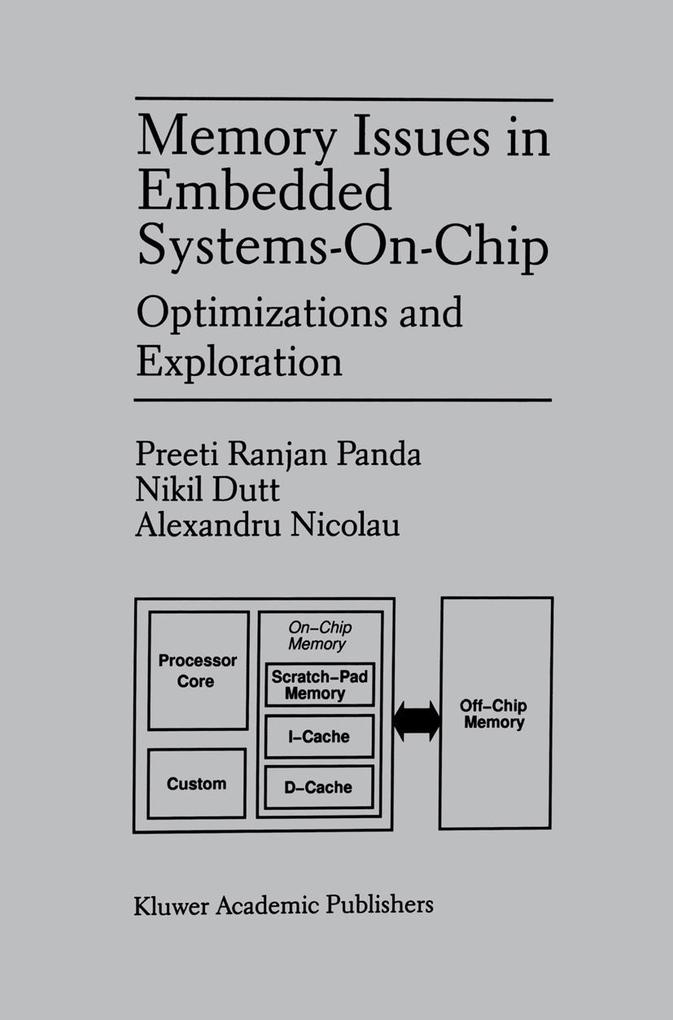
Memory Issues in Embedded Systems-On-Chip: Optimizations and Explorations is designed for different groups in the embedded systems-on-chip arena.
First, it is designed for researchers and graduate students who wish to understand the research issues involved in memory system optimization and exploration for embedded systems-on-chip.
Second, it is intended for designers of embedded systems who are migrating from a traditional micro-controllers centered, board-based design methodology to newer design methodologies using IP blocks for processor-core-based embedded systems-on-chip.
Also, since Memory Issues in Embedded Systems-on-Chip: Optimization and Explorations illustrates a methodology for optimizing and exploring the memory configuration of embedded systems-on-chip, it is intended for managers and system designers who may be interested in the emerging capabilities of embedded systems-on-chip design methodologies for memory-intensive applications.
Inhaltsverzeichnis
1. Introduction. - 1. 1 Embedded Systems-on-Chip Design. - 1. 2 Synthesis, Compilation and Architecture for Embedded SOC. - 1. 3 Embedded System Architecture. - 1. 4 Organization of the Book. - 2. Background. - 2. 1 Introduction. - 2. 2 Exploiting Memory Hierarchy. - 2. 3 Memory Issues in Embedded Systems. - 2. 4 In this book. - 3. Off-Chip Memory Access Optimizations. - 3. 1 Incorporating Off-chip Memory Accesses into Synthesis. - 3. 2 Power Optimizations in Memory Accesses. - 3. 3 Summary. - 4. Data Organization: The Processor Core/Cache Interface. - 4. 1 Introduction. - 4. 2 Memory Data Organization. - 4. 3 Data Alignment for Loop Blocking. - 4. 4 Summary. - 5. On-Chip vs. Off-Chip Memory: Utilizing Scratch-Pad Memory. - 5. 1 Scratch-Pad Memory. - 5. 2 Problem Description. - 5. 3 The Partitioning Strategy. - 5. 4 Context Switching. - 5. 5 Generalized Memory Hierarchy. - 5. 6 Experiments. - 5. 7 Summary. - 6. Memory Architecture Exploration. - 6. 1 Motivation. - 6. 2 Illustrative Example. - 6. 3 Exploration Strategy. - 6. 4 Memory Performance Estimation. - 6. 5 Experiments. - 6. 6 Summary. - 7. Case Study: MPEG Decoder. - 7. 1 Overview of MPEG Decoder. - 7. 2 Memory Exploration of Sample Routines. - 7. 3 Memory Exploration of MPEG Decoder. - 7. 4 Summary. - 8. Conclusions. - 8. 1 Extending this Work. - 8. 2 Future Directions. - References.